Press "Enter" to skip to content

Posts tagged as “medium”

花花酱 LeetCode 962. Maximum Width Ramp

Given an array A of integers, a ramp is a tuple (i, j) for which i < j and A[i] <= A[j].  The width of such a ramp is j - i.

Find the maximum width of a ramp in A.  If one doesn’t exist, return 0.

Example 1:

Input: [6,0,8,2,1,5] 
Output: 4
Explanation: The maximum width ramp is achieved at (i, j) = (1, 5): A[1] = 0 and A[5] = 5.

Example 2:

Input: [9,8,1,0,1,9,4,0,4,1] 
Output: 7
Explanation: The maximum width ramp is achieved at (i, j) = (2, 9): A[2] = 1 and A[9] = 1.

Note:

  1. 2 <= A.length <= 50000
  2. 0 <= A[i] <= 50000

Solution: Stack

  1. Using a stack to store start candidates’ (decreasing order) index
  2. Scan from right to left, compare the current number with the one on the top of the stack, pop if greater.

e.g.
A = [6,0,8,2,1,5]
stack = [0, 1] => [6, 0]
cur: A[5] = 5, stack.top = A[1] = 0, ramp = 5, stack.pop()
cur: A[4] = 1, stack.top = A[0] = 6
cur: A[3] = 2, stack.top = A[0] = 6
cur: A[2] = 8, stack.top = A[0] = 6, ramp = 2, stack.pop()
stack.isEmpty() => END

C++

Python3

花花酱 LeetCode 78. Subsets

Given a set of distinct integers, nums, return all possible subsets (the power set).

Note: The solution set must not contain duplicate subsets.

Example:

Input: nums = [1,2,3]
Output:[ [3],  [1],  [2],  [1,2,3],  [1,3],  [2,3],  [1,2],  []]

Solution: Combination

Time complexity: O(2^n)
Space complexity: O(n)

Implemention 1: DFS

C++

Python3

Implementation 2: Binary

C++

Python3

花花酱 LeetCode 220. Contains Duplicate III

Given an array of integers, find out whether there are two distinct indices i and j in the array such that the absolute difference between nums[i] and nums[j] is at most t and the absolute difference between i and j is at most k.

Example 1:

Input: nums = [1,2,3,1], k = 3, t = 0
Output: true

Example 2:

Input: nums = [1,0,1,1], k = 1, t = 2
Output: true

Example 3:

Input: nums = [1,5,9,1,5,9], k = 2, t = 3
Output: false

Solution: Sliding Window + Multiset (OrderedSet)

Maintaining a sliding window of sorted numbers of k + 1. After the i-th number was inserted into the sliding window, check whether its left and right neighbors satisfy abs(nums[i] – neighbor) <= t

Time complexity: O(nlogk)
Space complexity: O(k)

C++

花花酱 LeetCode 959. Regions Cut By Slashes

In a N x N grid composed of 1 x 1 squares, each 1 x 1 square consists of a /\, or blank space.  These characters divide the square into contiguous regions.

(Note that backslash characters are escaped, so a \ is represented as "\\".)

Return the number of regions.

Example 1:

Input:[  " /",  "/ "]
Output: 2
Explanation: The 2x2 grid is as follows:

Example 2:

Input:[  " /",  "  "]
Output: 1
Explanation: The 2x2 grid is as follows:

Example 3:

Input:[  "\\/",  "/\\"]
Output: 4
Explanation: (Recall that because \ characters are escaped, "\\/" refers to \/, and "/\\" refers to /\.)The 2x2 grid is as follows:

Example 4:

Input:[  "/\\",  "\\/"]
Output: 5
Explanation: (Recall that because \ characters are escaped, "/\\" refers to /\, and "\\/" refers to \/.)The 2x2 grid is as follows:

Example 5:

Input:[  "//",  "/ "]
Output: 3
Explanation: The 2x2 grid is as follows:

Note:

  1. 1 <= grid.length == grid[0].length <= 30
  2. grid[i][j] is either '/''\', or ' '.

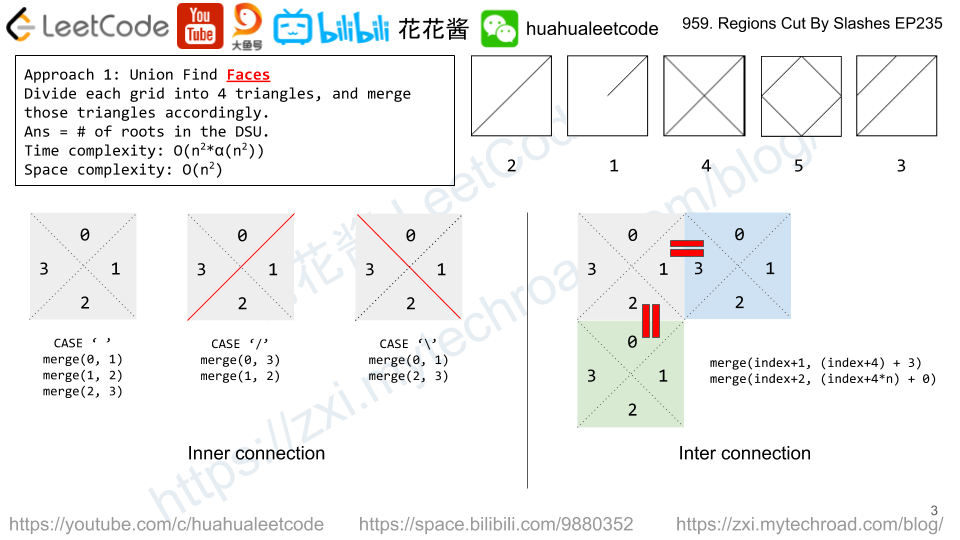
Solution 1: Split grid into 4 triangles and Union Find Faces

Divide each grid into 4 triangles and union them if not split.
Time complexity: O(n^2*alphn(n^2))
Space complexity: O(n^2)

C++


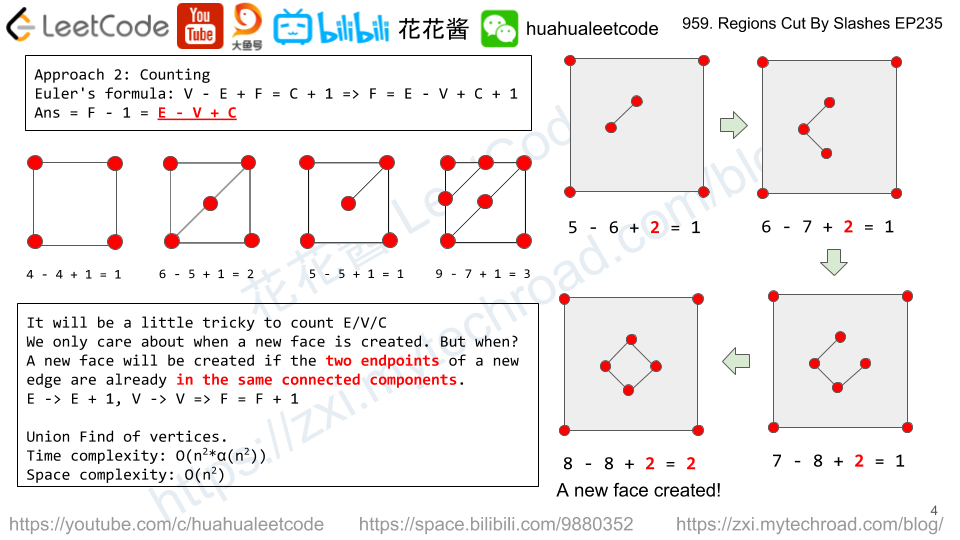
Solution 2: Euler’s Formula / Union-Find vertices

C++

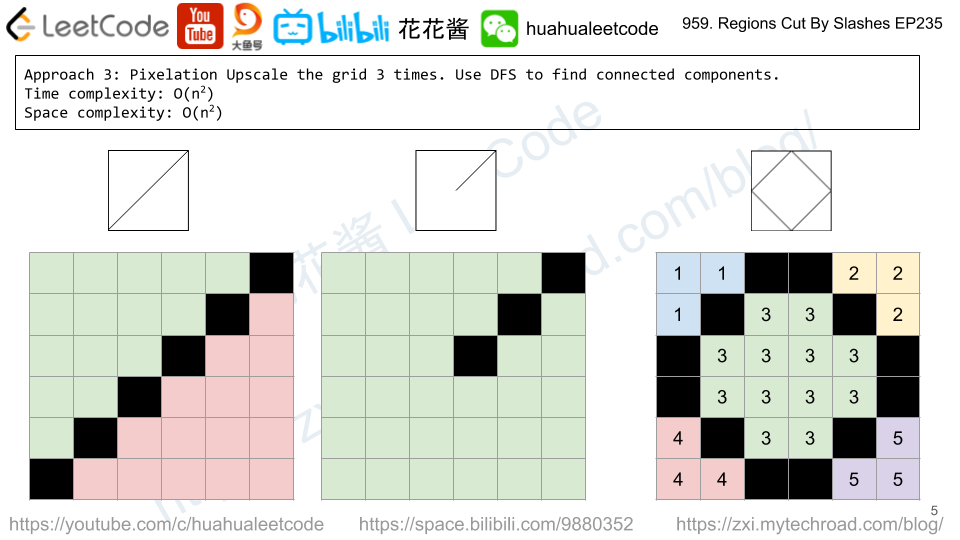
Solution 3: Pixelation (Upscale 3 times)

Time complexity: O(n^2)
Space complexity: O(n^2)

C++

花花酱 LeetCode 958. Check Completeness of a Binary Tree

Given a binary tree, determine if it is a complete binary tree.

Definition of a complete binary tree from Wikipedia:
In a complete binary tree every level, except possibly the last, is completely filled, and all nodes in the last level are as far left as possible. It can have between 1 and 2h nodes inclusive at the last level h.

Example 1:

Input: [1,2,3,4,5,6]
Output: true
Explanation: Every level before the last is full (ie. levels with node-values {1} and {2, 3}), and all nodes in the last level ({4, 5, 6}) are as far left as possible.

Example 2:

Input: [1,2,3,4,5,null,7]
Output: false
Explanation: The node with value 7 isn't as far left as possible.

Note:

  1. The tree will have between 1 and 100 nodes.

Solution:

Level order traversal, if any nodes appears after a missing node then the tree is not a perfect binary tree.

Time complexity: O(n)

Space complexity: O(n)

C++

Python3