Problem
n an election, the i-th vote was cast for persons[i] at time times[i].
Now, we would like to implement the following query function: TopVotedCandidate.q(int t) will return the number of the person that was leading the election at time t.
Votes cast at time t will count towards our query. In the case of a tie, the most recent vote (among tied candidates) wins.
Example 1:
Input: ["TopVotedCandidate","q","q","q","q","q","q"], [[[0,1,1,0,0,1,0],[0,5,10,15,20,25,30]],[3],[12],[25],[15],[24],[8]]
Output: [null,0,1,1,0,0,1]
Explanation:
At time 3, the votes are [0], and 0 is leading.
At time 12, the votes are [0,1,1], and 1 is leading.
At time 25, the votes are [0,1,1,0,0,1], and 1 is leading (as ties go to the most recent vote.)
This continues for 3 more queries at time 15, 24, and 8.
Note:
1 <= persons.length = times.length <= 50000 <= persons[i] <= persons.lengthtimesis a strictly increasing array with all elements in[0, 10^9].TopVotedCandidate.qis called at most10000times per test case.TopVotedCandidate.q(int t)is always called witht >= times[0].
Solution: HashTable + Binary Search
Compute the leads for each t in times using a hash table.
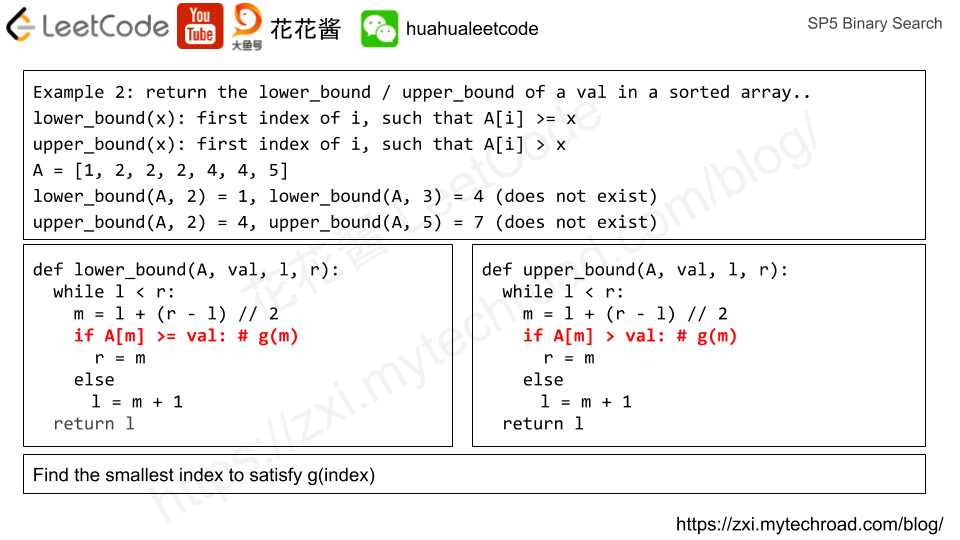
binary search the upper bound of t, and return the lead of previous entry.
Time complexity: Constructor O(n), Query: O(logn)
Space complexity: O(n)
C++
|
1 2 3 4 5 6 7 8 9 10 11 12 13 14 15 16 17 18 19 |
// Author: Huahua class TopVotedCandidate { public: TopVotedCandidate(vector<int> persons, vector<int> times) { vector<int> votes(persons.size() + 1); int last_lead = persons.front(); for (int i = 0; i < persons.size(); ++i) { if (++votes[persons[i]] >= votes[last_lead]) last_lead = persons[i]; leads_[times[i]] = last_lead; } } int q(int t) { return prev(leads_.upper_bound(t))->second; } private: map<int, int> leads_; // time -> lead }; |