Press "Enter" to skip to content

Posts published in “Uncategorized”

花花酱 LeetCode 2217. Find Palindrome With Fixed Length

Given an integer array queries and a positive integer intLength, return an array answer where answer[i] is either the queries[i]th smallest positive palindrome of length intLength or -1 if no such palindrome exists.

palindrome is a number that reads the same backwards and forwards. Palindromes cannot have leading zeros.

Example 1:

Input: queries = [1,2,3,4,5,90], intLength = 3
Output: [101,111,121,131,141,999]
Explanation:
The first few palindromes of length 3 are:
101, 111, 121, 131, 141, 151, 161, 171, 181, 191, 202, ...
The 90th palindrome of length 3 is 999.

Example 2:

Input: queries = [2,4,6], intLength = 4
Output: [1111,1331,1551]
Explanation:
The first six palindromes of length 4 are:
1001, 1111, 1221, 1331, 1441, and 1551.

Constraints:

  • 1 <= queries.length <= 5 * 104
  • 1 <= queries[i] <= 109
  • 1 <= intLength <= 15

Solution: Math

For even length e.g. 4, we work with length / 2, e.g. 2. Numbers: 10, 11, 12, …, 99, starting from 10, ends with 99, which consist of 99 – 10 + 1 = 90 numbers. For the x-th number, e.g. 88, the left part is 10 + 88 – 1 = 97, just mirror it o get the palindrome. 97|79. Thus we can answer a query in O(k/2) time which is critical.


For odd length e.g. 3 we work with length / 2 + 1, e.g. 2, Numbers: 10, 11, 12, 99. Drop the last digit and mirror the left part to get the palindrome. 101, 111, 121, …, 999.

Time complexity: O(n)
Space complexity: O(1)

C++

花花酱 LeetCode 2120. Execution of All Suffix Instructions Staying in a Grid

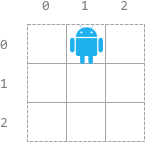
There is an n x n grid, with the top-left cell at (0, 0) and the bottom-right cell at (n - 1, n - 1). You are given the integer n and an integer array startPos where startPos = [startrow, startcol] indicates that a robot is initially at cell (startrow, startcol).

You are also given a 0-indexed string s of length m where s[i] is the ith instruction for the robot: 'L' (move left), 'R' (move right), 'U' (move up), and 'D' (move down).

The robot can begin executing from any ith instruction in s. It executes the instructions one by one towards the end of s but it stops if either of these conditions is met:

  • The next instruction will move the robot off the grid.
  • There are no more instructions left to execute.

Return an array answer of length m where answer[i] is the number of instructions the robot can execute if the robot begins executing from the ith instruction in s.

Example 1:

Input: n = 3, startPos = [0,1], s = "RRDDLU"
Output: [1,5,4,3,1,0]
Explanation: Starting from startPos and beginning execution from the ith instruction:
- 0th: "RRDDLU". Only one instruction "R" can be executed before it moves off the grid.
- 1st:  "RDDLU". All five instructions can be executed while it stays in the grid and ends at (1, 1).
- 2nd:   "DDLU". All four instructions can be executed while it stays in the grid and ends at (1, 0).
- 3rd:    "DLU". All three instructions can be executed while it stays in the grid and ends at (0, 0).
- 4th:     "LU". Only one instruction "L" can be executed before it moves off the grid.
- 5th:      "U". If moving up, it would move off the grid.

Example 2:

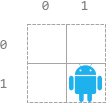
Input: n = 2, startPos = [1,1], s = "LURD"
Output: [4,1,0,0]
Explanation:
- 0th: "LURD".
- 1st:  "URD".
- 2nd:   "RD".
- 3rd:    "D".

Example 3:

Input: n = 1, startPos = [0,0], s = "LRUD"
Output: [0,0,0,0]
Explanation: No matter which instruction the robot begins execution from, it would move off the grid.

Constraints:

  • m == s.length
  • 1 <= n, m <= 500
  • startPos.length == 2
  • 0 <= startrow, startcol < n
  • s consists of 'L''R''U', and 'D'.

Solution: Simulation

Time complexity: O(m2)
Space complexity: O(1)

C++

花花酱 LeetCode 1768. Merge Strings Alternately

You are given two strings word1 and word2. Merge the strings by adding letters in alternating order, starting with word1. If a string is longer than the other, append the additional letters onto the end of the merged string.

Return the merged string.

Example 1:

Input: word1 = "abc", word2 = "pqr"
Output: "apbqcr"
Explanation: The merged string will be merged as so:
word1:  a   b   c
word2:    p   q   r
merged: a p b q c r

Example 2:

Input: word1 = "ab", word2 = "pqrs"
Output: "apbqrs"
Explanation: Notice that as word2 is longer, "rs" is appended to the end.
word1:  a   b 
word2:    p   q   r   s
merged: a p b q   r   s

Example 3:

Input: word1 = "abcd", word2 = "pq"
Output: "apbqcd"
Explanation: Notice that as word1 is longer, "cd" is appended to the end.
word1:  a   b   c   d
word2:    p   q 
merged: a p b q c   d

Constraints:

  • 1 <= word1.length, word2.length <= 100
  • word1 and word2 consist of lowercase English letters.

Solution: Find the shorter one

Time complexity: O(m+n)
Space complexity: O(1)

C++

花花酱 LeetCode 1722. Minimize Hamming Distance After Swap Operations

You are given two integer arrays, source and target, both of length n. You are also given an array allowedSwaps where each allowedSwaps[i] = [ai, bi] indicates that you are allowed to swap the elements at index ai and index bi (0-indexed) of array source. Note that you can swap elements at a specific pair of indices multiple times and in any order.

The Hamming distance of two arrays of the same length, source and target, is the number of positions where the elements are different. Formally, it is the number of indices i for 0 <= i <= n-1 where source[i] != target[i] (0-indexed).

Return the minimum Hamming distance of source and target after performing any amount of swap operations on array source.

Example 1:

Input: source = [1,2,3,4], target = [2,1,4,5], allowedSwaps = [[0,1],[2,3]]
Output: 1
Explanation: source can be transformed the following way:
- Swap indices 0 and 1: source = [2,1,3,4]
- Swap indices 2 and 3: source = [2,1,4,3]
The Hamming distance of source and target is 1 as they differ in 1 position: index 3.

Example 2:

Input: source = [1,2,3,4], target = [1,3,2,4], allowedSwaps = []
Output: 2
Explanation: There are no allowed swaps.
The Hamming distance of source and target is 2 as they differ in 2 positions: index 1 and index 2.

Example 3:

Input: source = [5,1,2,4,3], target = [1,5,4,2,3], allowedSwaps = [[0,4],[4,2],[1,3],[1,4]]
Output: 0

Constraints:

  • n == source.length == target.length
  • 1 <= n <= 105
  • 1 <= source[i], target[i] <= 105
  • 0 <= allowedSwaps.length <= 105
  • allowedSwaps[i].length == 2
  • 0 <= ai, bi <= n - 1
  • ai != bi

Solution: Union Find

Similar to 花花酱 LeetCode 1202. Smallest String With Swaps

Think each pair as an edge in a graph. Since we can swap as many time as we want, which means we can arrange the elements whose indices are in a connected component (CC) in any order.

For each index i, we increase the counter of CC(i) for key source[i] and decrease the counter of the same CC for key target[i]. If two keys are the same (can from different indices), one from source and one from target, it will cancel out, no distance. Otherwise, the counter will be off by two. Finally we sum up the counter for all the keys and divide it by two to get the hamming distance.

Time complexity: O(V+E)
Space complexity: O(V)

C++

花花酱 LeetCode 1673. Find the Most Competitive Subsequence

Given an integer array nums and a positive integer k, return the most competitive subsequence of nums of size k.

An array’s subsequence is a resulting sequence obtained by erasing some (possibly zero) elements from the array.

We define that a subsequence a is more competitive than a subsequence b (of the same length) if in the first position where a and b differ, subsequence a has a number less than the corresponding number in b. For example, [1,3,4] is more competitive than [1,3,5] because the first position they differ is at the final number, and 4 is less than 5.

Example 1:

Input: nums = [3,5,2,6], k = 2
Output: [2,6]
Explanation: Among the set of every possible subsequence: {[3,5], [3,2], [3,6], [5,2], [5,6], [2,6]}, [2,6] is the most competitive.

Example 2:

Input: nums = [2,4,3,3,5,4,9,6], k = 4
Output: [2,3,3,4]

Constraints:

  • 1 <= nums.length <= 105
  • 0 <= nums[i] <= 109
  • 1 <= k <= nums.length

Solution: Stack

Use a stack to track the best solution so far, pop if the current number is less than the top of the stack and there are sufficient numbers left. Then push the current number to the stack if not full.

Time complexity: O(n)
Space complexity: O(k)

C++

Java

Python3