Press "Enter" to skip to content

Huahua's Tech Road

花花酱 LeetCode 1761. Minimum Degree of a Connected Trio in a Graph

You are given an undirected graph. You are given an integer n which is the number of nodes in the graph and an array edges, where each edges[i] = [ui, vi] indicates that there is an undirected edge between ui and vi.

connected trio is a set of three nodes where there is an edge between every pair of them.

The degree of a connected trio is the number of edges where one endpoint is in the trio, and the other is not.

Return the minimum degree of a connected trio in the graph, or -1 if the graph has no connected trios.

Example 1:

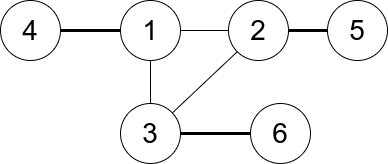
Input: n = 6, edges = [[1,2],[1,3],[3,2],[4,1],[5,2],[3,6]]
Output: 3
Explanation: There is exactly one trio, which is [1,2,3]. The edges that form its degree are bolded in the figure above.

Example 2:

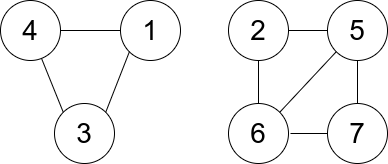
Input: n = 7, edges = [[1,3],[4,1],[4,3],[2,5],[5,6],[6,7],[7,5],[2,6]]
Output: 0
Explanation: There are exactly three trios:
1) [1,4,3] with degree 0.
2) [2,5,6] with degree 2.
3) [5,6,7] with degree 2.

Constraints:

  • 2 <= n <= 400
  • edges[i].length == 2
  • 1 <= edges.length <= n * (n-1) / 2
  • 1 <= ui, vi <= n
  • u!= vi
  • There are no repeated edges.

Solution: Brute Force

Try all possible Trios.

Time complexity: O(n^3)
Space complexity: O(n^2)

C++

花花酱 LeetCode 1760. Minimum Limit of Balls in a Bag

You are given an integer array nums where the ith bag contains nums[i] balls. You are also given an integer maxOperations.

You can perform the following operation at most maxOperations times:

  • Take any bag of balls and divide it into two new bags with a positive number of balls.
    • For example, a bag of 5 balls can become two new bags of 1 and 4 balls, or two new bags of 2 and 3 balls.

Your penalty is the maximum number of balls in a bag. You want to minimize your penalty after the operations.

Return the minimum possible penalty after performing the operations.

Example 1:

Input: nums = [9], maxOperations = 2
Output: 3
Explanation: 
- Divide the bag with 9 balls into two bags of sizes 6 and 3. [9] -> [6,3].
- Divide the bag with 6 balls into two bags of sizes 3 and 3. [6,3] -> [3,3,3].
The bag with the most number of balls has 3 balls, so your penalty is 3 and you should return 3.

Example 2:

Input: nums = [2,4,8,2], maxOperations = 4
Output: 2
Explanation:
- Divide the bag with 8 balls into two bags of sizes 4 and 4. [2,4,8,2] -> [2,4,4,4,2].
- Divide the bag with 4 balls into two bags of sizes 2 and 2. [2,4,4,4,2] -> [2,2,2,4,4,2].
- Divide the bag with 4 balls into two bags of sizes 2 and 2. [2,2,2,4,4,2] -> [2,2,2,2,2,4,2].
- Divide the bag with 4 balls into two bags of sizes 2 and 2. [2,2,2,2,2,4,2] -> [2,2,2,2,2,2,2,2].
The bag with the most number of balls has 2 balls, so your penalty is 2 an you should return 2.

Example 3:

Input: nums = [7,17], maxOperations = 2
Output: 7

Constraints:

  • 1 <= nums.length <= 105
  • 1 <= maxOperations, nums[i] <= 109

Solution: Binary Search

Find the smallest penalty that requires less or equal ops than max_ops.

Time complexity: O(nlogm)
Space complexity: O(1)

C++

花花酱 LeetCode 1759. Count Number of Homogenous Substrings

Given a string s, return the number of homogenous substrings of s. Since the answer may be too large, return it modulo 109 + 7.

A string is homogenous if all the characters of the string are the same.

substring is a contiguous sequence of characters within a string.

Example 1:

Input: s = "abbcccaa"
Output: 13
Explanation: The homogenous substrings are listed as below:
"a"   appears 3 times.
"aa"  appears 1 time.
"b"   appears 2 times.
"bb"  appears 1 time.
"c"   appears 3 times.
"cc"  appears 2 times.
"ccc" appears 1 time.
3 + 1 + 2 + 1 + 3 + 2 + 1 = 13.

Example 2:

Input: s = "xy"
Output: 2
Explanation: The homogenous substrings are "x" and "y".

Example 3:

Input: s = "zzzzz"
Output: 15

Constraints:

  • 1 <= s.length <= 105
  • s consists of lowercase letters.

Solution: Counting

Let m be the length of the longest homogenous substring, # of homogenous substring is m * (m + 1) / 2.
e.g. aaabb
“aaa” => m = 3, # = 3 * (3 + 1) / 2 = 6
“bb” => m = 2, # = 2 * (2+1) / 2 = 3
Total = 6 + 3 = 9

Time complexity: O(n)
Space complexity: O(1)

C++

花花酱 LeetCode 1758. Minimum Changes To Make Alternating Binary String

You are given a string s consisting only of the characters '0' and '1'. In one operation, you can change any '0' to '1' or vice versa.

The string is called alternating if no two adjacent characters are equal. For example, the string "010" is alternating, while the string "0100" is not.

Return the minimum number of operations needed to make s alternating.

Example 1:

Input: s = "0100"
Output: 1
Explanation: If you change the last character to '1', s will be "0101", which is alternating.

Example 2:

Input: s = "10"
Output: 0
Explanation: s is already alternating.

Example 3:

Input: s = "1111"
Output: 2
Explanation: You need two operations to reach "0101" or "1010".

Constraints:

  • 1 <= s.length <= 104
  • s[i] is either '0' or '1'.

Solution: Two Counters

The final string is either 010101… or 101010…
We just need two counters to record the number of changes needed to transform the original string to those two final strings.

Time complexity: O(n)
Space complexity: O(1)

C++

花花酱 LeetCode 1755. Closest Subsequence Sum

You are given an integer array nums and an integer goal.

You want to choose a subsequence of nums such that the sum of its elements is the closest possible to goal. That is, if the sum of the subsequence’s elements is sum, then you want to minimize the absolute difference abs(sum - goal).

Return the minimum possible value of abs(sum - goal).

Note that a subsequence of an array is an array formed by removing some elements (possibly all or none) of the original array.

Example 1:

Input: nums = [5,-7,3,5], goal = 6
Output: 0
Explanation: Choose the whole array as a subsequence, with a sum of 6.
This is equal to the goal, so the absolute difference is 0.

Example 2:

Input: nums = [7,-9,15,-2], goal = -5
Output: 1
Explanation: Choose the subsequence [7,-9,-2], with a sum of -4.
The absolute difference is abs(-4 - (-5)) = abs(1) = 1, which is the minimum.

Example 3:

Input: nums = [1,2,3], goal = -7
Output: 7

Constraints:

  • 1 <= nums.length <= 40
  • -107 <= nums[i] <= 107
  • -109 <= goal <= 109

Solution: Binary Search

Since n is too large to generate sums for all subsets O(2^n), we have to split the array into half, generate two sum sets. O(2^(n/2)).

Then the problem can be reduced to find the closet sum by picking one number (sum) each from two different arrays which can be solved in O(mlogm), where m = 2^(n/2).

So final time complexity is O(n * 2^(n/2))
Space complexity: O(2^(n/2))

C++