Press "Enter" to skip to content

Huahua's Tech Road

花花酱 LeetCode 1663. Smallest String With A Given Numeric Value

The numeric value of a lowercase character is defined as its position (1-indexed) in the alphabet, so the numeric value of a is 1, the numeric value of b is 2, the numeric value of c is 3, and so on.

The numeric value of a string consisting of lowercase characters is defined as the sum of its characters’ numeric values. For example, the numeric value of the string "abe" is equal to 1 + 2 + 5 = 8.

You are given two integers n and k. Return the lexicographically smallest string with length equal to n and numeric value equal to k.

Note that a string x is lexicographically smaller than string y if x comes before y in dictionary order, that is, either x is a prefix of y, or if i is the first position such that x[i] != y[i], then x[i] comes before y[i] in alphabetic order.

Example 1:

Input: n = 3, k = 27
Output: "aay"
Explanation: The numeric value of the string is 1 + 1 + 25 = 27, and it is the smallest string with such a value and length equal to 3.

Example 2:

Input: n = 5, k = 73
Output: "aaszz"

Constraints:

  • 1 <= n <= 105
  • n <= k <= 26 * n

Solution: Greedy, Fill in reverse order

Fill the entire string with ‘a’, k-=n, then fill in reverse order, replace ‘a’ with ‘z’ until not enough k left.

Time complexity: O(n)
Space complexity: O(n)

C++

Python3

花花酱 LeetCode 1662. Check If Two String Arrays are Equivalent

Given two string arrays word1 and word2, returntrue if the two arrays represent the same string, and false otherwise.

A string is represented by an array if the array elements concatenated in order forms the string.

Example 1:

Input: word1 = ["ab", "c"], word2 = ["a", "bc"]
Output: true
Explanation:
word1 represents string "ab" + "c" -> "abc"
word2 represents string "a" + "bc" -> "abc"
The strings are the same, so return true.

Example 2:

Input: word1 = ["a", "cb"], word2 = ["ab", "c"]
Output: false

Example 3:

Input: word1  = ["abc", "d", "defg"], word2 = ["abcddefg"]
Output: true

Constraints:

  • 1 <= word1.length, word2.length <= 103
  • 1 <= word1[i].length, word2[i].length <= 103
  • 1 <= sum(word1[i].length), sum(word2[i].length) <= 103
  • word1[i] and word2[i] consist of lowercase letters.

Solution1: Construct the string

Time complexity: O(l1 + l2)
Space complexity: O(l1 + l2)

C++

Solution 2: Pointers

Time complexity: O(l1 + l2)
Space complexity: O(1)

C++

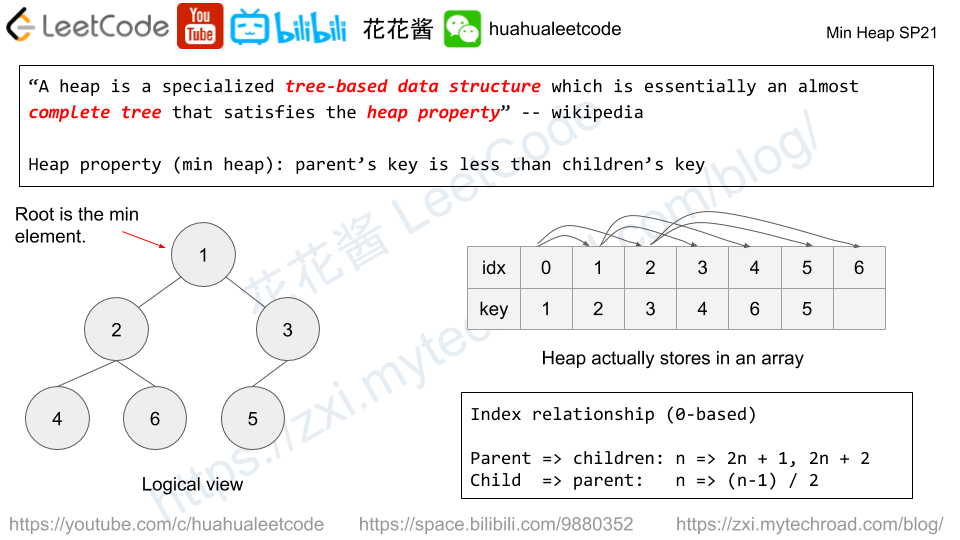
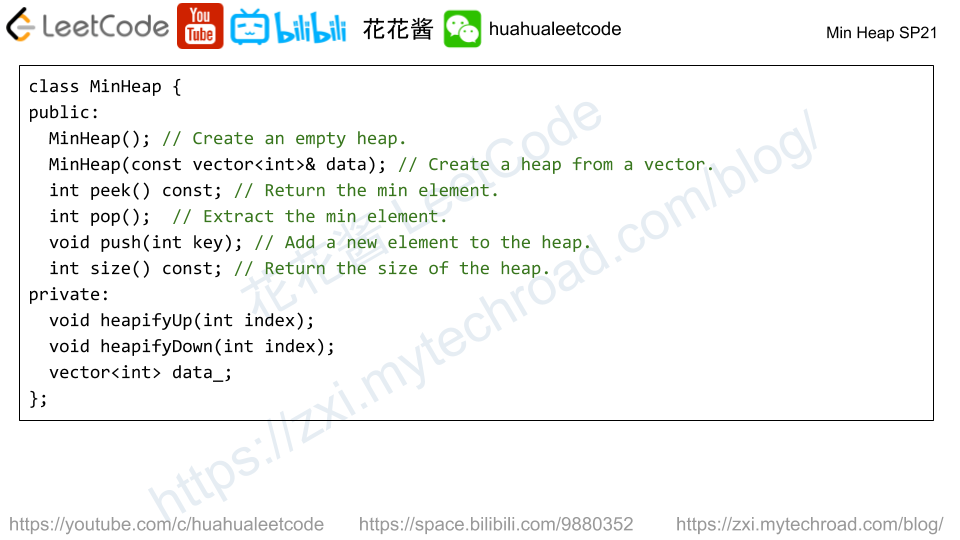
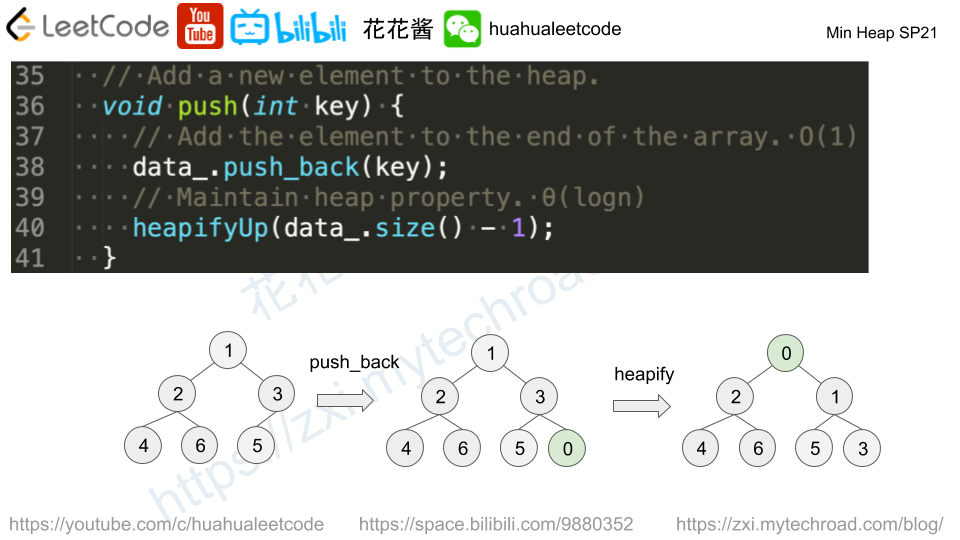
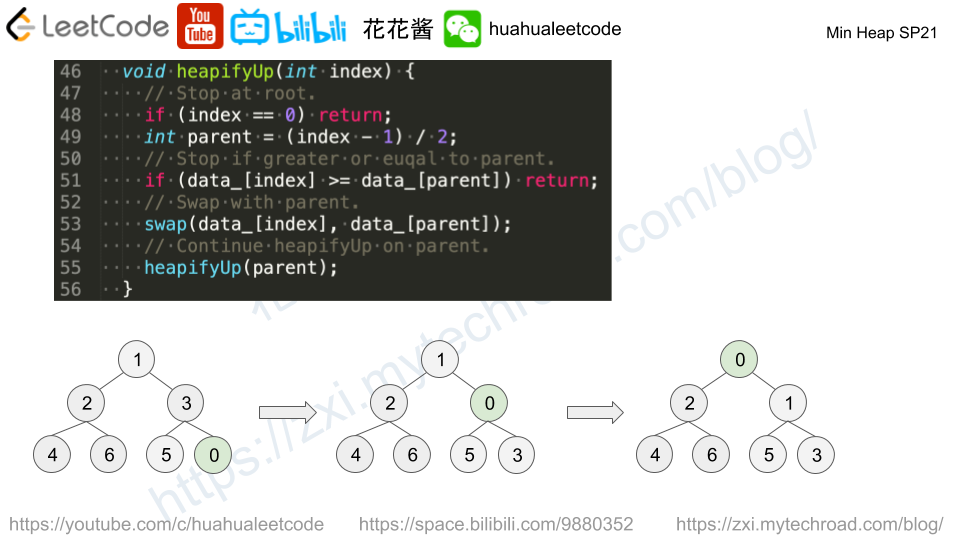
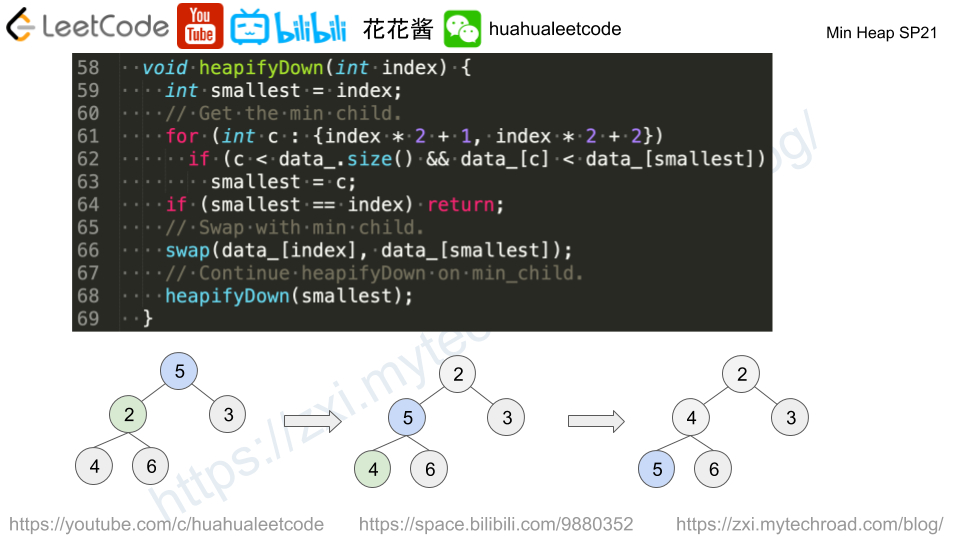
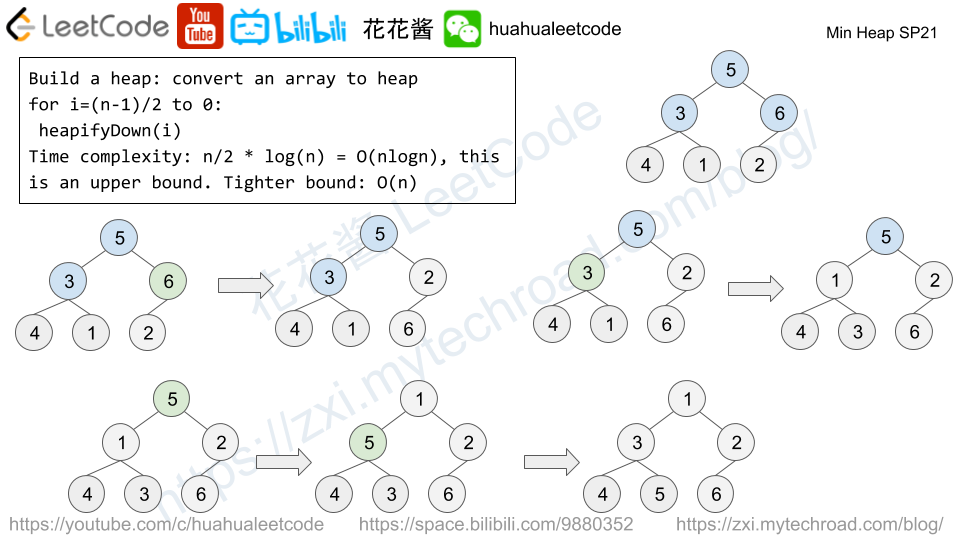
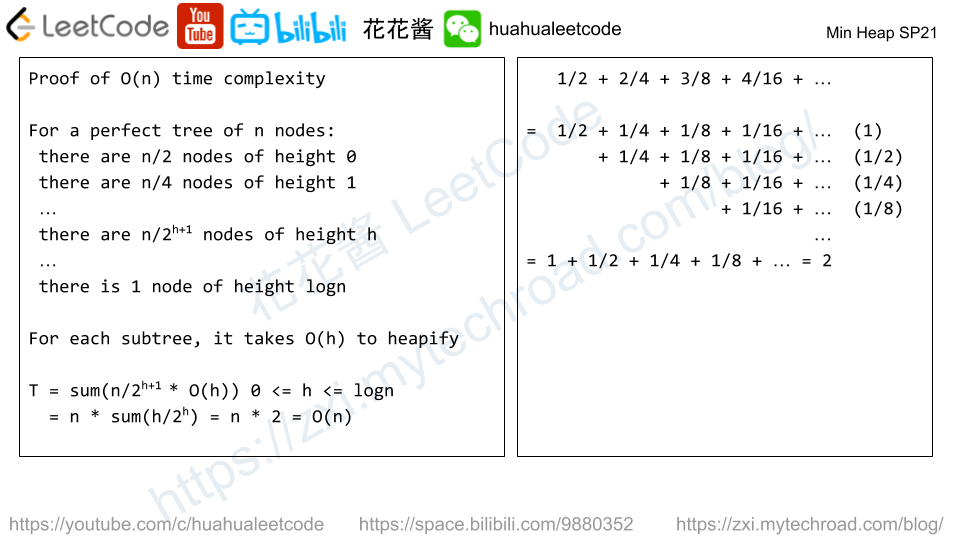
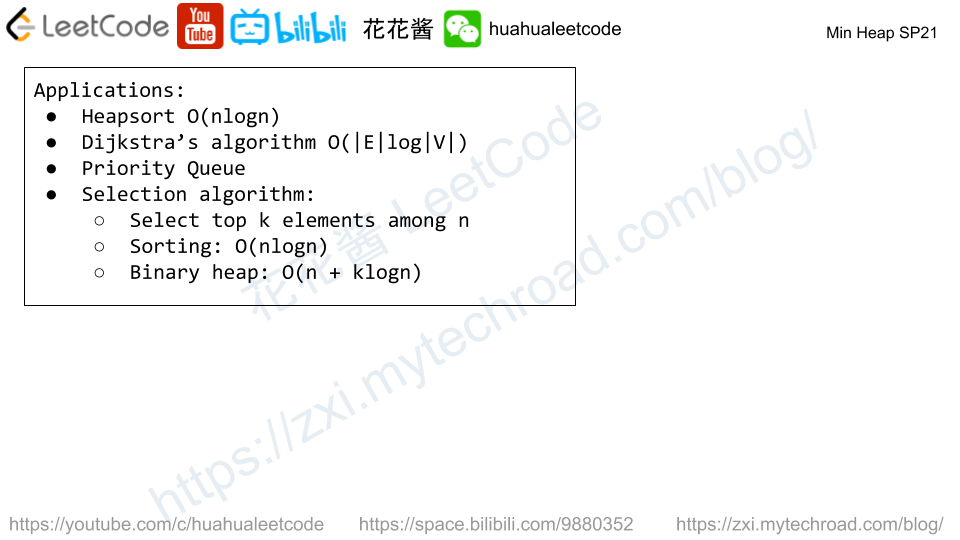
花花酱 Min Heap SP21

C++

Python3

花花酱 LeetCode 1658. Minimum Operations to Reduce X to Zero

You are given an integer array nums and an integer x. In one operation, you can either remove the leftmost or the rightmost element from the array nums and subtract its value from x. Note that this modifies the array for future operations.

Return the minimum number of operations to reduce x to exactly 0 if it’s possible, otherwise, return -1.

Example 1:

Input: nums = [1,1,4,2,3], x = 5
Output: 2
Explanation: The optimal solution is to remove the last two elements to reduce x to zero.

Example 2:

Input: nums = [5,6,7,8,9], x = 4
Output: -1

Example 3:

Input: nums = [3,2,20,1,1,3], x = 10
Output: 5
Explanation: The optimal solution is to remove the last three elements and the first two elements (5 operations in total) to reduce x to zero.

Constraints:

  • 1 <= nums.length <= 105
  • 1 <= nums[i] <= 104
  • 1 <= x <= 109

Solution1: Prefix Sum + Hashtable

Time complexity: O(n)
Space complexity: O(n)

C++

Solution2: Sliding Window

Find the longest sliding window whose sum of elements equals sum(nums) – x
ans = n – window_size

Time complexity: O(n)
Space complexity: O(1)

C++

花花酱 LeetCode 1657. Determine if Two Strings Are Close

Two strings are considered close if you can attain one from the other using the following operations:

  • Operation 1: Swap any two existing characters.
    • For example, abcde -> aecdb
  • Operation 2: Transform every occurrence of one existing character into another existing character, and do the same with the other character.
    • For example, aacabb -> bbcbaa (all a‘s turn into b‘s, and all b‘s turn into a‘s)

You can use the operations on either string as many times as necessary.

Given two strings, word1 and word2, return true if word1 and word2 are close, and false otherwise.

Example 1:

Input: word1 = "abc", word2 = "bca"
Output: true
Explanation: You can attain word2 from word1 in 2 operations.
Apply Operation 1: "abc" -> "acb"
Apply Operation 1: "acb" -> "bca"

Example 2:

Input: word1 = "a", word2 = "aa"
Output: false
Explanation: It is impossible to attain word2 from word1, or vice versa, in any number of operations.

Example 3:

Input: word1 = "cabbba", word2 = "abbccc"
Output: true
Explanation: You can attain word2 from word1 in 3 operations.
Apply Operation 1: "cabbba" -> "caabbb"
Apply Operation 2: "caabbb" -> "baaccc"
Apply Operation 2: "baaccc" -> "abbccc"

Example 4:

Input: word1 = "cabbba", word2 = "aabbss"
Output: false
Explanation: It is impossible to attain word2 from word1, or vice versa, in any amount of operations.

Constraints:

  • 1 <= word1.length, word2.length <= 105
  • word1 and word2 contain only lowercase English letters.

Solution: Hashtable

Two strings are close:
1. Have the same length, ccabbb => 6 == aabccc => 6
2. Have the same char set, ccabbb => (a, b, c) == aabccc => (a, b, c)
3. Have the same sorted char counts ccabbb => (1, 2, 3) == aabccc => (1, 2, 3)

Time complexity: O(n)
Space complexity: O(1)

C++

Python3