Press "Enter" to skip to content

Huahua's Tech Road

花花酱 LeetCode 1437. Check If All 1’s Are at Least Length K Places Away

Given an array nums of 0s and 1s and an integer k, return True if all 1’s are at least k places away from each other, otherwise return False.

Example 1:

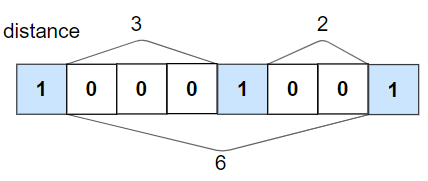
Input: nums = [1,0,0,0,1,0,0,1], k = 2
Output: true
Explanation: Each of the 1s are at least 2 places away from each other.

Example 2:

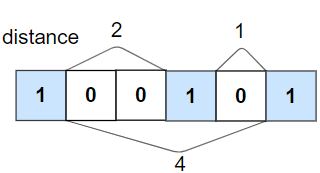
Input: nums = [1,0,0,1,0,1], k = 2
Output: false
Explanation: The second 1 and third 1 are only one apart from each other.

Example 3:

Input: nums = [1,1,1,1,1], k = 0
Output: true

Example 4:

Input: nums = [0,1,0,1], k = 1
Output: true

Constraints:

  • 1 <= nums.length <= 10^5
  • 0 <= k <= nums.length
  • nums[i] is 0 or 1

Solution: Scan the array

Only need to check adjacent ones. This problem should be easy instead of medium.

Time complexity: O(n)
Space complexity: O(1)

C++

花花酱 LeetCode 1436. Destination City

You are given the array paths, where paths[i] = [cityAi, cityBi] means there exists a direct path going from cityAi to cityBi. Return the destination city, that is, the city without any path outgoing to another city.

It is guaranteed that the graph of paths forms a line without any loop, therefore, there will be exactly one destination city.

Example 1:

Input: paths = [["London","New York"],["New York","Lima"],["Lima","Sao Paulo"]]
Output: "Sao Paulo" 
Explanation: Starting at "London" city you will reach "Sao Paulo" city which is the destination city. Your trip consist of: "London" -> "New York" -> "Lima" -> "Sao Paulo".

Example 2:

Input: paths = [["B","C"],["D","B"],["C","A"]]
Output: "A"
Explanation: All possible trips are: 
"D" -> "B" -> "C" -> "A". 
"B" -> "C" -> "A". 
"C" -> "A". 
"A". 
Clearly the destination city is "A".

Example 3:

Input: paths = [["A","Z"]]
Output: "Z"

Constraints:

  • 1 <= paths.length <= 100
  • paths[i].length == 2
  • 1 <= cityAi.length, cityBi.length <= 10
  • cityAi != cityBi
  • All strings consist of lowercase and uppercase English letters and the space character.

Solution: Count in / out degree for each node

Note: this is a more general solution to this type of problems.

Time complexity: O(n)
Space complexity: O(n)

Destination City: in_degree == 1 and out_degree == 0

C++

花花酱 LeetCode 1434. Number of Ways to Wear Different Hats to Each Other

There are n people and 40 types of hats labeled from 1 to 40.

Given a list of list of integers hats, where hats[i] is a list of all hats preferred by the i-th person.

Return the number of ways that the n people wear different hats to each other.

Since the answer may be too large, return it modulo 10^9 + 7.

Example 1:

Input: hats = [[3,4],[4,5],[5]]
Output: 1
Explanation: There is only one way to choose hats given the conditions. 
First person choose hat 3, Second person choose hat 4 and last one hat 5.

Example 2:

Input: hats = [[3,5,1],[3,5]]
Output: 4
Explanation: There are 4 ways to choose hats
(3,5), (5,3), (1,3) and (1,5)

Example 3:

Input: hats = [[1,2,3,4],[1,2,3,4],[1,2,3,4],[1,2,3,4]]
Output: 24
Explanation: Each person can choose hats labeled from 1 to 4.
Number of Permutations of (1,2,3,4) = 24.

Example 4:

Input: hats = [[1,2,3],[2,3,5,6],[1,3,7,9],[1,8,9],[2,5,7]]
Output: 111

Constraints:

  • n == hats.length
  • 1 <= n <= 10
  • 1 <= hats[i].length <= 40
  • 1 <= hats[i][j] <= 40
  • hats[i] contains a list of unique integers.

Solution: DP

dp[i][j] := # of ways using first i hats, j is the bit mask of people wearing hats.

e.g. dp[3][101] == # of ways using first 3 hats that people 1 and 3 are wearing hats.

init dp[0][0] = 1

dp[i][mask | (1 << p)] = dp[i-1][mask | (1 << p)] + dp[i-1][mask], where people p prefers hats i.

ans: dp[nHat][1…1]

Time complexity: O(2^n * h * n)
Space complexity: O(2^n * h) -> O(2^n)

C++

O(2^n) memory

C++

LeetCode 1433. Check If a String Can Break Another String

Given two strings: s1 and s2 with the same size, check if some permutation of string s1 can break some permutation of string s2 or vice-versa (in other words s2 can break s1).

A string x can break string y (both of size n) if x[i] >= y[i] (in alphabetical order) for all i between 0 and n-1.

Example 1:

Input: s1 = "abc", s2 = "xya"
Output: true
Explanation: "ayx" is a permutation of s2="xya" which can break to string "abc" which is a permutation of s1="abc".

Example 2:

Input: s1 = "abe", s2 = "acd"
Output: false 
Explanation: All permutations for s1="abe" are: "abe", "aeb", "bae", "bea", "eab" and "eba" and all permutation for s2="acd" are: "acd", "adc", "cad", "cda", "dac" and "dca". However, there is not any permutation from s1 which can break some permutation from s2 and vice-versa.

Example 3:

Input: s1 = "leetcodee", s2 = "interview"
Output: true

Constraints:

  • s1.length == n
  • s2.length == n
  • 1 <= n <= 10^5
  • All strings consist of lowercase English letters.

Solution 1: Sort and compare

Time complexity: O(nlogn)
Space complexity: O(1)

C++

Solution 2: Counting Sort

The cumulative number of elements must be monotonic e.g. t1 >= t2 or t2 >= t1 for all the letters.

Time complexity: O(n)
Space complexity: O(1)

C++

花花酱 LeetCode 1432. Max Difference You Can Get From Changing an Integer

You are given an integer num. You will apply the following steps exactly two times:

  • Pick a digit x (0 <= x <= 9).
  • Pick another digit y (0 <= y <= 9). The digit y can be equal to x.
  • Replace all the occurrences of x in the decimal representation of num by y.
  • The new integer cannot have any leading zeros, also the new integer cannot be 0.

Let a and b be the results of applying the operations to num the first and second times, respectively.

Return the max difference between a and b.

Example 1:

Input: num = 555
Output: 888
Explanation: The first time pick x = 5 and y = 9 and store the new integer in a.
The second time pick x = 5 and y = 1 and store the new integer in b.
We have now a = 999 and b = 111 and max difference = 888

Example 2:

Input: num = 9
Output: 8
Explanation: The first time pick x = 9 and y = 9 and store the new integer in a.
The second time pick x = 9 and y = 1 and store the new integer in b.
We have now a = 9 and b = 1 and max difference = 8

Example 3:

Input: num = 123456
Output: 820000

Example 4:

Input: num = 10000
Output: 80000

Example 5:

Input: num = 9288
Output: 8700

Constraints:

  • 1 <= num <= 10^8

Solution 1: Brute Force

Try all possible pairs of (x, y)

Time complexity: O(10*10*logn)
Space complexity: O(logn)

C++

Solution 2: Greedy

Maximize A and Minimize B

A – B will the answer.

To maximize A, find the left most digit that is not 9, replace that digit with 9.
e.g. 121 => 919
e.g. 9981 => 9991
To minimize B, fin the left most digit that is not 1 or 0, replace that digit with 0 (if not the first one) or 1.
e.g. 1024 -> 1004
e.g. 2024 -> 1014

Time complexity: O(logn)
Space complexity: O(logn)

C++