Given the array nums, for each nums[i] find out how many numbers in the array are smaller than it. That is, for each nums[i] you have to count the number of valid j's such that j != iandnums[j] < nums[i].
Return the answer in an array.
Example 1:
Input: nums = [8,1,2,2,3]
Output: [4,0,1,1,3]
Explanation:
For nums[0]=8 there exist four smaller numbers than it (1, 2, 2 and 3).
For nums[1]=1 does not exist any smaller number than it.
For nums[2]=2 there exist one smaller number than it (1).
For nums[3]=2 there exist one smaller number than it (1).
For nums[4]=3 there exist three smaller numbers than it (1, 2 and 2).
In a special ranking system, each voter gives a rank from highest to lowest to all teams participated in the competition.
The ordering of teams is decided by who received the most position-one votes. If two or more teams tie in the first position, we consider the second position to resolve the conflict, if they tie again, we continue this process until the ties are resolved. If two or more teams are still tied after considering all positions, we rank them alphabetically based on their team letter.
Given an array of strings votes which is the votes of all voters in the ranking systems. Sort all teams according to the ranking system described above.
Return a string of all teamssorted by the ranking system.
Example 1:
Input: votes = ["ABC","ACB","ABC","ACB","ACB"]
Output: "ACB"
Explanation: Team A was ranked first place by 5 voters. No other team was voted as first place so team A is the first team.
Team B was ranked second by 2 voters and was ranked third by 3 voters.
Team C was ranked second by 3 voters and was ranked third by 2 voters.
As most of the voters ranked C second, team C is the second team and team B is the third.
Example 2:
Input: votes = ["WXYZ","XYZW"]
Output: "XWYZ"
Explanation: X is the winner due to tie-breaking rule. X has same votes as W for the first position but X has one vote as second position while W doesn't have any votes as second position.
Example 3:
Input: votes = ["ZMNAGUEDSJYLBOPHRQICWFXTVK"]
Output: "ZMNAGUEDSJYLBOPHRQICWFXTVK"
Explanation: Only one voter so his votes are used for the ranking.
Example 4:
Input: votes = ["BCA","CAB","CBA","ABC","ACB","BAC"]
Output: "ABC"
Explanation:
Team A was ranked first by 2 voters, second by 2 voters and third by 2 voters.
Team B was ranked first by 2 voters, second by 2 voters and third by 2 voters.
Team C was ranked first by 2 voters, second by 2 voters and third by 2 voters.
There is a tie and we rank teams ascending by their IDs.
Example 5:
Input: votes = ["M","M","M","M"]
Output: "M"
Explanation: Only team M in the competition so it has the first rank.
Constraints:
1 <= votes.length <= 1000
1 <= votes[i].length <= 26
votes[i].length == votes[j].length for 0 <= i, j < votes.length.
votes[i][j] is an English upper-case letter.
All characters of votes[i] are unique.
All the characters that occur in votes[0]also occur in votes[j] where 1 <= j < votes.length.
Solution: Sort by rank
Time complexity: O(v*n + n^2*logn) Space complexity: O(n*n)
Given a binary tree root and a linked list with head as the first node.
Return True if all the elements in the linked list starting from the head correspond to some downward path connected in the binary tree otherwise return False.
In this context downward path means a path that starts at some node and goes downwards.
Example 1:
Input: head = [4,2,8], root = [1,4,4,null,2,2,null,1,null,6,8,null,null,null,null,1,3]
Output: true
Explanation: Nodes in blue form a subpath in the binary Tree.
Example 2:
Input: head = [1,4,2,6], root = [1,4,4,null,2,2,null,1,null,6,8,null,null,null,null,1,3]
Output: true
Example 3:
Input: head = [1,4,2,6,8], root = [1,4,4,null,2,2,null,1,null,6,8,null,null,null,null,1,3]
Output: false
Explanation: There is no path in the binary tree that contains all the elements of the linked list from head.
Constraints:
1 <= node.val <= 100 for each node in the linked list and binary tree.
The given linked list will contain between 1 and 100 nodes.
The given binary tree will contain between 1 and 2500 nodes.
Solution: Recursion
We need two recursion functions: isSubPath / isPath, the later one does a strict match.
Time complexity: O(|L| * |T|) Space complexity: O(|T|)
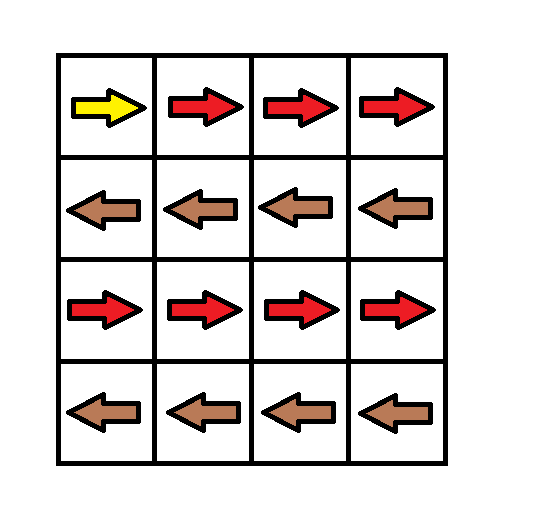
Given a m x ngrid. Each cell of the grid has a sign pointing to the next cell you should visit if you are currently in this cell. The sign of grid[i][j] can be:
1 which means go to the cell to the right. (i.e go from grid[i][j] to grid[i][j + 1])
2 which means go to the cell to the left. (i.e go from grid[i][j] to grid[i][j - 1])
3 which means go to the lower cell. (i.e go from grid[i][j] to grid[i + 1][j])
4 which means go to the upper cell. (i.e go from grid[i][j] to grid[i - 1][j])
Notice that there could be some invalid signs on the cells of the grid which points outside the grid.
You will initially start at the upper left cell (0,0). A valid path in the grid is a path which starts from the upper left cell (0,0) and ends at the bottom-right cell (m - 1, n - 1) following the signs on the grid. The valid path doesn’t have to be the shortest.
You can modify the sign on a cell with cost = 1. You can modify the sign on a cell one time only.
Return the minimum cost to make the grid have at least one valid path.
Example 1:
Input: grid = [[1,1,1,1],[2,2,2,2],[1,1,1,1],[2,2,2,2]]
Output: 3
Explanation: You will start at point (0, 0).
The path to (3, 3) is as follows. (0, 0) --> (0, 1) --> (0, 2) --> (0, 3) change the arrow to down with cost = 1 --> (1, 3) --> (1, 2) --> (1, 1) --> (1, 0) change the arrow to down with cost = 1 --> (2, 0) --> (2, 1) --> (2, 2) --> (2, 3) change the arrow to down with cost = 1 --> (3, 3)
The total cost = 3.
Example 2:
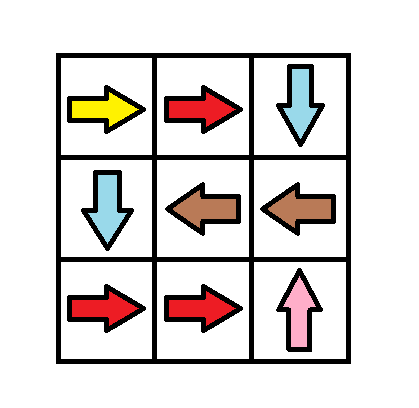
Input: grid = [[1,1,3],[3,2,2],[1,1,4]]
Output: 0
Explanation: You can follow the path from (0, 0) to (2, 2).
Example 3:
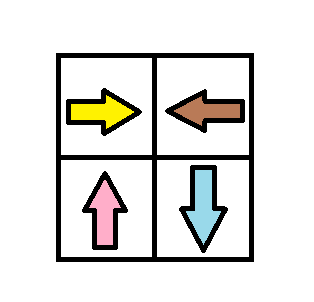
Input: grid = [[1,2],[4,3]]
Output: 1
Example 4:
Input: grid = [[2,2,2],[2,2,2]]
Output: 3
Example 5:
Input: grid = [[4]]
Output: 0
Constraints:
m == grid.length
n == grid[i].length
1 <= m, n <= 100
Solution 1: Lazy BFS (fake DP)
dp[i][j] := min steps to reach (i, j)
Time complexity: O((m+n)*m*n) Space complexity: O(m*n)
Implement the class TweetCounts that supports two methods:
1. recordTweet(string tweetName, int time)
Stores the tweetName at the recorded time (in seconds).
2. getTweetCountsPerFrequency(string freq, string tweetName, int startTime, int endTime)
Returns the total number of occurrences for the given tweetName per minute, hour, or day (depending on freq) starting from the startTime (in seconds) and ending at the endTime (in seconds).
freq is always minute, hour or day, representing the time interval to get the total number of occurrences for the given tweetName.
The first time interval always starts from the startTime, so the time intervals are [startTime, startTime + delta*1>, [startTime + delta*1, startTime + delta*2>, [startTime + delta*2, startTime + delta*3>, ... , [startTime + delta*i, min(startTime + delta*(i+1), endTime + 1)> for some non-negative number i and delta (which depends on freq).
Example:
Input
["TweetCounts","recordTweet","recordTweet","recordTweet","getTweetCountsPerFrequency","getTweetCountsPerFrequency","recordTweet","getTweetCountsPerFrequency"]
[[],["tweet3",0],["tweet3",60],["tweet3",10],["minute","tweet3",0,59],["minute","tweet3",0,60],["tweet3",120],["hour","tweet3",0,210]]

Output
[null,null,null,null,[2]
[2,1],null,[4]]

Explanation
TweetCounts tweetCounts = new TweetCounts();
tweetCounts.recordTweet("tweet3", 0);
tweetCounts.recordTweet("tweet3", 60);
tweetCounts.recordTweet("tweet3", 10);                             // All tweets correspond to "tweet3" with recorded times at 0, 10 and 60.
tweetCounts.getTweetCountsPerFrequency("minute", "tweet3", 0, 59); // return [2]. The frequency is per minute (60 seconds), so there is one interval of time: 1) [0, 60> - > 2 tweets.
tweetCounts.getTweetCountsPerFrequency("minute", "tweet3", 0, 60); // return [2, 1]. The frequency is per minute (60 seconds), so there are two intervals of time: 1) [0, 60> - > 2 tweets, and 2) [60,61> - > 1 tweet.
tweetCounts.recordTweet("tweet3", 120);                            // All tweets correspond to "tweet3" with recorded times at 0, 10, 60 and 120.
tweetCounts.getTweetCountsPerFrequency("hour", "tweet3", 0, 210);  // return [4]. The frequency is per hour (3600 seconds), so there is one interval of time: 1) [0, 211> - > 4 tweets.
Constraints:
There will be at most 10000 operations considering both recordTweet and getTweetCountsPerFrequency.
0 <= time, startTime, endTime <= 10^9
Solution: Hashtable + binary search
Time complexity: Record: O(logn) getCount: O(logn + |entries|)