Press "Enter" to skip to content

Huahua's Tech Road

花花酱 LeetCode 1155. Number of Dice Rolls With Target Sum

You have d dice, and each die has f faces numbered 1, 2, ..., f.

Return the number of possible ways (out of fd total ways) modulo 10^9 + 7 to roll the dice so the sum of the face up numbers equals target.

Example 1:

Input: d = 1, f = 6, target = 3
Output: 1
Explanation: 
You throw one die with 6 faces.  There is only one way to get a sum of 3.

Example 2:

Input: d = 2, f = 6, target = 7
Output: 6
Explanation: 
You throw two dice, each with 6 faces.  There are 6 ways to get a sum of 7:
1+6, 2+5, 3+4, 4+3, 5+2, 6+1.

Example 3:

Input: d = 2, f = 5, target = 10
Output: 1
Explanation: 
You throw two dice, each with 5 faces.  There is only one way to get a sum of 10: 5+5.

Example 4:

Input: d = 1, f = 2, target = 3
Output: 0
Explanation: 
You throw one die with 2 faces.  There is no way to get a sum of 3.

Example 5:

Input: d = 30, f = 30, target = 500
Output: 222616187
Explanation: 
The answer must be returned modulo 10^9 + 7.

Constraints:

  • 1 <= d, f <= 30
  • 1 <= target <= 1000

Solution: DP

definition: dp[i][k] := ways to have sum of k using all first i dices.
Init: dp[0][0] = 1
transition: dp[i][k] = sum(dp[i – 1][k – j]), 1 <= j <= f
ans: dp[d][target]

Time complexity: O(|d|*|f|*target)
Space complexity: O(|d|*target) -> O(target)

C++

O(target)

Python

花花酱 LeetCode 1154. Day of the Year

Given a string date representing a Gregorian calendar date formatted as YYYY-MM-DD, return the day number of the year.

Example 1:

Input: date = "2019-01-09"
Output: 9
Explanation: Given date is the 9th day of the year in 2019.

Example 2:

Input: date = "2019-02-10"
Output: 41

Example 3:

Input: date = "2003-03-01"
Output: 60

Example 4:

Input: date = "2004-03-01"
Output: 61

Constraints:

  • date.length == 10
  • date[4] == date[7] == '-', and all other date[i]‘s are digits
  • date represents a calendar date between Jan 1st, 1900 and Dec 31, 2019.

Solution:

Key: checking whether that year is a leap year or not.
is_leap = (year % 4 == 0 and year % 100 !=0) or year % 400 == 0

Time complexity: O(1)
Space complexity: O(1)

Python

花花酱 LeetCode 1157. Online Majority Element In Subarray

Implementing the class MajorityChecker, which has the following API:

  • MajorityChecker(int[] arr) constructs an instance of MajorityChecker with the given array arr;
  • int query(int left, int right, int threshold) has arguments such that:
    • 0 <= left <= right < arr.length representing a subarray of arr;
    • 2 * threshold > right - left + 1, ie. the threshold is always a strict majority of the length of the subarray

Each query(...) returns the element in arr[left], arr[left+1], ..., arr[right]that occurs at least threshold times, or -1 if no such element exists.

Example:

MajorityChecker majorityChecker = new MajorityChecker([1,1,2,2,1,1]);
majorityChecker.query(0,5,4); // returns 1
majorityChecker.query(0,3,3); // returns -1
majorityChecker.query(2,3,2); // returns 2

Constraints:

  • 1 <= arr.length <= 20000
  • 1 <= arr[i] <= 20000
  • For each query, 0 <= left <= right < len(arr)
  • For each query, 2 * threshold > right - left + 1
  • The number of queries is at most 10000

Solution 0: Brute Force TLE

For each range, find the majority element in O(n) time / O(n) or O(1) space.

Solution 1: Cache the range result

Cache the result for each range: mode and frequency

Time complexity:
init: O(1)
query: O(|right – left|)
total queries: O(sum(right_i – left_i)), right_i, left_i are bounds of unique ranges.
Space complexity:
init: O(1)
query: O(20000)

C++

Solution 2: HashTable + binary search

Preprocessing: use a hashtable to store the indices of each element. And sort by frequency of the element in descending order.
Query: iterator over (total_freq, num) pair, if freq >= threshold do a binary search to find the frequency of the given range for num in O(logn).

Time complexity:
Init: O(nlogn)
Query: worst case: O(nlogn), best case: O(logn)

C++

Solution 2+: Randomization

Randomly pick a num in range [left, right] and check its freq, try k (e.g. 30) times. If a majority element exists, you should find it with error rate 1/2^k.

Time complexity:
Init: O(n)
Query: O(30 * logn)
Space complexity: O(n)

C++

花花酱 LeetCode 1110. Delete Nodes And Return Forest

Given the root of a binary tree, each node in the tree has a distinct value.

After deleting all nodes with a value in to_delete, we are left with a forest (a disjoint union of trees).

Return the roots of the trees in the remaining forest.  You may return the result in any order.

Example 1:

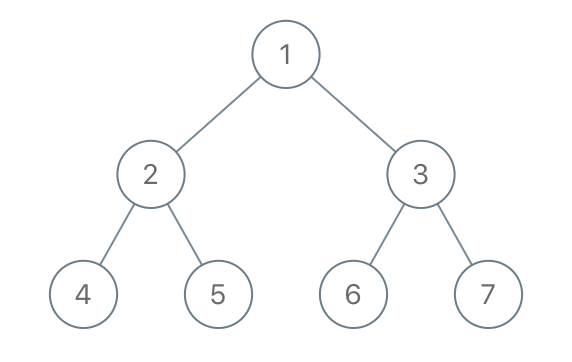
Input: root = [1,2,3,4,5,6,7], to_delete = [3,5]
Output: [[1,2,null,4],[6],[7]]

Constraints:

  • The number of nodes in the given tree is at most 1000.
  • Each node has a distinct value between 1 and 1000.
  • to_delete.length <= 1000
  • to_delete contains distinct values between 1 and 1000.

Solution: Recursion / Post-order traversal

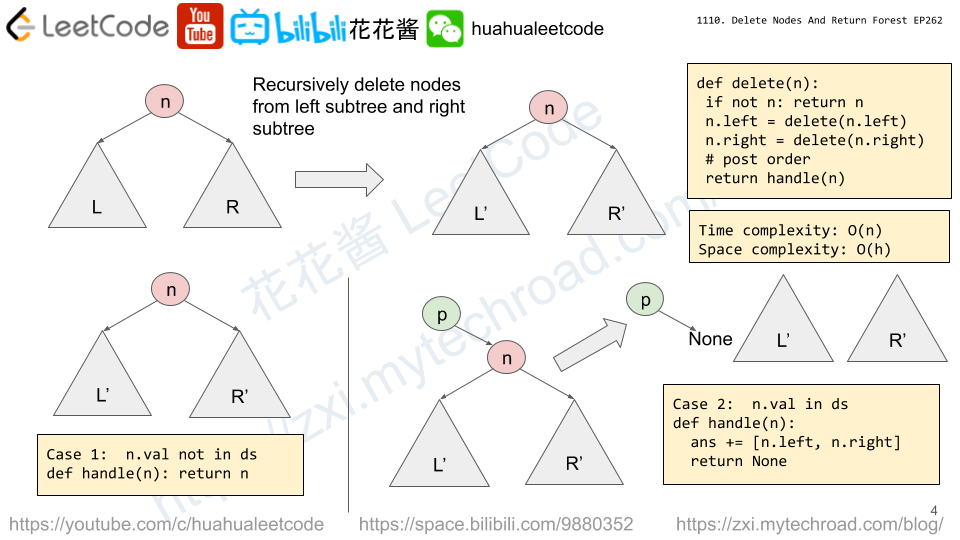
Recursively delete nodes on left subtree and right subtree and return the trimmed tree.
if the current node needs to be deleted, then its non-null children will be added to output array.

Time complexity: O(n)
Space complexity: O(|d| + h)

C++

Python3

花花酱 LeetCode 1147. Longest Chunked Palindrome Decomposition

Return the largest possible k such that there exists a_1, a_2, ..., a_k such that:

  • Each a_i is a non-empty string;
  • Their concatenation a_1 + a_2 + ... + a_k is equal to text;
  • For all 1 <= i <= k,  a_i = a_{k+1 - i}.

Example 1:

Input: text = "ghiabcdefhelloadamhelloabcdefghi"
Output: 7
Explanation: We can split the string on "(ghi)(abcdef)(hello)(adam)(hello)(abcdef)(ghi)".

Example 2:

Input: text = "merchant"
Output: 1
Explanation: We can split the string on "(merchant)".

Example 3:

Input: text = "antaprezatepzapreanta"
Output: 11
Explanation: We can split the string on "(a)(nt)(a)(pre)(za)(tpe)(za)(pre)(a)(nt)(a)".

Example 4:

Input: text = "aaa"
Output: 3
Explanation: We can split the string on "(a)(a)(a)".

Solution: Greedy

Break the string when the shortest palindrome is found.
prefer to use string_view

Time complexity: O(n^2)
Space complexity: O(n)

C++