Press "Enter" to skip to content

Huahua's Tech Road

花花酱 LeetCode 1051. Height Checker

Students are asked to stand in non-decreasing order of heights for an annual photo.

Return the minimum number of students not standing in the right positions.  (This is the number of students that must move in order for all students to be standing in non-decreasing order of height.)

Example 1:

Input: [1,1,4,2,1,3]
Output: 3
Explanation: 
Students with heights 4, 3 and the last 1 are not standing in the right positions.

Note:

  1. 1 <= heights.length <= 100
  2. 1 <= heights[i] <= 100

Solution: Sorting

Time complexity: O(nlogn)
Space complexity: O(n)

C++

花花酱 LeetCode Weekly Contest 137

1046. Last Stone Weight

Solution: Simulation (priority_queue)

Time complexity: O(nlogn)
Space complexity: O(n)

C++

1047. Remove All Adjacent Duplicates In String

Solution: Stack / Deque

Time complexity: O(n)
Space complexity: O(n)

C++

1048. Longest String Chain

Solution: DP

dp[i] := max length of chain of (A[0] ~ A[i-1])

dp[i] = max{dp[j] + 1} if A[j] is prederrsor of A[i], 1 <= j <i

Time complexity: O(n^2*l)
Space complexity: O(n)

C++

1049. Last Stone Weight II

Solution: DP / target sum

Time complexity: O(n * S) = O(n * 100)

Space complexity: O(S) = O(100)

C++

花花酱 LeetCode 718. Maximum Length of Repeated Subarray

iven two integer arrays A and B, return the maximum length of an subarray that appears in both arrays.

Example 1:

Input:
A: [1,2,3,2,1]
B: [3,2,1,4,7]
Output: 3
Explanation: 
The repeated subarray with maximum length is [3, 2, 1].

Note:

  1. 1 <= len(A), len(B) <= 1000
  2. 0 <= A[i], B[i] < 100

Solution: DP

dp[i][j] := max length of (A[0:i], B[0:j])

dp[i][j] = dp[i – 1][j – 1] + 1 if A[i-1] == B[j-1] else 0

Time complexity: O(m*n)
Space complexity: O(m*n) -> O(n)

C++ S:O(mn)

C++ S:O(min(m,n))

花花酱 LeetCode 90. Subsets II

Given a collection of integers that might contain duplicates, nums, return all possible subsets (the power set).

Note: The solution set must not contain duplicate subsets.

Example:

Solution: DFS

The key to this problem is how to remove/avoid duplicates efficiently.

For the same depth, among the same numbers, only the first number can be used.

Time complexity: O(2^n * n)
Space complexity: O(n)

C++

花花酱 LeetCode 1043. Partition Array for Maximum Sum

Given an integer array A, you partition the array into (contiguous) subarrays of length at most K.  After partitioning, each subarray has their values changed to become the maximum value of that subarray.

Return the largest sum of the given array after partitioning.

Example 1:

Input: A = [1,15,7,9,2,5,10], K = 3
Output: 84
Explanation: A becomes [15,15,15,9,10,10,10]

Note:

  1. 1 <= K <= A.length <= 500
  2. 0 <= A[i] <= 10^6

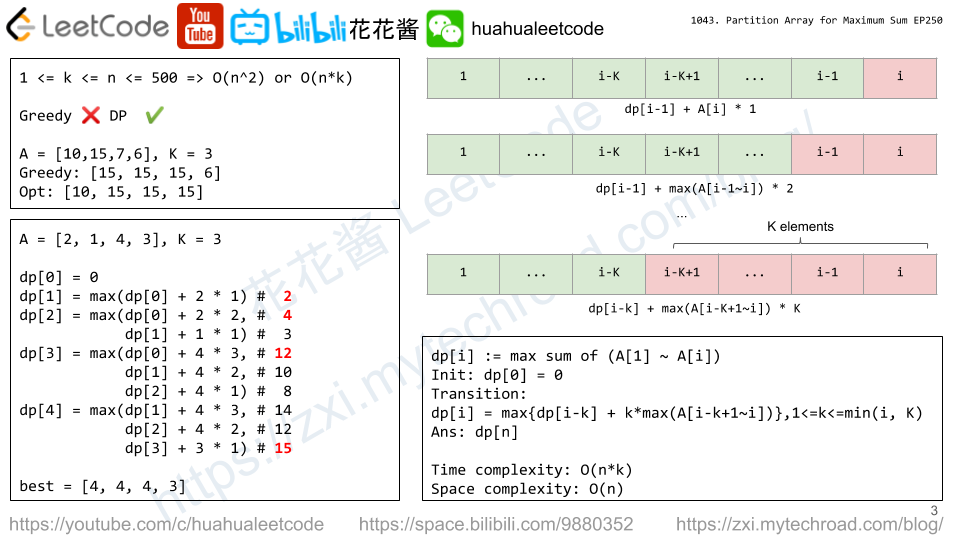
Solution: DP

Time complexity: O(n*k)
Space complexity: O(n)

dp[i] := max sum of A[1] ~ A[i]
init: dp[0] = 0
transition: dp[i] = max{dp[i – k] + max(A[i-k:i]) * k}, 1 <= k <= min(i, K)
ans: dp[n]

A = | 2 | 1 | 4 | 3 |
K = 3
dp[0] = 0
dp[1] = max(dp[0] + 2 * 1) = 2
dp[2] = max(dp[0] + 2 * 2, dp[1] + 1 * 1) = max(4, 3) = 4
dp[3] = max(dp[0] + 4 * 3, dp[1] + 4 * 2, dp[2] + 4 * 1) = max(12, 10, 8) = 12
dp[4] = max(dp[1] + 4 * 3, dp[2] + 4 * 2, dp[3] + 3 * 1) = max(14, 12, 15) = 15
best = | 4 | 4 | 4 | 3 |

C++