Press "Enter" to skip to content

Huahua's Tech Road

花花酱 LeetCode Weekly Contest 135 (1037, 1038, 1039, 1040)

LeetCode 1037. Valid Boomerang

Solution: Math
Time complexity: O(1)
Space complexity: O(1)

C++

LeetCode 1038. Binary Search Tree to Greater Sum Tree

Solution: Recursion: right, root, left

Time complexity: O(n)
Space complexity: O(n)

C++

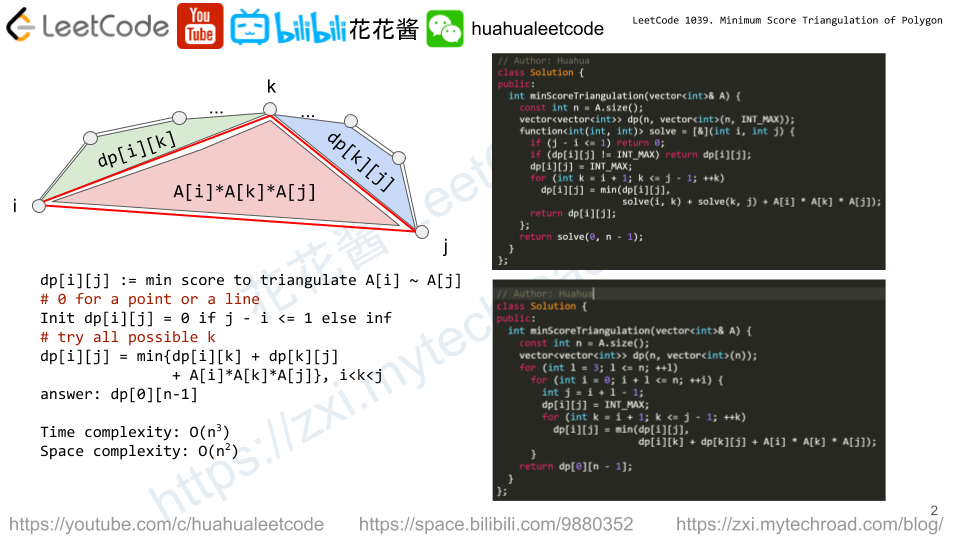
1039. Minimum Score Triangulation of Polygon

Solution: DP

Init: dp[i][j] = 0 if 0 <= j – i <= 1
dp[i][j] := min score to triangulate A[i] ~ A[j]
dp[i][j] = min{dp[i][k] + dp[k][j] + A[i]*A[k]*A[j]), i < k < j
answer: dp[0][n – 1]

Time complexity: O(n^3)
Space complexity: O(n^2)

C++/bottom-up

C++/top-down

Python

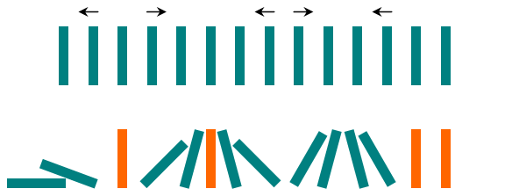
1040. Moving Stones Until Consecutive II

Solution: Sliding Window

Time complexity: O(nlogn)
Space complexity: O(1)

C++

花花酱 LeetCode 851. Loud and Rich

In a group of N people (labelled 0, 1, 2, ..., N-1), each person has different amounts of money, and different levels of quietness.

For convenience, we’ll call the person with label x, simply “person x“.

We’ll say that richer[i] = [x, y] if person x definitely has more money than person y.  Note that richer may only be a subset of valid observations.

Also, we’ll say quiet[x] = q if person x has quietness q.

Now, return answer, where answer[x] = y if y is the least quiet person (that is, the person y with the smallest value of quiet[y]), among all people who definitely have equal to or more money than person x.

Example 1:

Input: richer = [[1,0],[2,1],[3,1],[3,7],[4,3],[5,3],[6,3]], quiet = [3,2,5,4,6,1,7,0]
Output: [5,5,2,5,4,5,6,7]
Explanation: 
answer[0] = 5.
Person 5 has more money than 3, which has more money than 1, which has more money than 0.
The only person who is quieter (has lower quiet[x]) is person 7, but
it isn't clear if they have more money than person 0.

answer[7] = 7.
Among all people that definitely have equal to or more money than person 7
(which could be persons 3, 4, 5, 6, or 7), the person who is the quietest (has lower quiet[x])
is person 7.

The other answers can be filled out with similar reasoning.

Note:

  1. 1 <= quiet.length = N <= 500
  2. 0 <= quiet[i] < N, all quiet[i] are different.
  3. 0 <= richer.length <= N * (N-1) / 2
  4. 0 <= richer[i][j] < N
  5. richer[i][0] != richer[i][1]
  6. richer[i]‘s are all different.
  7. The observations in richer are all logically consistent.

Solution: DFS + Memoization

For person i , remember the quietest person who is richer than person i.

Time complexity: O(n^2)
Space complexity: O(n)

C++

花花酱 8 Puzzles – Bidirectional A* vs Bidirectional BFS

8 Puzzles # nodes expended of 1000 solvable instances

Conclusion:

Nodes expended: BiDirectional A* << A* (Manhattan) <= Bidirectional BFS < A* Hamming << BFS
Running time: BiDirectional A* < Bidirectional BFS <= A* (Manhattan) < A* Hamming << BFS

Code:

C++ Version

花花酱 LeetCode 853. Car Fleet

N cars are going to the same destination along a one lane road.  The destination is target miles away.

Each car i has a constant speed speed[i] (in miles per hour), and initial position position[i] miles towards the target along the road.

A car can never pass another car ahead of it, but it can catch up to it, and drive bumper to bumper at the same speed.

The distance between these two cars is ignored – they are assumed to have the same position.

car fleet is some non-empty set of cars driving at the same position and same speed.  Note that a single car is also a car fleet.

If a car catches up to a car fleet right at the destination point, it will still be considered as one car fleet.


How many car fleets will arrive at the destination?

Example 1:

Input: target = 12, position = [10,8,0,5,3], speed = [2,4,1,1,3]
Output: 3
Explanation:
The cars starting at 10 and 8 become a fleet, meeting each other at 12.
The car starting at 0 doesn't catch up to any other car, so it is a fleet by itself.
The cars starting at 5 and 3 become a fleet, meeting each other at 6.
Note that no other cars meet these fleets before the destination, so the answer is 3.


Note:

  1. 0 <= N <= 10 ^ 4
  2. 0 < target <= 10 ^ 6
  3. 0 < speed[i] <= 10 ^ 6
  4. 0 <= position[i] < target
  5. All initial positions are different.

Solution: Greedy

  1. Compute the time when each car can reach target.
  2. Sort cars by position DESC

Answer will be number slow cars in the time array.

Ex 1: 
target = 12
p = [10,8,0,5,3] 
v = [2,4,1,1,3]


p     t
10    1  <- slow -- ^
 8    1             |
 5    7  <- slow -- ^
 3    3             |
 0   12  <- slow -- ^

Ex 2
target = 10
p = [5, 4, 3, 2, 1]
v = [1, 2, 3, 4, 5]

p     t
5     5  <- slow -- ^
4     3             |
3     2.33          |
2     2             |
1     1.8           |

Time complexity: O(nlogn)
Space complexity: O(n)

C++

Python3

花花酱 LeetCode 45. Jump Game II

Given an array of non-negative integers, you are initially positioned at the first index of the array.

Each element in the array represents your maximum jump length at that position.

Your goal is to reach the last index in the minimum number of jumps.

Example:

Input: [2,3,1,1,4]
Output: 2
Explanation: The minimum number of jumps to reach the last index is 2.
    Jump 1 step from index 0 to 1, then 3 steps to the last index.

Note:

You can assume that you can always reach the last index.

Solution: Greedy

Jump as far as possible but lazily.

[2, 3, 1, 1, 4]
i    nums[i]   steps   near   far
-      -         0       0     0
0      2         0       0     2
1      3         1       2     4
2      1         1       2     4
3      1         2       4     4
4      4         2       4     8

Time complexity: O(n)
Space complexity: O(1)

C++