Press "Enter" to skip to content

Huahua's Tech Road

花花酱 LeetCode 902. Numbers At Most N Given Digit Set

Problem

We have a sorted set of digits D, a non-empty subset of {'1','2','3','4','5','6','7','8','9'}.  (Note that '0' is not included.)

Now, we write numbers using these digits, using each digit as many times as we want.  For example, if D = {'1','3','5'}, we may write numbers such as '13', '551', '1351315'.

Return the number of positive integers that can be written (using the digits of D) that are less than or equal to N.

Example 1:

Input: D = ["1","3","5","7"], N = 100
Output: 20
Explanation: 
The 20 numbers that can be written are:
1, 3, 5, 7, 11, 13, 15, 17, 31, 33, 35, 37, 51, 53, 55, 57, 71, 73, 75, 77.

Example 2:

Input: D = ["1","4","9"], N = 1000000000
Output: 29523
Explanation: 
We can write 3 one digit numbers, 9 two digit numbers, 27 three digit numbers,
81 four digit numbers, 243 five digit numbers, 729 six digit numbers,
2187 seven digit numbers, 6561 eight digit numbers, and 19683 nine digit numbers.
In total, this is 29523 integers that can be written using the digits of D.

Note:

  1. D is a subset of digits '1'-'9' in sorted order.
  2. 1 <= N <= 10^9


Solution -1: DFS (TLE)

Time complexity: O(|D|^log10(N))

Space complexity: O(n)

Solution 1: Math

Time complexity: O(log10(N))

Space complexity: O(1)

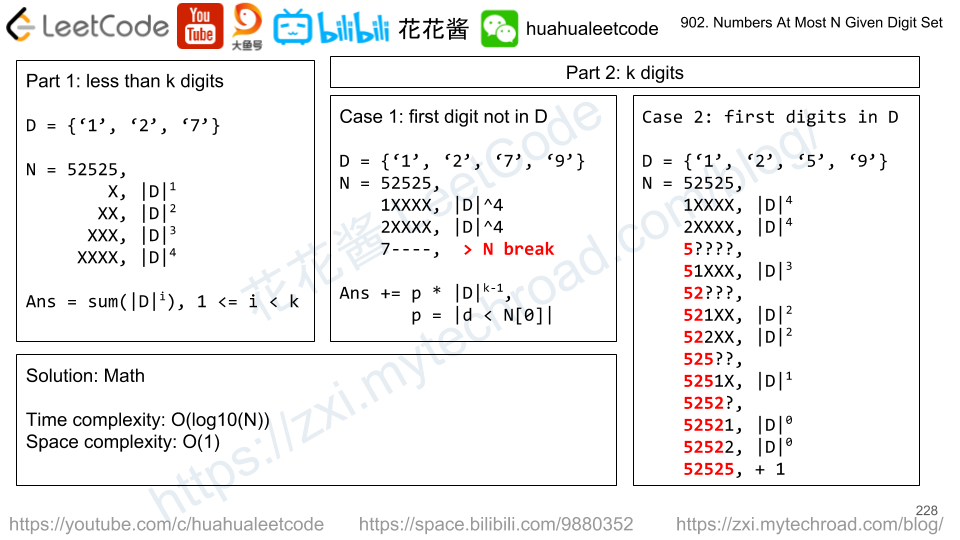
Suppose N has n digits.

less than n digits

We can use all the numbers from D to construct numbers of with length 1,2,…,n-1 which are guaranteed to be less than N.

e.g. n = 52125, D = [1, 2, 5]

format X: e.g. 1, 2, 5 counts = |D| ^ 1

format XX: e.g. 11,12,15,21,22,25,51,52,55, counts = |D|^2

format XXX:  counts = |D|^3

format XXXX: counts = |D|^4

exact n digits

if all numbers in D  != N[0], counts = |d < N[0] | d in D| * |D|^(n-1), and we are done.

e.g. N = 34567, D = [1,2,8]

we can make:

  • X |3|^1
  • XX |3| ^ 2
  • XXX |3| ^ 3
  • XXXX |3| ^ 3
  • 1XXXX, |3|^4
  • 2XXXX, |3|^4
  • we can’t do 8XXXX

Total = (3^1 + 3^2 + 3^3 + 3^4) + 2 * |3|^ 4 = 120 + 162 = 282

N = 52525, D = [1,2,5]

However, if d = N[i], we need to check the next digit…

  • X |3|^1
  • XX |3| ^ 2
  • XXX |3| ^ 3
  • XXXX |3| ^ 3
  • 1XXXX, |3|^4
  • 2XXXX, |3|^4
  •  5????
    • 51XXX |3|^3
    • 52???
      • 521XX |3|^2
      • 522XX |3|^2
      • 525??
        • 5251X |3|^1
        • 5252?
          • 52521 |3|^0
          • 52522 |3|^0
          • 52525 +1

total = (120) + 2 * |3|^4 + |3|^3 + 2*|3|^2 + |3|^1 + 2 * |3|^0 + 1 = 120 + 213 = 333

if every digit of N is from D, then we also have a valid solution, thus need to + 1.

C++

Java


Python3

花花酱 LeetCode 900. RLE Iterator

Problem

Write an iterator that iterates through a run-length encoded sequence.

The iterator is initialized by RLEIterator(int[] A), where A is a run-length encoding of some sequence.  More specifically, for all even iA[i] tells us the number of times that the non-negative integer value A[i+1] is repeated in the sequence.

The iterator supports one function: next(int n), which exhausts the next n elements (n >= 1) and returns the last element exhausted in this way.  If there is no element left to exhaust, next returns -1 instead.

For example, we start with A = [3,8,0,9,2,5], which is a run-length encoding of the sequence [8,8,8,5,5].  This is because the sequence can be read as “three eights, zero nines, two fives”.

Example 1:

Input: ["RLEIterator","next","next","next","next"], [[[3,8,0,9,2,5]],[2],[1],[1],[2]]
Output: [null,8,8,5,-1]
Explanation: 
RLEIterator is initialized with RLEIterator([3,8,0,9,2,5]).
This maps to the sequence [8,8,8,5,5].
RLEIterator.next is then called 4 times:

.next(2) exhausts 2 terms of the sequence, returning 8.  The remaining sequence is now [8, 5, 5].

.next(1) exhausts 1 term of the sequence, returning 8.  The remaining sequence is now [5, 5].

.next(1) exhausts 1 term of the sequence, returning 5.  The remaining sequence is now [5].

.next(2) exhausts 2 terms, returning -1.  This is because the first term exhausted was 5,
but the second term did not exist.  Since the last term exhausted does not exist, we return -1.

Note:

  1. 0 <= A.length <= 1000
  2. A.length is an even integer.
  3. 0 <= A[i] <= 10^9
  4. There are at most 1000 calls to RLEIterator.next(int n) per test case.
  5. Each call to RLEIterator.next(int n) will have 1 <= n <= 10^9.

Solution: Simulation

Time complexity: O(|A|)

Space complexity: O(|A|)

C++

Java

Python3


花花酱 LeetCode 12. Integer to Roman

Problem

Roman numerals are represented by seven different symbols: IVXLCD and M.

Symbol       Value
I             1
V             5
X             10
L             50
C             100
D             500
M             1000

For example, two is written as II in Roman numeral, just two one’s added together. Twelve is written as, XII, which is simply X + II. The number twenty seven is written as XXVII, which is XX + V + II.

Roman numerals are usually written largest to smallest from left to right. However, the numeral for four is not IIII. Instead, the number four is written as IV. Because the one is before the five we subtract it making four. The same principle applies to the number nine, which is written as IX. There are six instances where subtraction is used:

  • I can be placed before V (5) and X (10) to make 4 and 9.
  • X can be placed before L (50) and C (100) to make 40 and 90.
  • C can be placed before D (500) and M (1000) to make 400 and 900.

Given an integer, convert it to a roman numeral. Input is guaranteed to be within the range from 1 to 3999.

Example 1:

Input: 3
Output: "III"

Example 2:

Input: 4
Output: "IV"

Example 3:

Input: 9
Output: "IX"

Example 4:

Input: 58
Output: "LVIII"
Explanation: C = 100, L = 50, XXX = 30 and III = 3.

Example 5:

Input: 1994
Output: "MCMXCIV"
Explanation: M = 1000, CM = 900, XC = 90 and IV = 4.

Solution: HashTable + Simulation

Map integer 1,4,5,9,10,40,50,90, …, 1000 to Romain

Start from the largest number y,

if x >= y:
ans += Roman[y]
x -= y

Time complexity: O(x)

Space complexity: O(x)

C++

Python3

花花酱 LeetCode 9. Palindrome Number

Problem

Determine whether an integer is a palindrome. An integer is a palindrome when it reads the same backward as forward.

Example 1:

Input: 121
Output: true

Example 2:

Input: -121
Output: false
Explanation: From left to right, it reads -121. From right to left, it becomes 121-. Therefore it is not a palindrome.

Example 3:

Input: 10
Output: false
Explanation: Reads 01 from right to left. Therefore it is not a palindrome.

Follow up:

Could you solve it without converting the integer to a string?

Solution 1: Convert to string (cheating)

Time complexity: O(log10(x))

Space complexity: O(log10(x))

C++

Solution 2: Digit by Digit

Every time we compare the first and last digits of x, if they are not the same, return false. Otherwise, remove first and last digit and continue this process.

How can we achieve that via int math?

e.g. x = 9999, t = pow((10, int)log10(x)) = 1000

first digit: x / t, last digit: x % 10

then x = (x – x / t * t) / 10 removes first and last digits.

t /= 100 since we removed two digits.

x / t = 9 = 9 = x % 10, 9999 => 99

9 = 9, 99 => “”

Time complexity: O(log10(x) / 2)

Space complexity: O(1)

C++

花花酱 LeetCode 8. String to Integer (atoi)

Problem

Implement atoi which converts a string to an integer.

The function first discards as many whitespace characters as necessary until the first non-whitespace character is found. Then, starting from this character, takes an optional initial plus or minus sign followed by as many numerical digits as possible, and interprets them as a numerical value.

The string can contain additional characters after those that form the integral number, which are ignored and have no effect on the behavior of this function.

If the first sequence of non-whitespace characters in str is not a valid integral number, or if no such sequence exists because either str is empty or it contains only whitespace characters, no conversion is performed.

If no valid conversion could be performed, a zero value is returned.

Note:

  • Only the space character ' ' is considered as whitespace character.
  • Assume we are dealing with an environment which could only store integers within the 32-bit signed integer range: [−231,  231 − 1]. If the numerical value is out of the range of representable values, INT_MAX (231 − 1) or INT_MIN (−231) is returned.

Example 1:

Input: "42"
Output: 42

Example 2:

Input: "   -42"
Output: -42
Explanation: The first non-whitespace character is '-', which is the minus sign.
             Then take as many numerical digits as possible, which gets 42.

Example 3:

Input: "4193 with words"
Output: 4193
Explanation: Conversion stops at digit '3' as the next character is not a numerical digit.

Example 4:

Input: "words and 987"
Output: 0
Explanation: The first non-whitespace character is 'w', which is not a numerical 
             digit or a +/- sign. Therefore no valid conversion could be performed.

Example 5:

Input: "-91283472332"
Output: -2147483648
Explanation: The number "-91283472332" is out of the range of a 32-bit signed integer.
             Thefore INT_MIN (−231) is returned.

Solution: Simulation

You need to handle all corner cases in order to pass…

Time complexity: O(n)

Space complexity: O(n)

C++