Press "Enter" to skip to content

Huahua's Tech Road

花花酱 LeetCode 2208. Minimum Operations to Halve Array Sum

You are given an array nums of positive integers. In one operation, you can choose any number from nums and reduce it to exactly half the number. (Note that you may choose this reduced number in future operations.)

Return the minimum number of operations to reduce the sum of nums by at least half.

Example 1:

Input: nums = [5,19,8,1]
Output: 3
Explanation: The initial sum of nums is equal to 5 + 19 + 8 + 1 = 33.
The following is one of the ways to reduce the sum by at least half:
Pick the number 19 and reduce it to 9.5.
Pick the number 9.5 and reduce it to 4.75.
Pick the number 8 and reduce it to 4.
The final array is [5, 4.75, 4, 1] with a total sum of 5 + 4.75 + 4 + 1 = 14.75. 
The sum of nums has been reduced by 33 - 14.75 = 18.25, which is at least half of the initial sum, 18.25 >= 33/2 = 16.5.
Overall, 3 operations were used so we return 3.
It can be shown that we cannot reduce the sum by at least half in less than 3 operations.

Example 2:

Input: nums = [3,8,20]
Output: 3
Explanation: The initial sum of nums is equal to 3 + 8 + 20 = 31.
The following is one of the ways to reduce the sum by at least half:
Pick the number 20 and reduce it to 10.
Pick the number 10 and reduce it to 5.
Pick the number 3 and reduce it to 1.5.
The final array is [1.5, 8, 5] with a total sum of 1.5 + 8 + 5 = 14.5. 
The sum of nums has been reduced by 31 - 14.5 = 16.5, which is at least half of the initial sum, 16.5 >= 31/2 = 16.5.
Overall, 3 operations were used so we return 3.
It can be shown that we cannot reduce the sum by at least half in less than 3 operations.

Constraints:

  • 1 <= nums.length <= 105
  • 1 <= nums[i] <= 107

Solution: Greedy + PriorityQueue/Max Heap

Always half the largest number, put all the numbers onto a max heap (priority queue), extract the largest one, and put reduced number back.

Time complexity: O(nlogn)
Space complexity: O(n)

C++

花花酱 LeetCode 2206. Divide Array Into Equal Pairs

You are given an integer array nums consisting of 2 * n integers.

You need to divide nums into n pairs such that:

  • Each element belongs to exactly one pair.
  • The elements present in a pair are equal.

Return true if nums can be divided into n pairs, otherwise return false.

Example 1:

Input: nums = [3,2,3,2,2,2]
Output: true
Explanation: 
There are 6 elements in nums, so they should be divided into 6 / 2 = 3 pairs.
If nums is divided into the pairs (2, 2), (3, 3), and (2, 2), it will satisfy all the conditions.

Example 2:

Input: nums = [1,2,3,4]
Output: false
Explanation: 
There is no way to divide nums into 4 / 2 = 2 pairs such that the pairs satisfy every condition.

Constraints:

  • nums.length == 2 * n
  • 1 <= n <= 500
  • 1 <= nums[i] <= 500

Solution: Hashtable

Each number has to appear even numbers in order to be paired. Count the frequency of each number, return true if all of them are even numbers, return false otherwise.

Time complexity: O(n)
Space complexity: O(n)

C++

花花酱 LeetCode 2192. All Ancestors of a Node in a Directed Acyclic Graph

You are given a positive integer n representing the number of nodes of a Directed Acyclic Graph (DAG). The nodes are numbered from 0 to n - 1 (inclusive).

You are also given a 2D integer array edges, where edges[i] = [fromi, toi] denotes that there is a unidirectional edge from fromi to toi in the graph.

Return a list answer, where answer[i] is the list of ancestors of the ith node, sorted in ascending order.

A node u is an ancestor of another node v if u can reach v via a set of edges.

Example 1:

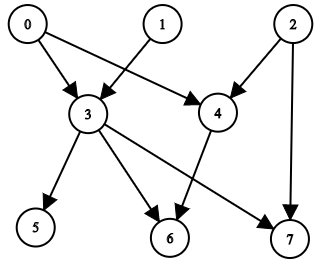
Input: n = 8, edgeList = [[0,3],[0,4],[1,3],[2,4],[2,7],[3,5],[3,6],[3,7],[4,6]]
Output: [[],[],[],[0,1],[0,2],[0,1,3],[0,1,2,3,4],[0,1,2,3]]
Explanation:
The above diagram represents the input graph.
- Nodes 0, 1, and 2 do not have any ancestors.
- Node 3 has two ancestors 0 and 1.
- Node 4 has two ancestors 0 and 2.
- Node 5 has three ancestors 0, 1, and 3.
- Node 6 has five ancestors 0, 1, 2, 3, and 4.
- Node 7 has four ancestors 0, 1, 2, and 3.

Example 2:

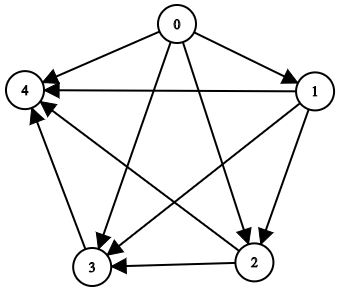
Input: n = 5, edgeList = [[0,1],[0,2],[0,3],[0,4],[1,2],[1,3],[1,4],[2,3],[2,4],[3,4]]
Output: [[],[0],[0,1],[0,1,2],[0,1,2,3]]
Explanation:
The above diagram represents the input graph.
- Node 0 does not have any ancestor.
- Node 1 has one ancestor 0.
- Node 2 has two ancestors 0 and 1.
- Node 3 has three ancestors 0, 1, and 2.
- Node 4 has four ancestors 0, 1, 2, and 3.

Constraints:

  • 1 <= n <= 1000
  • 0 <= edges.length <= min(2000, n * (n - 1) / 2)
  • edges[i].length == 2
  • 0 <= fromi, toi <= n - 1
  • fromi != toi
  • There are no duplicate edges.
  • The graph is directed and acyclic.

Solution: DFS

For each source node S, add it to all its reachable nodes by traversing the entire graph.
In one pass, only traverse each child node at most once.

Time complexity: O(VE)
Space complexity: (V+E)

C++

花花酱 LeetCode 2190. Most Frequent Number Following Key In an Array

You are given a 0-indexed integer array nums. You are also given an integer key, which is present in nums.

For every unique integer target in numscount the number of times target immediately follows an occurrence of key in nums. In other words, count the number of indices i such that:

  • 0 <= i <= nums.length - 2,
  • nums[i] == key and,
  • nums[i + 1] == target.

Return the target with the maximum count. The test cases will be generated such that the target with maximum count is unique.

Example 1:

Input: nums = [1,100,200,1,100], key = 1
Output: 100
Explanation: For target = 100, there are 2 occurrences at indices 1 and 4 which follow an occurrence of key.
No other integers follow an occurrence of key, so we return 100.

Example 2:

Input: nums = [2,2,2,2,3], key = 2
Output: 2
Explanation: For target = 2, there are 3 occurrences at indices 1, 2, and 3 which follow an occurrence of key.
For target = 3, there is only one occurrence at index 4 which follows an occurrence of key.
target = 2 has the maximum number of occurrences following an occurrence of key, so we return 2.

Constraints:

  • 2 <= nums.length <= 1000
  • 1 <= nums[i] <= 1000
  • The test cases will be generated such that the answer is unique.

Solution: Hashtable

Time complexity: O(n)
Space complexity: O(n)

C++

花花酱 LeetCode 2197. Replace Non-Coprime Numbers in Array

You are given an array of integers nums. Perform the following steps:

  1. Find any two adjacent numbers in nums that are non-coprime.
  2. If no such numbers are found, stop the process.
  3. Otherwise, delete the two numbers and replace them with their LCM (Least Common Multiple).
  4. Repeat this process as long as you keep finding two adjacent non-coprime numbers.

Return the final modified array. It can be shown that replacing adjacent non-coprime numbers in any arbitrary order will lead to the same result.

The test cases are generated such that the values in the final array are less than or equal to 108.

Two values x and y are non-coprime if GCD(x, y) > 1 where GCD(x, y) is the Greatest Common Divisor of x and y.

Example 1:

Input: nums = [6,4,3,2,7,6,2]
Output: [12,7,6]
Explanation: 
- (6, 4) are non-coprime with LCM(6, 4) = 12. Now, nums = [12,3,2,7,6,2].
- (12, 3) are non-coprime with LCM(12, 3) = 12. Now, nums = [12,2,7,6,2].
- (12, 2) are non-coprime with LCM(12, 2) = 12. Now, nums = [12,7,6,2].
- (6, 2) are non-coprime with LCM(6, 2) = 6. Now, nums = [12,7,6].
There are no more adjacent non-coprime numbers in nums.
Thus, the final modified array is [12,7,6].
Note that there are other ways to obtain the same resultant array.

Example 2:

Input: nums = [2,2,1,1,3,3,3]
Output: [2,1,1,3]
Explanation: 
- (3, 3) are non-coprime with LCM(3, 3) = 3. Now, nums = [2,2,1,1,3,3].
- (3, 3) are non-coprime with LCM(3, 3) = 3. Now, nums = [2,2,1,1,3].
- (2, 2) are non-coprime with LCM(2, 2) = 2. Now, nums = [2,1,1,3].
There are no more adjacent non-coprime numbers in nums.
Thus, the final modified array is [2,1,1,3].
Note that there are other ways to obtain the same resultant array.

Constraints:

  • 1 <= nums.length <= 105
  • 1 <= nums[i] <= 105
  • The test cases are generated such that the values in the final array are less than or equal to 108.

Solution: Stack

“””It can be shown that replacing adjacent non-coprime numbers in any arbitrary order will lead to the same result.”””

So that we can do it in one pass from left to right using a stack/vector.

Push the current number onto stack, and merge top two if they are not co-prime.

Time complexity: O(nlogm)
Space complexity: O(n)

C++