Press "Enter" to skip to content

Huahua's Tech Road

花花酱 LeetCode 2151. Maximum Good People Based on Statements

There are two types of persons:

  • The good person: The person who always tells the truth.
  • The bad person: The person who might tell the truth and might lie.

You are given a 0-indexed 2D integer array statements of size n x n that represents the statements made by n people about each other. More specifically, statements[i][j] could be one of the following:

  • 0 which represents a statement made by person i that person j is a bad person.
  • 1 which represents a statement made by person i that person j is a good person.
  • 2 represents that no statement is made by person i about person j.

Additionally, no person ever makes a statement about themselves. Formally, we have that statements[i][i] = 2 for all 0 <= i < n.

Return the maximum number of people who can be good based on the statements made by the n people.

Example 1:
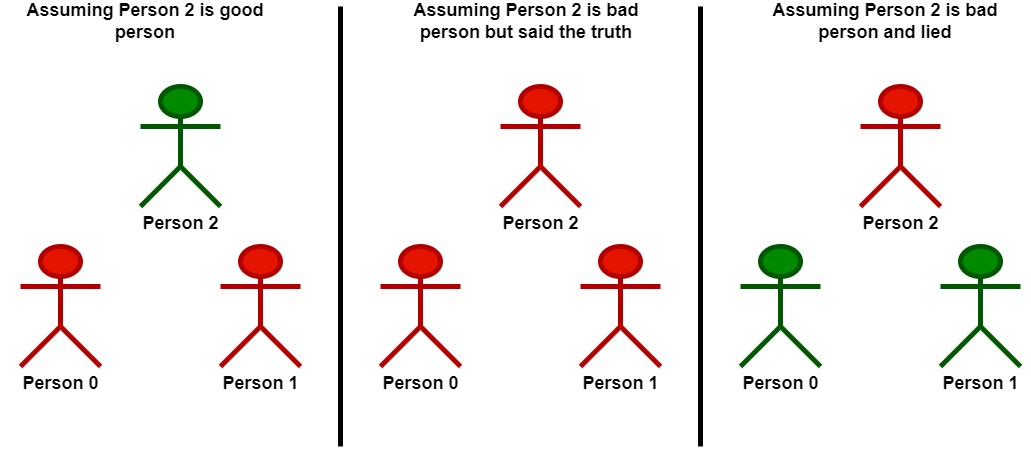
Input: statements = [[2,1,2],[1,2,2],[2,0,2]]
Output: 2
Explanation: Each person makes a single statement.
- Person 0 states that person 1 is good.
- Person 1 states that person 0 is good.
- Person 2 states that person 1 is bad.
Let's take person 2 as the key.
- Assuming that person 2 is a good person:
    - Based on the statement made by person 2, person 1 is a bad person.
    - Now we know for sure that person 1 is bad and person 2 is good.
    - Based on the statement made by person 1, and since person 1 is bad, they could be:
        - telling the truth. There will be a contradiction in this case and this assumption is invalid.
        - lying. In this case, person 0 is also a bad person and lied in their statement.
    - Following that person 2 is a good person, there will be only one good person in the group.
- Assuming that person 2 is a bad person:
    - Based on the statement made by person 2, and since person 2 is bad, they could be:
        - telling the truth. Following this scenario, person 0 and 1 are both bad as explained before.
            - Following that person 2 is bad but told the truth, there will be no good persons in the group.
        - lying. In this case person 1 is a good person.
            - Since person 1 is a good person, person 0 is also a good person.
            - Following that person 2 is bad and lied, there will be two good persons in the group.
We can see that at most 2 persons are good in the best case, so we return 2.
Note that there is more than one way to arrive at this conclusion.

Example 2:
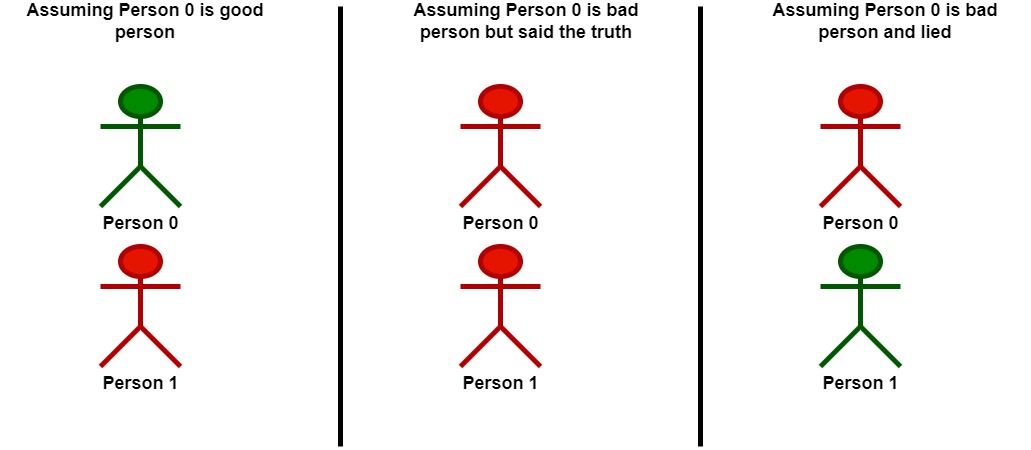
Input: statements = [[2,0],[0,2]]
Output: 1
Explanation: Each person makes a single statement.
- Person 0 states that person 1 is bad.
- Person 1 states that person 0 is bad.
Let's take person 0 as the key.
- Assuming that person 0 is a good person:
    - Based on the statement made by person 0, person 1 is a bad person and was lying.
    - Following that person 0 is a good person, there will be only one good person in the group.
- Assuming that person 0 is a bad person:
    - Based on the statement made by person 0, and since person 0 is bad, they could be:
        - telling the truth. Following this scenario, person 0 and 1 are both bad.
            - Following that person 0 is bad but told the truth, there will be no good persons in the group.
        - lying. In this case person 1 is a good person.
            - Following that person 0 is bad and lied, there will be only one good person in the group.
We can see that at most, one person is good in the best case, so we return 1.
Note that there is more than one way to arrive at this conclusion.

Constraints:

  • n == statements.length == statements[i].length
  • 2 <= n <= 15
  • statements[i][j] is either 01, or 2.
  • statements[i][i] == 2

Solution: Combination / Bitmask

Enumerate all subsets of n people and assume they are good people. Check whether their statements have any conflicts. We can ignore the statements from bad people since those can be either true or false and does not affect our checks.

Time complexity: O(n22n)
Space complexity: O(1)

C++

花花酱 LeetCode 2150. Find All Lonely Numbers in the Array

You are given an integer array nums. A number x is lonely when it appears only once, and no adjacent numbers (i.e. x + 1 and x - 1) appear in the array.

Return all lonely numbers in nums. You may return the answer in any order.

Example 1:

Input: nums = [10,6,5,8]
Output: [10,8]
Explanation: 
- 10 is a lonely number since it appears exactly once and 9 and 11 does not appear in nums.
- 8 is a lonely number since it appears exactly once and 7 and 9 does not appear in nums.
- 5 is not a lonely number since 6 appears in nums and vice versa.
Hence, the lonely numbers in nums are [10, 8].
Note that [8, 10] may also be returned.

Example 2:

Input: nums = [1,3,5,3]
Output: [1,5]
Explanation: 
- 1 is a lonely number since it appears exactly once and 0 and 2 does not appear in nums.
- 5 is a lonely number since it appears exactly once and 4 and 6 does not appear in nums.
- 3 is not a lonely number since it appears twice.
Hence, the lonely numbers in nums are [1, 5].
Note that [5, 1] may also be returned.

Constraints:

  • 1 <= nums.length <= 105
  • 0 <= nums[i] <= 106

Solution: Counter

Computer the frequency of each number in the array, for a given number x with freq = 1, check freq of (x – 1) and (x + 1), if both of them are zero then x is lonely.

Time complexity: O(n)
Space complexity: O(n)

C++

花花酱 LeetCode 2149. Rearrange Array Elements by Sign

You are given a 0-indexed integer array nums of even length consisting of an equal number of positive and negative integers.

You should rearrange the elements of nums such that the modified array follows the given conditions:

  1. Every consecutive pair of integers have opposite signs.
  2. For all integers with the same sign, the order in which they were present in nums is preserved.
  3. The rearranged array begins with a positive integer.

Return the modified array after rearranging the elements to satisfy the aforementioned conditions.

Example 1:

Input: nums = [3,1,-2,-5,2,-4]
Output: [3,-2,1,-5,2,-4]
Explanation:
The positive integers in nums are [3,1,2]. The negative integers are [-2,-5,-4].
The only possible way to rearrange them such that they satisfy all conditions is [3,-2,1,-5,2,-4].
Other ways such as [1,-2,2,-5,3,-4], [3,1,2,-2,-5,-4], [-2,3,-5,1,-4,2] are incorrect because they do not satisfy one or more conditions.  

Example 2:

Input: nums = [-1,1]
Output: [1,-1]
Explanation:
1 is the only positive integer and -1 the only negative integer in nums.
So nums is rearranged to [1,-1].

Constraints:

  • 2 <= nums.length <= 2 * 105
  • nums.length is even
  • 1 <= |nums[i]| <= 105
  • nums consists of equal number of positive and negative integers.

Solution 1: Split and merge

Create two arrays to store positive and negative numbers.

Time complexity: O(n)
Space complexity: O(n)

C++

Solution 2: Two Pointers

Use two pointers to store the next pos / neg.

Time complexity: O(n)
Space complexity: O(n)

C++

花花酱 LeetCode 2148. Count Elements With Strictly Smaller and Greater Elements

Given an integer array nums, return the number of elements that have both a strictly smaller and a strictly greater element appear in nums.

Example 1:

Input: nums = [11,7,2,15]
Output: 2
Explanation: The element 7 has the element 2 strictly smaller than it and the element 11 strictly greater than it.
Element 11 has element 7 strictly smaller than it and element 15 strictly greater than it.
In total there are 2 elements having both a strictly smaller and a strictly greater element appear in nums.

Example 2:

Input: nums = [-3,3,3,90]
Output: 2
Explanation: The element 3 has the element -3 strictly smaller than it and the element 90 strictly greater than it.
Since there are two elements with the value 3, in total there are 2 elements having both a strictly smaller and a strictly greater element appear in nums.

Constraints:

  • 1 <= nums.length <= 100
  • -105 <= nums[i] <= 105

Solution: Min / Max elements

Find min and max of the array, count elements other than those two.

Time complexity: O(n)
Space complexity: O(1)

C++

花花酱 LeetCode 2147. Number of Ways to Divide a Long Corridor

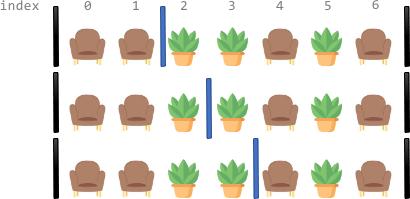
Along a long library corridor, there is a line of seats and decorative plants. You are given a 0-indexed string corridor of length n consisting of letters 'S' and 'P' where each 'S' represents a seat and each 'P' represents a plant.

One room divider has already been installed to the left of index 0, and another to the right of index n - 1. Additional room dividers can be installed. For each position between indices i - 1 and i (1 <= i <= n - 1), at most one divider can be installed.

Divide the corridor into non-overlapping sections, where each section has exactly two seats with any number of plants. There may be multiple ways to perform the division. Two ways are different if there is a position with a room divider installed in the first way but not in the second way.

Return the number of ways to divide the corridor. Since the answer may be very large, return it modulo 109 + 7. If there is no way, return 0.

Example 1:

Input: corridor = "SSPPSPS"
Output: 3
Explanation: There are 3 different ways to divide the corridor.
The black bars in the above image indicate the two room dividers already installed.
Note that in each of the ways, each section has exactly two seats.

Example 2:

Input: corridor = "PPSPSP"
Output: 1
Explanation: There is only 1 way to divide the corridor, by not installing any additional dividers.
Installing any would create some section that does not have exactly two seats.

Example 3:

Input: corridor = "S"
Output: 0
Explanation: There is no way to divide the corridor because there will always be a section that does not have exactly two seats.

Constraints:

  • n == corridor.length
  • 1 <= n <= 105
  • corridor[i] is either 'S' or 'P'.

Solution: Combination

If the 2k-th seat is positioned at j, and the 2k+1-th seat is at i. There are (i – j) ways to split between these two groups.

ans = prod{ik – jk}

Time complexity: O(n)
Space complexity: O(1)

C++