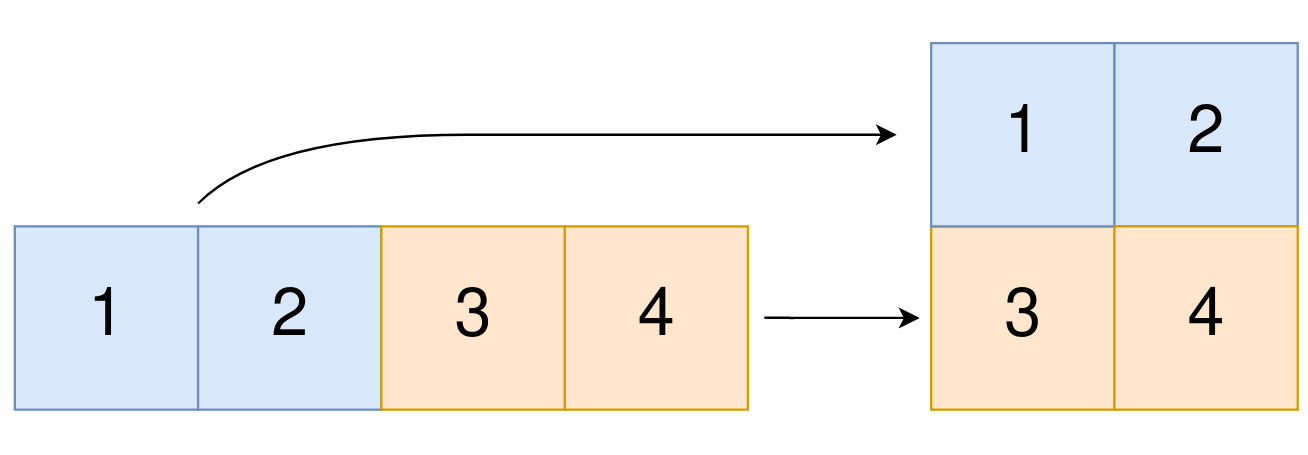
You are given a 0-indexed 1-dimensional (1D) integer array original, and two integers, m and n. You are tasked with creating a 2-dimensional (2D) array with m rows and n columns using all the elements from original.
The elements from indices 0 to n - 1 (inclusive) of original should form the first row of the constructed 2D array, the elements from indices n to 2 * n - 1 (inclusive) should form the second row of the constructed 2D array, and so on.
Return an m x n 2D array constructed according to the above procedure, or an empty 2D array if it is impossible.
Example 1:
Input: original = [1,2,3,4], m = 2, n = 2
Output: [[1,2],[3,4]]
Explanation:
The constructed 2D array should contain 2 rows and 2 columns.
The first group of n=2 elements in original, [1,2], becomes the first row in the constructed 2D array.
The second group of n=2 elements in original, [3,4], becomes the second row in the constructed 2D array.
Example 2:
Input: original = [1,2,3], m = 1, n = 3
Output: [[1,2,3]]
Explanation:
The constructed 2D array should contain 1 row and 3 columns.
Put all three elements in original into the first row of the constructed 2D array.
Example 3:
Input: original = [1,2], m = 1, n = 1
Output: []
Explanation:
There are 2 elements in original.
It is impossible to fit 2 elements in a 1x1 2D array, so return an empty 2D array.
Example 4:
Input: original = [3], m = 1, n = 2
Output: []
Explanation:
There is 1 element in original.
It is impossible to make 1 element fill all the spots in a 1x2 2D array, so return an empty 2D array.
Constraints:
1 <= original.length <= 5 * 104
1 <= original[i] <= 105
1 <= m, n <= 4 * 104
Solution: Brute Force
the i-th element in original array will have index (i//n, i % n) in the 2D array.
You are given a 2D integer grid of size m x n and an integer x. In one operation, you can addx to or subtractx from any element in the grid.
A uni-value grid is a grid where all the elements of it are equal.
Return the minimum number of operations to make the grid uni-value. If it is not possible, return -1.
Example 1:
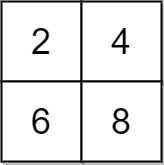
Input: grid = [[2,4],[6,8]], x = 2
Output: 4
Explanation: We can make every element equal to 4 by doing the following:
- Add x to 2 once.
- Subtract x from 6 once.
- Subtract x from 8 twice.
A total of 4 operations were used.
Example 2:
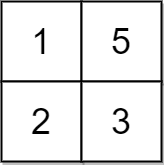
Input: grid = [[1,5],[2,3]], x = 1
Output: 5
Explanation: We can make every element equal to 3.
Example 3:
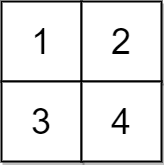
Input: grid = [[1,2],[3,4]], x = 2
Output: -1
Explanation: It is impossible to make every element equal.
Constraints:
m == grid.length
n == grid[i].length
1 <= m, n <= 105
1 <= m * n <= 105
1 <= x, grid[i][j] <= 104
Solution: Median
To achieve minimum operations, the uni-value must be the median of the array.
Given three integer arrays nums1, nums2, and nums3, return a distinct array containing all the values that are present in at least two out of the three arrays. You may return the values in any order.
Example 1:
Input: nums1 = [1,1,3,2], nums2 = [2,3], nums3 = [3]
Output: [3,2]
Explanation: The values that are present in at least two arrays are:
- 3, in all three arrays.
- 2, in nums1 and nums2.
Example 2:
Input: nums1 = [3,1], nums2 = [2,3], nums3 = [1,2]
Output: [2,3,1]
Explanation: The values that are present in at least two arrays are:
- 2, in nums2 and nums3.
- 3, in nums1 and nums2.
- 1, in nums1 and nums3.
Example 3:
Input: nums1 = [1,2,2], nums2 = [4,3,3], nums3 = [5]
Output: []
Explanation: No value is present in at least two arrays.
There is a network of n servers, labeled from 0 to n - 1. You are given a 2D integer array edges, where edges[i] = [ui, vi] indicates there is a message channel between servers ui and vi, and they can pass any number of messages to each other directly in one second. You are also given a 0-indexed integer array patience of length n.
All servers are connected, i.e., a message can be passed from one server to any other server(s) directly or indirectly through the message channels.
The server labeled 0 is the master server. The rest are data servers. Each data server needs to send its message to the master server for processing and wait for a reply. Messages move between servers optimally, so every message takes the least amount of time to arrive at the master server. The master server will process all newly arrived messages instantly and send a reply to the originating server via the reversed path the message had gone through.
At the beginning of second 0, each data server sends its message to be processed. Starting from second 1, at the beginning of every second, each data server will check if it has received a reply to the message it sent (including any newly arrived replies) from the master server:
If it has not, it will resend the message periodically. The data server i will resend the message every patience[i] second(s), i.e., the data server i will resend the message if patience[i] second(s) have elapsed since the last time the message was sent from this server.
Otherwise, no more resending will occur from this server.
The network becomes idle when there are no messages passing between servers or arriving at servers.
Return the earliest second starting from which the network becomes idle.
Example 1:
Input: edges = [[0,1],[1,2]], patience = [0,2,1]
Output: 8
Explanation:
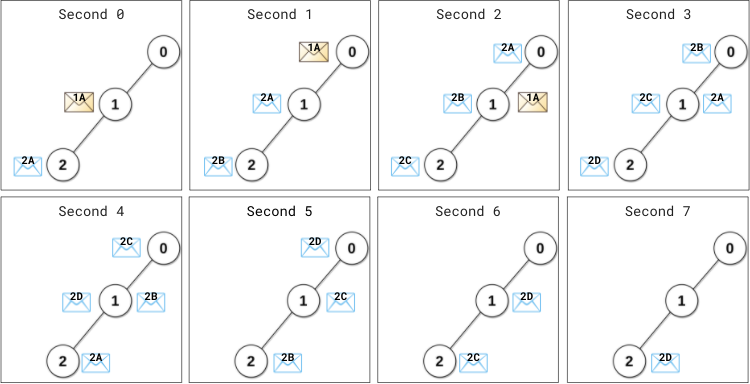
At (the beginning of) second 0,
- Data server 1 sends its message (denoted 1A) to the master server.
- Data server 2 sends its message (denoted 2A) to the master server.

At second 1,
- Message 1A arrives at the master server. Master server processes message 1A instantly and sends a reply 1A back.
- Server 1 has not received any reply. 1 second (1 < patience[1] = 2) elapsed since this server has sent the message, therefore it does not resend the message.
- Server 2 has not received any reply. 1 second (1 == patience[2] = 1) elapsed since this server has sent the message, therefore it resends the message (denoted 2B).

At second 2,
- The reply 1A arrives at server 1. No more resending will occur from server 1.
- Message 2A arrives at the master server. Master server processes message 2A instantly and sends a reply 2A back.
- Server 2 resends the message (denoted 2C).
...
At second 4,
- The reply 2A arrives at server 2. No more resending will occur from server 2.
...
At second 7, reply 2D arrives at server 2.

Starting from the beginning of the second 8, there are no messages passing between servers or arriving at servers.
This is the time when the network becomes idle.
Example 2:
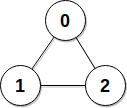
Input: edges = [[0,1],[0,2],[1,2]], patience = [0,10,10]
Output: 3
Explanation: Data servers 1 and 2 receive a reply back at the beginning of second 2.
From the beginning of the second 3, the network becomes idle.
Constraints:
n == patience.length
2 <= n <= 105
patience[0] == 0
1 <= patience[i] <= 105 for 1 <= i < n
1 <= edges.length <= min(105, n * (n - 1) / 2)
edges[i].length == 2
0 <= ui, vi < n
ui != vi
There are no duplicate edges.
Each server can directly or indirectly reach another server.
Solution: Shortest Path
Compute the shortest path from node 0 to rest of the nodes using BFS.
Idle time for node i = (dist[i] * 2 – 1) / patince[i] * patience[i] + dist[i] * 2 + 1
Time complexity: O(E + V) Space complexity: O(E + V)
There are n pieces arranged in a line, and each piece is colored either by 'A' or by 'B'. You are given a string colors of length n where colors[i] is the color of the ith piece.
Alice and Bob are playing a game where they take alternating turns removing pieces from the line. In this game, Alice moves first.
Alice is only allowed to remove a piece colored 'A' if both its neighbors are also colored 'A'. She is not allowed to remove pieces that are colored 'B'.
Bob is only allowed to remove a piece colored 'B' if both its neighbors are also colored 'B'. He is not allowed to remove pieces that are colored 'A'.
Alice and Bob cannot remove pieces from the edge of the line.
If a player cannot make a move on their turn, that player loses and the other player wins.
Assuming Alice and Bob play optimally, return true if Alice wins, or return false if Bob wins.
Example 1:
Input: colors = "AAABABB"
Output: true
Explanation:
AAABABB -> AABABB
Alice moves first.
She removes the second 'A' from the left since that is the only 'A' whose neighbors are both 'A'.

Now it's Bob's turn.
Bob cannot make a move on his turn since there are no 'B's whose neighbors are both 'B'.
Thus, Alice wins, so return true.
Example 2:
Input: colors = "AA"
Output: false
Explanation:
Alice has her turn first.
There are only two 'A's and both are on the edge of the line, so she cannot move on her turn.
Thus, Bob wins, so return false.
Example 3:
Input: colors = "ABBBBBBBAAA"
Output: false
Explanation:
ABBBBBBBAAA -> ABBBBBBBAA
Alice moves first.
Her only option is to remove the second to last 'A' from the right.

ABBBBBBBAA -> ABBBBBBAA
Next is Bob's turn.
He has many options for which 'B' piece to remove. He can pick any.

On Alice's second turn, she has no more pieces that she can remove.
Thus, Bob wins, so return false.