Given an input string (s) and a pattern (p), implement regular expression matching with support for '.' and '*'.
'.' Matches any single character.
'*' Matches zero or more of the preceding element.
The matching should cover the entire input string (not partial).
Note:
s could be empty and contains only lowercase letters a-z.
p could be empty and contains only lowercase letters a-z, and characters like . or *.
Example 1:
Input:
s = "aa"
p = "a"
Output: false
Explanation: "a" does not match the entire string "aa".
Example 2:
Input:
s = "aa"
p = "a*"
Output: true
Explanation: '*' means zero or more of the precedeng element, 'a'. Therefore, by repeating 'a' once, it becomes "aa".
Example 3:
Input:
s = "ab"
p = ".*"
Output: true
Explanation: ".*" means "zero or more (*) of any character (.)".
Example 4:
Input:
s = "aab"
p = "c*a*b"
Output: true
Explanation: c can be repeated 0 times, a can be repeated 1 time. Therefore it matches "aab".
Example 5:
Input:
s = "mississippi"
p = "mis*is*p*."
Output: false
e.g. sumSubarrayMins([3, 1, 2, 4]) !=sumSubarrayMins([1, 2, 3, 4]) since the first one will not have a subarray of [3,4].
For A[i], assuming there are L numbers that are greater than A[i] in range A[0] ~ A[i – 1], and there are R numbers that are greater or equal than A[i] in the range of A[i+1] ~ A[n – 1]. Thus A[i] will be the min of (L + 1) * (R + 1) subsequences.
e.g. A = [3,1,2,4], A[1] = 1, L = 1, R = 2, there are (1 + 1) * (2 + 1) = 6 subsequences are 1 is the min number. [3,1], [3,1,2], [3,1,2,4], [1], [1,2], [1,2,4]
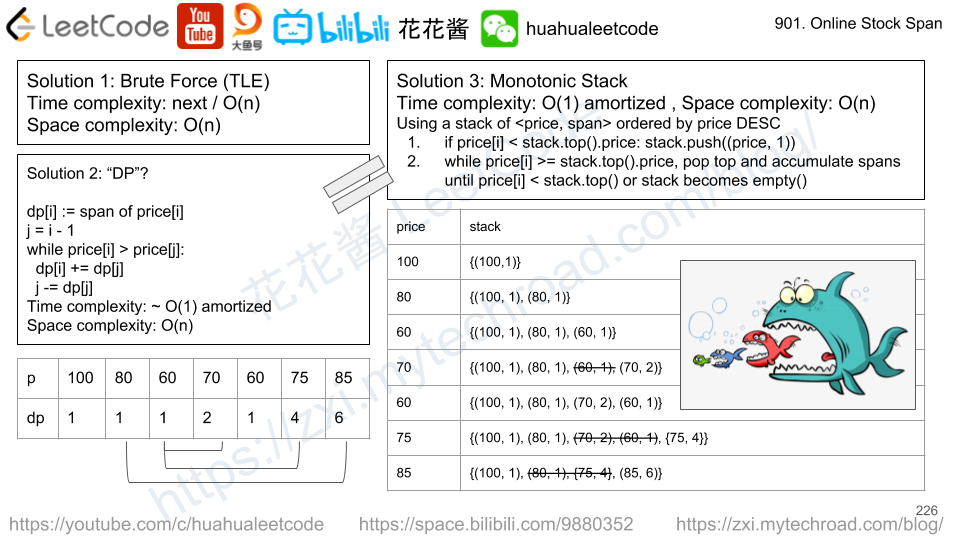
Write a class StockSpanner which collects daily price quotes for some stock, and returns the span of that stock’s price for the current day.
The span of the stock’s price today is defined as the maximum number of consecutive days (starting from today and going backwards) for which the price of the stock was less than or equal to today’s price.
For example, if the price of a stock over the next 7 days were [100, 80, 60, 70, 60, 75, 85], then the stock spans would be [1, 1, 1, 2, 1, 4, 6].
Example 1:
Input: ["StockSpanner","next","next","next","next","next","next","next"], [[],[100],[80],[60],[70],[60],[75],[85]]Output: [null,1,1,1,2,1,4,6]Explanation:
First, S = StockSpanner() is initialized. Then:
S.next(100) is called and returns 1,
S.next(80) is called and returns 1,
S.next(60) is called and returns 1,
S.next(70) is called and returns 2,
S.next(60) is called and returns 1,
S.next(75) is called and returns 4,
S.next(85) is called and returns 6.
Note that (for example) S.next(75) returned 4, because the last 4 prices
(including today's price of 75) were less than or equal to today's price.
Note:
Calls to StockSpanner.next(int price) will have 1 <= price <= 10^5.
There will be at most 10000 calls to StockSpanner.next per test case.
There will be at most 150000 calls to StockSpanner.next across all test cases.
The total time limit for this problem has been reduced by 75% for C++, and 50% for all other languages.
Solution 1: Brute Force (TLE)
Time complexity: O(n) per next call
Space complexity: O(n)
Solution 2: DP
dp[i] := span of prices[i]
j = i – 1
while j >= 0 and prices[i] >= prices[j]: j -= dp[j]
dp[i] = i – j
C++
1
2
3
4
5
6
7
8
9
10
11
12
13
14
15
16
17
18
19
20
21
22
// Author: Huahua, 144 ms
classStockSpanner{
public:
StockSpanner(){}
intnext(intprice){
if(prices_.empty()||price<prices_.back()){
dp_.push_back(1);
}else{
intj=prices_.size()-1;
while(j>=0&&price>=prices_[j]){
j-=dp_[j];
}
dp_.push_back(prices_.size()-j);
}
prices_.push_back(price);
returndp_.back();
}
private:
vector<int>dp_;
vector<int>prices_;
};
Solution 3: Monotonic Stack
Maintain a monotonic stack whose element are pairs of <price, span>, sorted by price from high to low.
When a new price comes in
If it’s less than top price, add a new pair (price, 1) to the stack, return 1
If it’s greater than top element, collapse the stack and accumulate the span until the top price is higher than the new price. return the total span
e.g. prices: 10, 6, 5, 4, 3, 7
after 3, the stack looks [(10,1), (6,1), (5,1), (4,1), (3, 1)],
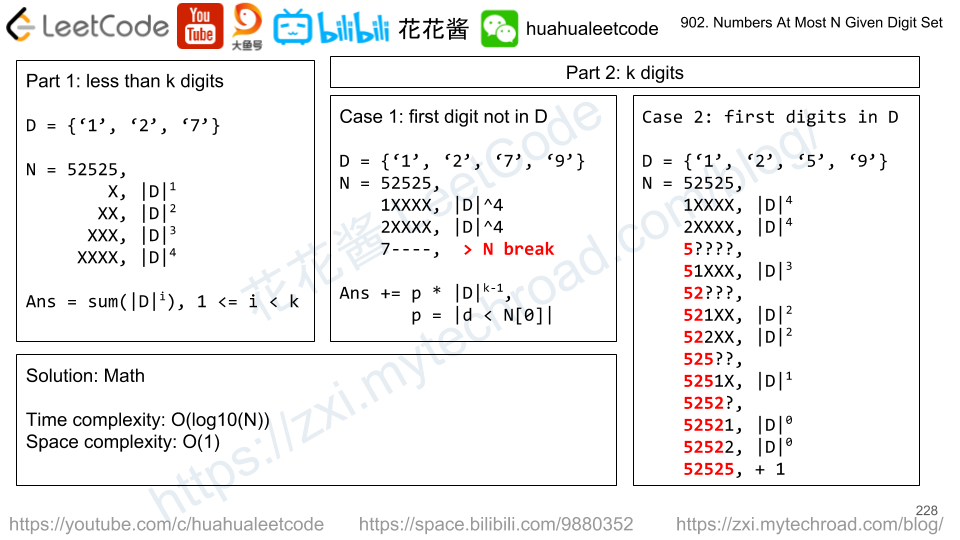
We have a sorted set of digits D, a non-empty subset of {'1','2','3','4','5','6','7','8','9'}. (Note that '0' is not included.)
Now, we write numbers using these digits, using each digit as many times as we want. For example, if D = {'1','3','5'}, we may write numbers such as '13', '551', '1351315'.
Return the number of positive integers that can be written (using the digits of D) that are less than or equal to N.
Example 1:
Input: D = ["1","3","5","7"], N = 100Output: 20Explanation:
The 20 numbers that can be written are:
1, 3, 5, 7, 11, 13, 15, 17, 31, 33, 35, 37, 51, 53, 55, 57, 71, 73, 75, 77.
Example 2:
Input: D = ["1","4","9"], N = 1000000000Output: 29523Explanation:
We can write 3 one digit numbers, 9 two digit numbers, 27 three digit numbers,
81 four digit numbers, 243 five digit numbers, 729 six digit numbers,
2187 seven digit numbers, 6561 eight digit numbers, and 19683 nine digit numbers.
In total, this is 29523 integers that can be written using the digits of D.
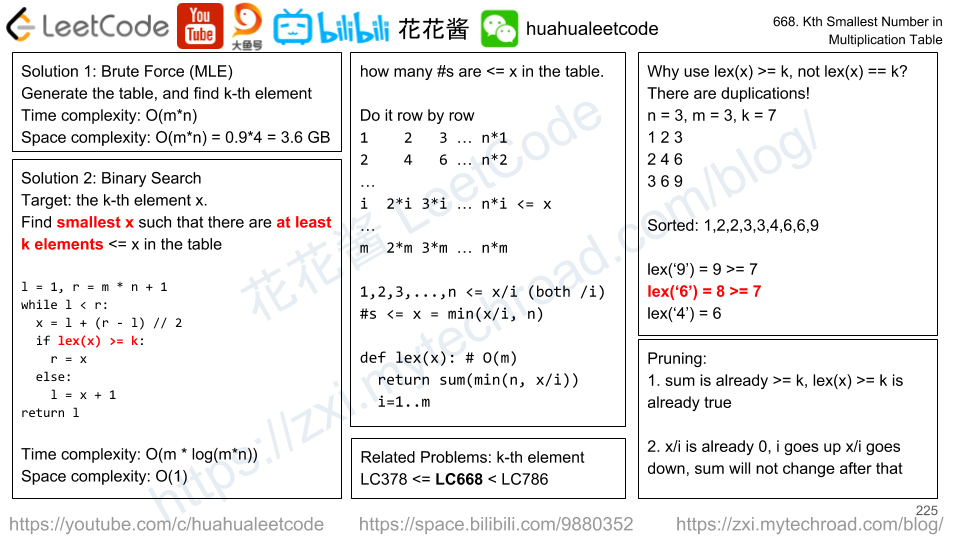
Nearly every one have used the Multiplication Table. But could you find out the k-th smallest number quickly from the multiplication table?
Given the height m and the length n of a m * n Multiplication Table, and a positive integer k, you need to return the k-th smallest number in this table.
Example 1:
Input: m = 3, n = 3, k = 5
Output:Explanation:
The Multiplication Table:
1 2 3
2 4 6
3 6 9
The 5-th smallest number is 3 (1, 2, 2, 3, 3).
Example 2:
Input: m = 2, n = 3, k = 6
Output:Explanation:
The Multiplication Table:
1 2 3
2 4 6
The 6-th smallest number is 6 (1, 2, 2, 3, 4, 6).
Note:
The m and n will be in the range [1, 30000].
The k will be in the range [1, m * n]
Solution 1: Nth element (MLE)
Time complexity: O(mn)
Space complexity: O(mn)
C++
1
2
3
4
5
6
7
8
9
10
11
12
13
// 59 / 69 test cases passed.
classSolution{
public:
intfindKthNumber(intm,intn,intk){
vector<int>s(m*n);
auto it=begin(s);
for(inti=1;i<=m;++i)
for(intj=1;j<=n;++j)
*it++=i*j;
nth_element(begin(s),begin(s)+k-1,end(s));
returns[k-1];
}
};
Solution2 : Binary Search
Find first x such that there are k elements less or equal to x in the table.
Time complexity: O(m*log(m*n))
Space complexity: O(1)
C++
1
2
3
4
5
6
7
8
9
10
11
12
13
14
15
16
17
18
19
20
21
22
23
24
// Author: Huahua, 12 ms
classSolution{
public:
intfindKthNumber(intm,intn,intk){
intl=1;
intr=m*n+1;
while(l<r){
intx=l+(r-l)/2;
if(LEX(m,n,x)>=k)
r=x;
else
l=x+1;
}
returnl;
}
private:
// Returns # of elements in the m*n table that are <= x
intLEX(intm,intn,intx){
intcount=0;
for(inti=1;i<=m;++i)
count+=min(n,x/i);
returncount;
}
};
Java
1
2
3
4
5
6
7
8
9
10
11
12
13
14
15
16
17
18
19
20
21
22
23
// Author: Huahua, 16 ms
classSolution{
publicintfindKthNumber(intm,intn,intk){
intl=1;
intr=m*n+1;
while(l<r){
intx=l+(r-l)/2;
if(LEX(m,n,x)>=k)
r=x;
else
l=x+1;
}
returnl;
}
// Returns # of elements in the m*n table that are <= x