Press "Enter" to skip to content

Posts tagged as “medium”

花花酱 LeetCode 2090. K Radius Subarray Averages

You are given a 0-indexed array nums of n integers, and an integer k.

The k-radius average for a subarray of nums centered at some index i with the radius k is the average of all elements in nums between the indices i - k and i + k (inclusive). If there are less than k elements before or after the index i, then the k-radius average is -1.

Build and return an array avgs of length n where avgs[i] is the k-radius average for the subarray centered at index i.

The average of x elements is the sum of the x elements divided by x, using integer division. The integer division truncates toward zero, which means losing its fractional part.

  • For example, the average of four elements 231, and 5 is (2 + 3 + 1 + 5) / 4 = 11 / 4 = 2.75, which truncates to 2.

Example 1:

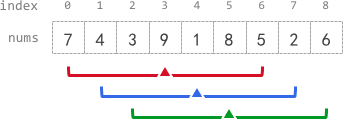
Input: nums = [7,4,3,9,1,8,5,2,6], k = 3
Output: [-1,-1,-1,5,4,4,-1,-1,-1]
Explanation:
- avg[0], avg[1], and avg[2] are -1 because there are less than k elements before each index.
- The sum of the subarray centered at index 3 with radius 3 is: 7 + 4 + 3 + 9 + 1 + 8 + 5 = 37.
  Using integer division, avg[3] = 37 / 7 = 5.
- For the subarray centered at index 4, avg[4] = (4 + 3 + 9 + 1 + 8 + 5 + 2) / 7 = 4.
- For the subarray centered at index 5, avg[5] = (3 + 9 + 1 + 8 + 5 + 2 + 6) / 7 = 4.
- avg[6], avg[7], and avg[8] are -1 because there are less than k elements after each index.

Example 2:

Input: nums = [100000], k = 0
Output: [100000]
Explanation:
- The sum of the subarray centered at index 0 with radius 0 is: 100000.
  avg[0] = 100000 / 1 = 100000.

Example 3:

Input: nums = [8], k = 100000
Output: [-1]
Explanation: 
- avg[0] is -1 because there are less than k elements before and after index 0.

Constraints:

  • n == nums.length
  • 1 <= n <= 105
  • 0 <= nums[i], k <= 105

Solution: Sliding Window

We compute i – k’s average at position i.

Time complexity: O(n)
Space complexity: O(1)

C++

花花酱 LeetCode 137. Single Number II

Given an integer array nums where every element appears three times except for one, which appears exactly onceFind the single element and return it.

You must implement a solution with a linear runtime complexity and use only constant extra space.

Example 1:

Input: nums = [2,2,3,2]
Output: 3

Example 2:

Input: nums = [0,1,0,1,0,1,99]
Output: 99

Constraints:

  • 1 <= nums.length <= 3 * 104
  • -231 <= nums[i] <= 231 - 1
  • Each element in nums appears exactly three times except for one element which appears once.

Solution: Bit by bit

Since every number appears three times, the i-th bit must be a factor of 3, if not, that bit belongs to the single number.

Time complexity: O(32n)
Space complexity: O(1)

C++

Related Problems

花花酱 LeetCode 114. Flatten Binary Tree to Linked List

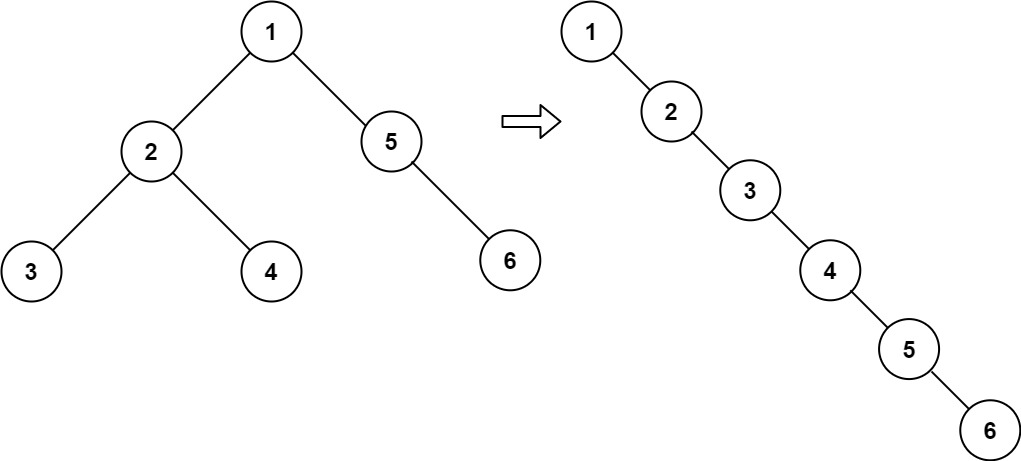
Given the root of a binary tree, flatten the tree into a “linked list”:

  • The “linked list” should use the same TreeNode class where the right child pointer points to the next node in the list and the left child pointer is always null.
  • The “linked list” should be in the same order as a pre-order traversal of the binary tree.

Example 1:

Input: root = [1,2,5,3,4,null,6]
Output: [1,null,2,null,3,null,4,null,5,null,6]

Example 2:

Input: root = []
Output: []

Example 3:

Input: root = [0]
Output: [0]

Constraints:

  • The number of nodes in the tree is in the range [0, 2000].
  • -100 <= Node.val <= 100

Follow up: Can you flatten the tree in-place (with O(1) extra space)?

Solution 1: Recursion

Time complexity: O(n)
Space complexity: O(|height|)

Python3

Solution 2: Unfolding

Time complexity: O(n)
Space complexity: O(1)

Python3

花花酱 LeetCode 109. Convert Sorted List to Binary Search Tree

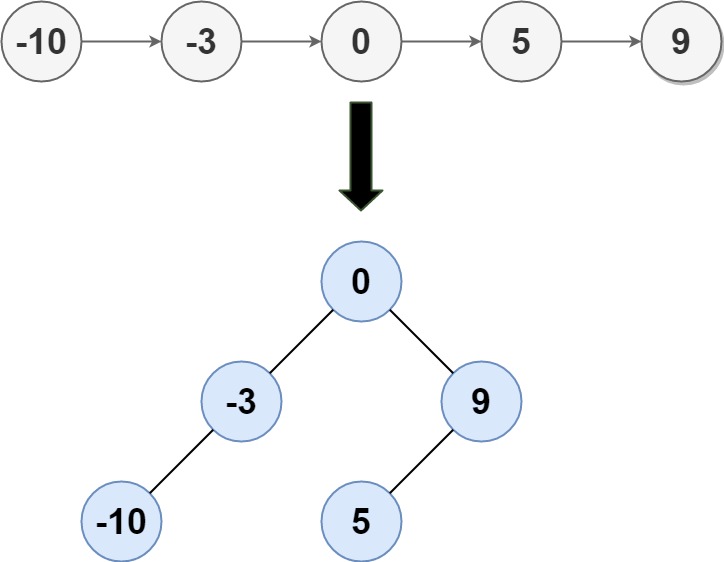
Given the head of a singly linked list where elements are sorted in ascending order, convert it to a height balanced BST.

For this problem, a height-balanced binary tree is defined as a binary tree in which the depth of the two subtrees of every node never differ by more than 1.

Example 1:

Input: head = [-10,-3,0,5,9]
Output: [0,-3,9,-10,null,5]
Explanation: One possible answer is [0,-3,9,-10,null,5], which represents the shown height balanced BST.

Example 2:

Input: head = []
Output: []

Example 3:

Input: head = [0]
Output: [0]

Example 4:

Input: head = [1,3]
Output: [3,1]

Constraints:

  • The number of nodes in head is in the range [0, 2 * 104].
  • -105 <= Node.val <= 105

Solution 1: Recursion w/ Fast + Slow Pointers

For each sublist, use fast/slow pointers to find the mid and build the tree.

Time complexity: O(nlogn)
Space complexity: O(logn)

C++

花花酱 LeetCode 2086. Minimum Number of Buckets Required to Collect Rainwater from Houses

You are given a 0-indexed string street. Each character in street is either 'H' representing a house or '.' representing an empty space.

You can place buckets on the empty spaces to collect rainwater that falls from the adjacent houses. The rainwater from a house at index i is collected if a bucket is placed at index i - 1 and/or index i + 1. A single bucket, if placed adjacent to two houses, can collect the rainwater from both houses.

Return the minimum number of buckets needed so that for every house, there is at least one bucket collecting rainwater from it, or -1 if it is impossible.

Example 1:

Input: street = "H..H"
Output: 2
Explanation:
We can put buckets at index 1 and index 2.
"H..H" -> "HBBH" ('B' denotes where a bucket is placed).
The house at index 0 has a bucket to its right, and the house at index 3 has a bucket to its left.
Thus, for every house, there is at least one bucket collecting rainwater from it.

Example 2:

Input: street = ".H.H."
Output: 1
Explanation:
We can put a bucket at index 2.
".H.H." -> ".HBH." ('B' denotes where a bucket is placed).
The house at index 1 has a bucket to its right, and the house at index 3 has a bucket to its left.
Thus, for every house, there is at least one bucket collecting rainwater from it.

Example 3:

Input: street = ".HHH."
Output: -1
Explanation:
There is no empty space to place a bucket to collect the rainwater from the house at index 2.
Thus, it is impossible to collect the rainwater from all the houses.

Example 4:

Input: street = "H"
Output: -1
Explanation:
There is no empty space to place a bucket.
Thus, it is impossible to collect the rainwater from the house.

Example 5:

Constraints:

  • 1 <= street.length <= 105
  • street[i] is either'H' or '.'.

Solution: Greedy

Try to put a bucket after a house if possible, otherwise put it before the house, or impossible.

Time complexity: O(n)
Space complexity: O(1)

C++