现代手机上的 SDR 已经不是传统意义上的 100 nits SDR 了。很多 OLED 手机、平板和 XDR 屏幕在播放普通 SDR 内容时,也能把白场或高亮 UI 推到几百甚至 1000 nits。也就是说,一个 Rec.709 视频虽然技术上仍是 SDR,但它在真实观看环境里的亮度,早就和“100 nits 参考监视器”相差很远。这个变化会直接影响我们怎么曝光 N-Log。
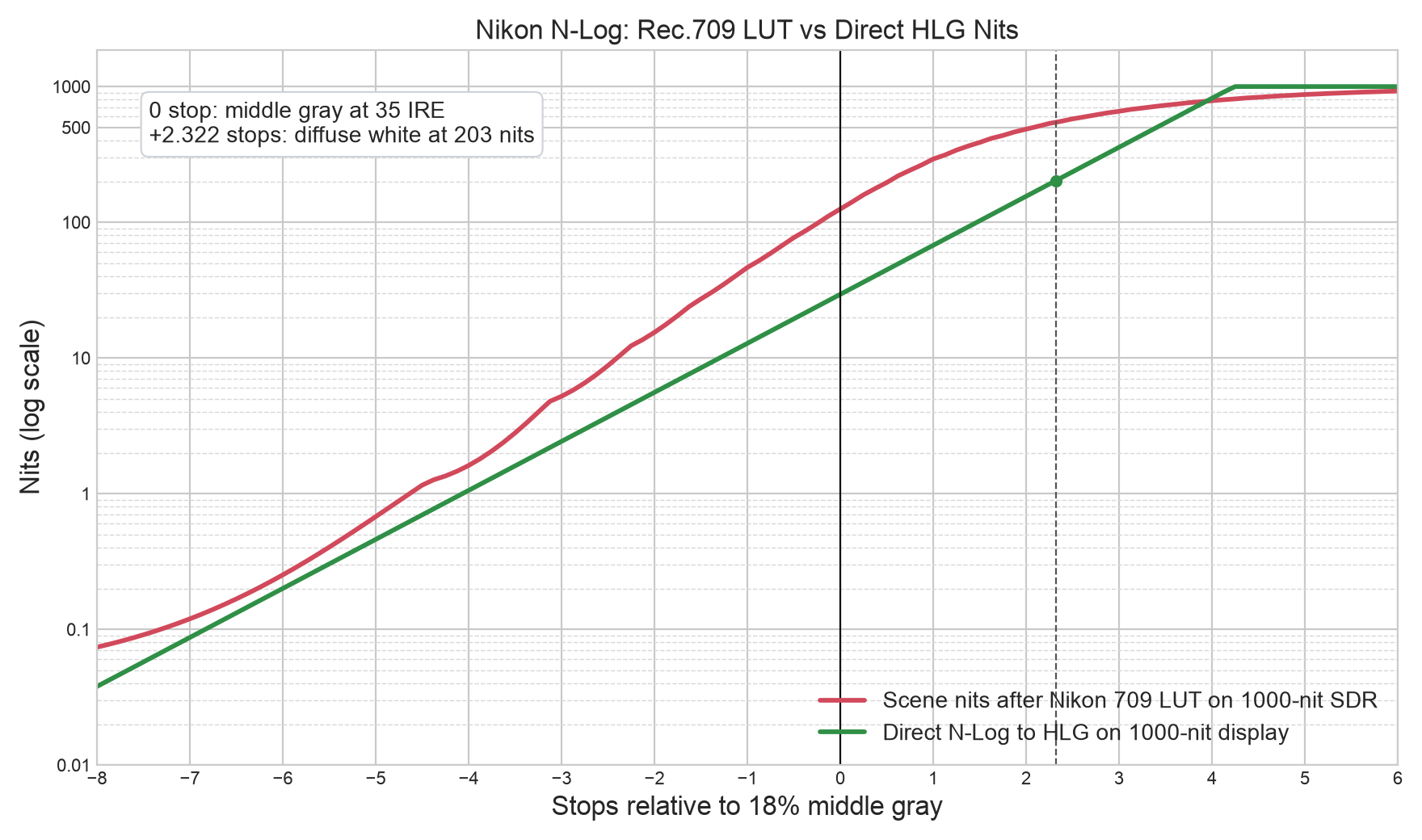
我用 Nikon 官方 N-Log 到 Rec.709/BT.1886 LUT 做了一组计算,并和一个不经过 LUT 的 HLG 技术转换比较。两边都假设显示器峰值是 1000 nits;拍摄端假设中灰曝光到 35 IRE,HLG 漫射白锚定到 203 nits。
结果很说明问题。中灰 0 stop 时,N-Log 经过 Rec.709 LUT 后是 42.07 IRE,在 1000 nits SDR 显示模型下约为 125 nits;同一个输入做 direct HLG 只有约 29 nits。也就是说,Rec.709 版本的中灰比 HLG 亮大约 2.09 stops。再看 -2 stops 的暗部,Rec.709 是 15.4 nits,HLG 是 5.6 nits,前者仍然亮约 1.47 stops。
| Stops | N-Log IRE | Rec.709 SDR nits | Direct HLG nits | Rec.709 vs HLG |
|---|---|---|---|---|
| -4 | 16.49 | 1.6 | 1.1 | +0.61 stops |
| -2 | 23.00 | 15.4 | 5.6 | +1.47 stops |
| 0 | 35.00 | 125.2 | 29.4 | +2.09 stops |
| +2.32 | 57.20 | 545.5 | 203.0 | +1.43 stops |
| +4 | 74.26 | 786.7 | 819.7 | -0.06 stops |
| +5 | 84.42 | 874.2 | 1000.0 | -0.19 stops |
这就是为什么 N-Log 还原到 709 后,暗部噪点经常显得特别多。噪点不是 LUT “凭空制造”的,而是拍摄时落在低码值、低信噪比区域里的暗部信息,被 Rec.709 tone curve 和现代高亮 SDR 屏幕一起抬到了很容易看见的位置。以前 100 nits SDR 时代,暗部可能藏在几 nit 里;现在它可能被显示到十几、几十 nit,观众自然更容易看到脏、浮、彩噪和压缩痕迹。
所以如果最终目标是 Rec.709 SDR,尤其是给手机、OLED 电视、XDR 屏幕观看,N-Log 往往更需要 ETTR。ETTR 的目的不是让成片更亮,而是在不剪掉重要高光的前提下,把主体、中间调和暗部尽量放到更高、更干净的编码区域。后期再用 LUT 或调色压回正常亮度时,噪声不会被放大得那么难看。
HDR/HLG 的逻辑不一样。HLG 技术转换会把中灰放得更低,给高光保留空间。表格里 +2.32 stops 的漫射白是 203 nits,到了 +4 stops,HLG 已经约 820 nits,而 Rec.709 SDR 约 787 nits;+5 和 +6 stops 时 HLG 直接到 1000 nits,Rec.709 则被压在 874 和 927 nits 附近。HDR 的价值就在这里:不是把整张画面抬亮,而是保留真实光比,让亮的东西真的亮。
因此,做 HDR 时盲目 ETTR 反而可能有害。你把 N-Log 整体往右推,确实能让暗部更干净,但也更容易把天空、灯光、反射和皮肤高光推到 HLG 顶部,失去 HDR 最珍贵的高光层次。HDR 交付更应该优先保护高光、保持自然中灰,而不是单纯追求波形图“用满”。
一句话总结:Rec.709 SDR 在现代 1000 nits 屏幕上会把 N-Log 的暗部和中间调显示得很亮,所以更需要 ETTR 来换信噪比;HDR/HLG 则把中灰放低、把空间留给高光,所以不一定需要激进 ETTR,除非场景本身没有重要高光可失去。
Why N-Log Needs More ETTR for Rec.709, but Not Necessarily for HDR/HLG
Modern phone SDR is no longer the old 100-nit SDR we used to imagine. Many OLED phones, tablets, and XDR displays can show ordinary SDR content at several hundred nits, sometimes close to 1000 nits. So even if a video is technically Rec.709 SDR, its real viewing brightness can be far beyond the traditional 100-nit reference. That changes how we should expose N-Log.
I compared Nikon’s official N-Log to Rec.709/BT.1886 LUT against a direct technical HLG conversion. Both are viewed on a 1000-nit display. The exposure assumption is middle gray at 35 IRE, with HLG diffuse white anchored at 203 nits.
The numbers are revealing. At 0 stop middle gray, the Nikon Rec.709 LUT outputs 42.07 IRE, which becomes about 125 nits on a 1000-nit SDR display model. The direct HLG conversion for the same input is only about 29 nits. Rec.709 middle gray is therefore about 2.09 stops brighter than HLG. At -2 stops, Rec.709 is about 15.4 nits, while HLG is about 5.6 nits, still a 1.47-stop lift.
This is why N-Log can look noisy after being restored to Rec.709. The LUT is not magically creating noise. It is taking shadow information that was recorded in low-code-value, low-SNR regions and lifting it into a much more visible display range. In the old 100-nit SDR world, those shadows might have stayed hidden at only a few nits. On a modern bright SDR screen, they may sit at tens of nits, where noise, chroma crawl, and compression artifacts become obvious.
So for a Rec.709 SDR delivery, especially for phones, OLED TVs, and XDR displays, N-Log often benefits from ETTR. The goal is not to make the final image brighter. The goal is to record the subject, midtones, and shadows in cleaner code values without clipping important highlights. Then, when the image is brought back down in grading, the noise floor is not amplified as aggressively.
HDR/HLG works differently. A technical HLG conversion keeps middle gray lower and saves room for highlights. In the table, diffuse white at +2.32 stops is 203 nits. By +4 stops, HLG reaches about 820 nits while Rec.709 SDR is about 787 nits. At +5 and +6 stops, HLG hits 1000 nits, while Rec.709 is compressed around 874 and 927 nits. That is the point of HDR: not making everything bright, but preserving scene contrast so bright things can actually be bright.
This is why aggressive ETTR can be counterproductive for HDR. It may clean up shadows, but it also pushes skies, lamps, reflections, and skin highlights closer to the top of the HLG range, where highlight separation can be lost. For HDR delivery, the priority is often highlight protection and natural midtone placement, not simply filling the waveform.
In short: modern 1000-nit SDR makes Rec.709 N-Log shadows and midtones very visible, so ETTR is often valuable for noise control. HDR/HLG keeps middle gray lower and reserves headroom for highlights, so it does not always need aggressive ETTR unless the scene has no important highlights to protect.


