Find the largest 3^x that <= n, subtract that from n and repeat the process. x should be monotonically decreasing, otherwise we have duplicate terms. e.g. 12 = 32 + 31 true e.g. 21 = 32 + 32+ 31 false
You are given two integers, x and y, which represent your current location on a Cartesian grid: (x, y). You are also given an array points where each points[i] = [ai, bi] represents that a point exists at (ai, bi). A point is valid if it shares the same x-coordinate or the same y-coordinate as your location.
Return the index (0-indexed) of the valid point with the smallest Manhattan distance from your current location. If there are multiple, return the valid point with the smallest index. If there are no valid points, return -1.
The Manhattan distance between two points (x1, y1) and (x2, y2) is abs(x1 - x2) + abs(y1 - y2).
Example 1:
Input: x = 3, y = 4, points = [[1,2],[3,1],[2,4],[2,3],[4,4]]
Output: 2
Explanation: Of all the points, only [3,1], [2,4] and [4,4] are valid. Of the valid points, [2,4] and [4,4] have the smallest Manhattan distance from your current location, with a distance of 1. [2,4] has the smallest index, so return 2.
Example 2:
Input: x = 3, y = 4, points = [[3,4]]
Output: 0
Explanation: The answer is allowed to be on the same location as your current location.
Example 3:
Input: x = 3, y = 4, points = [[2,3]]
Output: -1
Explanation: There are no valid points.
There are n cars traveling at different speeds in the same direction along a one-lane road. You are given an array cars of length n, where cars[i] = [positioni, speedi] represents:
positioni is the distance between the ith car and the beginning of the road in meters. It is guaranteed that positioni < positioni+1.
speedi is the initial speed of the ith car in meters per second.
For simplicity, cars can be considered as points moving along the number line. Two cars collide when they occupy the same position. Once a car collides with another car, they unite and form a single car fleet. The cars in the formed fleet will have the same position and the same speed, which is the initial speed of the slowest car in the fleet.
Return an array answer, where answer[i] is the time, in seconds, at which the ith car collides with the next car, or -1 if the car does not collide with the next car. Answers within 10-5 of the actual answers are accepted.
Example 1:
Input: cars = [[1,2],[2,1],[4,3],[7,2]]
Output: [1.00000,-1.00000,3.00000,-1.00000]
Explanation: After exactly one second, the first car will collide with the second car, and form a car fleet with speed 1 m/s. After exactly 3 seconds, the third car will collide with the fourth car, and form a car fleet with speed 2 m/s.
Key observation: If my speed is slower than the speed of the previous car, not only mine but also all cars behind me will NEVER be able to catch/collide with the previous car. Such that we can throw it away.
Maintain a stack that stores the indices of cars with increasing speed.
Process car from right to left, for each car, pop the stack (throw the fastest car away) if any of the following conditions hold. 1) speed <= stack.top().speed 2) There are more than one car before me and it takes more than to collide the fastest car than time the fastest took to collide.
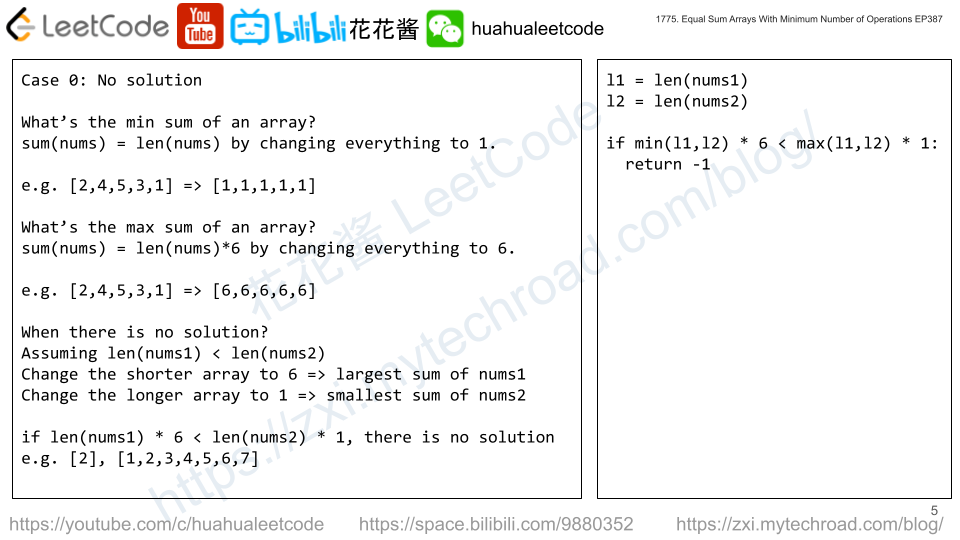
You are given two arrays of integers nums1 and nums2, possibly of different lengths. The values in the arrays are between 1 and 6, inclusive.
In one operation, you can change any integer’s value in any of the arrays to any value between 1 and 6, inclusive.
Return the minimum number of operations required to make the sum of values in nums1 equal to the sum of values in nums2. Return -1 if it is not possible to make the sum of the two arrays equal.
Example 1:
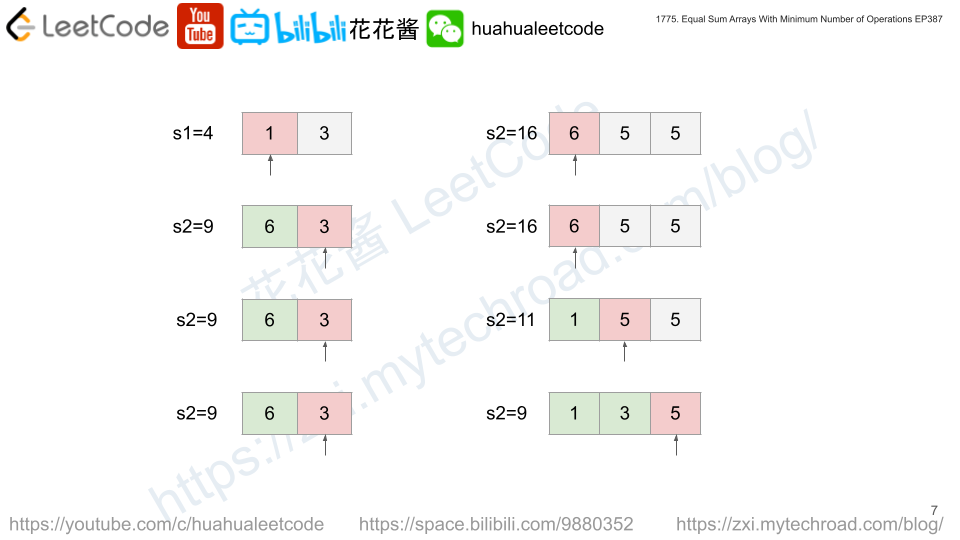
Input: nums1 = [1,2,3,4,5,6], nums2 = [1,1,2,2,2,2]
Output: 3
Explanation: You can make the sums of nums1 and nums2 equal with 3 operations. All indices are 0-indexed.
- Change nums2[0] to 6. nums1 = [1,2,3,4,5,6], nums2 = [6,1,2,2,2,2].
- Change nums1[5] to 1. nums1 = [1,2,3,4,5,1], nums2 = [6,1,2,2,2,2].
- Change nums1[2] to 2. nums1 = [1,2,2,4,5,1], nums2 = [6,1,2,2,2,2].
Example 2:
Input: nums1 = [1,1,1,1,1,1,1], nums2 = [6]
Output: -1
Explanation: There is no way to decrease the sum of nums1 or to increase the sum of nums2 to make them equal.
Example 3:
Input: nums1 = [6,6], nums2 = [1]
Output: 3
Explanation: You can make the sums of nums1 and nums2 equal with 3 operations. All indices are 0-indexed.
- Change nums1[0] to 2. nums1 = [2,6], nums2 = [1].
- Change nums1[1] to 2. nums1 = [2,2], nums2 = [1].
- Change nums2[0] to 4. nums1 = [2,2], nums2 = [4].
Constraints:
1 <= nums1.length, nums2.length <= 105
1 <= nums1[i], nums2[i] <= 6
Solution: Greedy
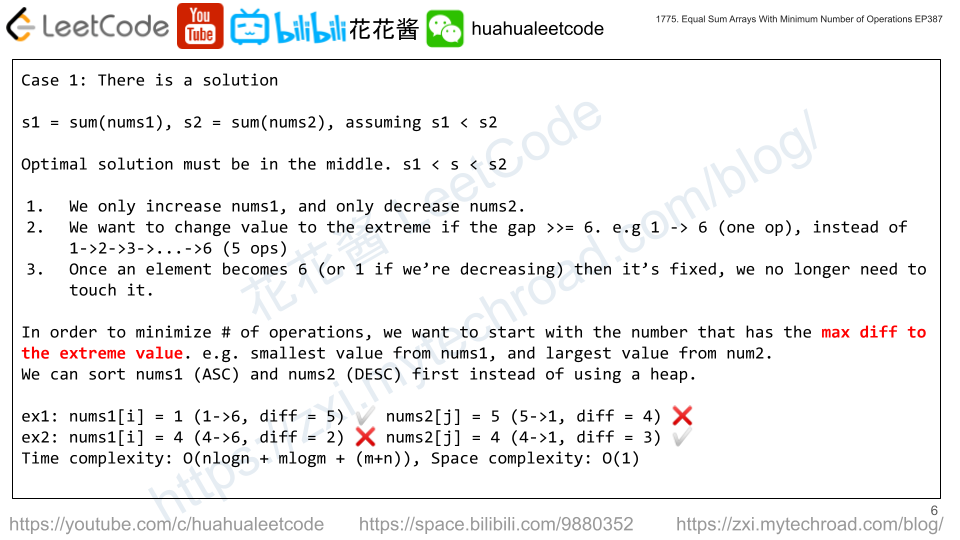
Assuming sum(nums1) < sum(nums2), sort both arrays * scan nums1 from left to right, we need to increase the value form the smallest one. * scan nums2 from right to left, we need to decrease the value from the largest one. Each time, select the one with the largest delta to change.
e.g. nums1[i] = 2, nums[j] = 4, delta1 = 6 – 2 = 4, delta2 = 4 – 1 = 3, Increase 2 to 6 instead of decreasing 4 to 1.
Time complexity: O(mlogm + nlogn) Space complexity: O(1)