Press "Enter" to skip to content

Huahua's Tech Road

花花酱 LeetCode 1686. Stone Game VI

Alice and Bob take turns playing a game, with Alice starting first.

There are n stones in a pile. On each player’s turn, they can remove a stone from the pile and receive points based on the stone’s value. Alice and Bob may value the stones differently.

You are given two integer arrays of length naliceValues and bobValues. Each aliceValues[i] and bobValues[i] represents how Alice and Bob, respectively, value the ith stone.

The winner is the person with the most points after all the stones are chosen. If both players have the same amount of points, the game results in a draw. Both players will play optimally.

Determine the result of the game, and:

  • If Alice wins, return 1.
  • If Bob wins, return -1.
  • If the game results in a draw, return 0.

Example 1:

Input: aliceValues = [1,3], bobValues = [2,1]
Output: 1
Explanation:
If Alice takes stone 1 (0-indexed) first, Alice will receive 3 points.
Bob can only choose stone 0, and will only receive 2 points.
Alice wins.

Example 2:

Input: aliceValues = [1,2], bobValues = [3,1]
Output: 0
Explanation:
If Alice takes stone 0, and Bob takes stone 1, they will both have 1 point.
Draw.

Example 3:

Input: aliceValues = [2,4,3], bobValues = [1,6,7]
Output: -1
Explanation:
Regardless of how Alice plays, Bob will be able to have more points than Alice.
For example, if Alice takes stone 1, Bob can take stone 2, and Alice takes stone 0, Alice will have 6 points to Bob's 7.
Bob wins.

Constraints:

  • n == aliceValues.length == bobValues.length
  • 1 <= n <= 105
  • 1 <= aliceValues[i], bobValues[i] <= 100

Solution: Greedy

Sort by the sum of stone values.

Time complexity: O(nlogn)
Space complexity: O(n)

C++

花花酱 LeetCode 1685. Sum of Absolute Differences in a Sorted Array

You are given an integer array nums sorted in non-decreasing order.

Build and return an integer array result with the same length as nums such that result[i] is equal to the summation of absolute differences between nums[i] and all the other elements in the array.

In other words, result[i] is equal to sum(|nums[i]-nums[j]|) where 0 <= j < nums.length and j != i (0-indexed).

Example 1:

Input: nums = [2,3,5]
Output: [4,3,5]
Explanation: Assuming the arrays are 0-indexed, then
result[0] = |2-2| + |2-3| + |2-5| = 0 + 1 + 3 = 4,
result[1] = |3-2| + |3-3| + |3-5| = 1 + 0 + 2 = 3,
result[2] = |5-2| + |5-3| + |5-5| = 3 + 2 + 0 = 5.

Example 2:

Input: nums = [1,4,6,8,10]
Output: [24,15,13,15,21]

Constraints:

  • 2 <= nums.length <= 105
  • 1 <= nums[i] <= nums[i + 1] <= 104

Solution: Prefix Sum

Let s[i] denote sum(num[i] – num[j]) 0 <= j <= i
s[i] = s[i – 1] + (num[i] – num[i – 1]) * i
Let l[i] denote sum(nums[j] – nums[i]) i <= j < n
l[i] = l[i + 1] + (nums[i + 1] – num[i]) * (n – i – 1)
ans[i] = s[i] + l[i]

e.g. 1, 3, 7, 9
s[0] = 0
s[1] = 0 + (3 – 1) * 1 = 2
s[2] = 2 + (7 – 3) * 2 = 10
s[3] = 10 + (9 – 7) * 3 = 16
l[3] = 0
l[2] = 0 + (9 – 7) * 1 = 2
l[1] = 2 + (7 – 3) * 2 = 10
l[0] = 10 + (3 – 1) * 3 = 16

ans = [16, 12, 12, 16]

Time complexity: O(n)
Space complexity: O(n)

C++

花花酱 LeetCode 1684. Count the Number of Consistent Strings

You are given a string allowed consisting of distinct characters and an array of strings words. A string is consistent if all characters in the string appear in the string allowed.

Return the number of consistent strings in the array words.

Example 1:

Input: allowed = "ab", words = ["ad","bd","aaab","baa","badab"]
Output: 2
Explanation: Strings "aaab" and "baa" are consistent since they only contain characters 'a' and 'b'.

Example 2:

Input: allowed = "abc", words = ["a","b","c","ab","ac","bc","abc"]
Output: 7
Explanation: All strings are consistent.

Example 3:

Input: allowed = "cad", words = ["cc","acd","b","ba","bac","bad","ac","d"]
Output: 4
Explanation: Strings "cc", "acd", "ac", and "d" are consistent.

Constraints:

  • 1 <= words.length <= 104
  • 1 <= allowed.length <=26
  • 1 <= words[i].length <= 10
  • The characters in allowed are distinct.
  • words[i] and allowed contain only lowercase English letters.

Solution: Hashtable

Time complexity: O(sum(len(word))
Space complexity: O(1)

C++

Python3

花花酱 LeetCode 1681. Minimum Incompatibility

You are given an integer array nums​​​ and an integer k. You are asked to distribute this array into k subsets of equal size such that there are no two equal elements in the same subset.

A subset’s incompatibility is the difference between the maximum and minimum elements in that array.

Return the minimum possible sum of incompatibilities of the k subsets after distributing the array optimally, or return -1 if it is not possible.

A subset is a group integers that appear in the array with no particular order.

Example 1:

Input: nums = [1,2,1,4], k = 2
Output: 4
Explanation: The optimal distribution of subsets is [1,2] and [1,4].
The incompatibility is (2-1) + (4-1) = 4.
Note that [1,1] and [2,4] would result in a smaller sum, but the first subset contains 2 equal elements.

Example 2:

Input: nums = [6,3,8,1,3,1,2,2], k = 4
Output: 6
Explanation: The optimal distribution of subsets is [1,2], [2,3], [6,8], and [1,3].
The incompatibility is (2-1) + (3-2) + (8-6) + (3-1) = 6.

Example 3:

Input: nums = [5,3,3,6,3,3], k = 3
Output: -1
Explanation: It is impossible to distribute nums into 3 subsets where no two elements are equal in the same subset.

Constraints:

  • 1 <= k <= nums.length <= 16
  • nums.length is divisible by k
  • 1 <= nums[i] <= nums.length

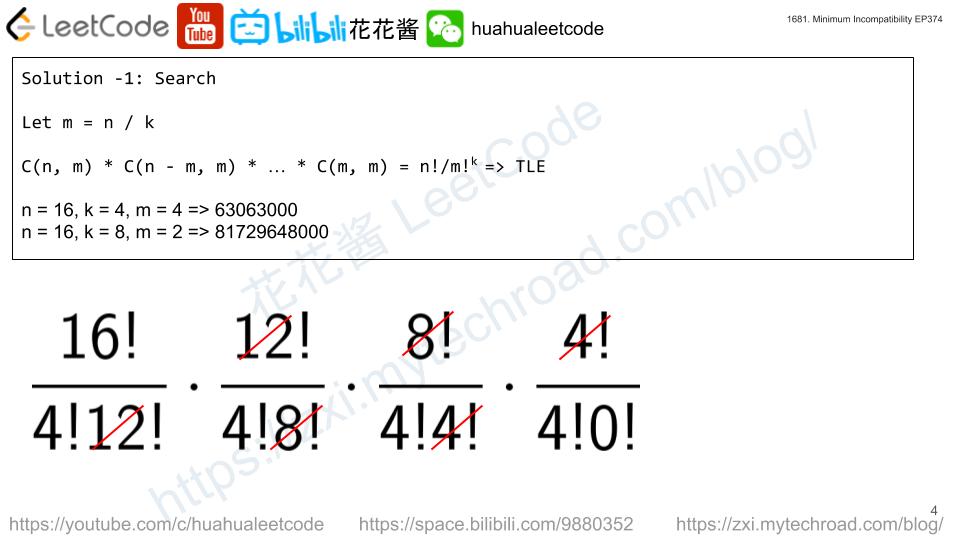
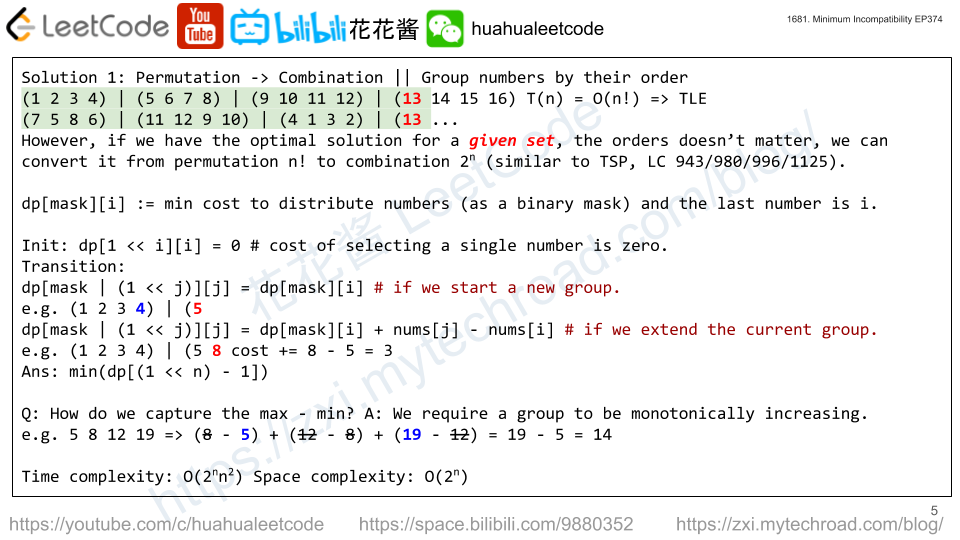
Solution: TSP

dp[s][i] := min cost to distribute a set of numbers represented as a binary mask s, the last number in the set is the i-th number.

Init:
1.dp[*][*] = inf
2. dp[1 <<i][i] = 0, cost of selecting a single number is zero.

Transition:
1. dp[s | (1 << j)][j] = dp[s][i] if s % (n / k) == 0, we start a new group, no extra cost.
2. dp[s | (1 << j)][j] = dp[s][i] + nums[j] – nums[i] if nums[j] > nums[i]. In the same group, we require the selected numbers are monotonically increasing. Each cost is nums[j] – nums[i].
e.g. 1, 3, 7, 20, cost is (3 – 1) + (7 – 3) + (20 – 7) = 20 – 1 = 19.

Ans: min(dp[(1 << n) – 1])

Time complexity: O(2^n * n^2)
Space complexity: O(2^n * n)

C++

花花酱 LeetCode 1680. Concatenation of Consecutive Binary Numbers

Given an integer n, return the decimal value of the binary string formed by concatenating the binary representations of 1 to n in order, modulo 10+ 7.

Example 1:

Input: n = 1
Output: 1
Explanation: "1" in binary corresponds to the decimal value 1. 

Example 2:

Input: n = 3
Output: 27
Explanation: In binary, 1, 2, and 3 corresponds to "1", "10", and "11".
After concatenating them, we have "11011", which corresponds to the decimal value 27.

Example 3:

Input: n = 12
Output: 505379714
Explanation: The concatenation results in "1101110010111011110001001101010111100".
The decimal value of that is 118505380540.
After modulo 109 + 7, the result is 505379714.

Constraints:

  • 1 <= n <= 105

Solution: Bit Operation

f(n) = (f(n – 1) << length(n)) | n

length(n) increase by 1 whenever n is power of 2.
n = 1, YES, len = 1
n = 2, YES, len = 2
n = 3, NO, len = 2
n = 4, YES, len = 3
n = 5, NO, len = 3
n = 6, NO, len = 3
n = 7, NO, len = 3
n = 8, YES, len = 4

Time complexity: O(n)
Space complexity: O(1)

C++