Press "Enter" to skip to content

Huahua's Tech Road

花花酱 1095. Find in Mountain Array – EP369

(This problem is an interactive problem.)

You may recall that an array A is a mountain array if and only if:

  • A.length >= 3
  • There exists some i with 0 < i < A.length - 1 such that:
    • A[0] < A[1] < ... A[i-1] < A[i]
    • A[i] > A[i+1] > ... > A[A.length - 1]

Given a mountain array mountainArr, return the minimum index such that mountainArr.get(index) == target.  If such an index doesn’t exist, return -1.

You can’t access the mountain array directly.  You may only access the array using a MountainArray interface:

  • MountainArray.get(k) returns the element of the array at index k (0-indexed).
  • MountainArray.length() returns the length of the array.

Submissions making more than 100 calls to MountainArray.get will be judged Wrong Answer.  Also, any solutions that attempt to circumvent the judge will result in disqualification.

Example 1:

Input: array = [1,2,3,4,5,3,1], target = 3
Output: 2
Explanation: 3 exists in the array, at index=2 and index=5. Return the minimum index, which is 2.

Example 2:

Input: array = [0,1,2,4,2,1], target = 3
Output: -1
Explanation: 3 does not exist in the array, so we return -1.

Constraints:

  • 3 <= mountain_arr.length() <= 10000
  • 0 <= target <= 10^9
  • 0 <= mountain_arr.get(index) <= 10^9

Solution: Binary Search
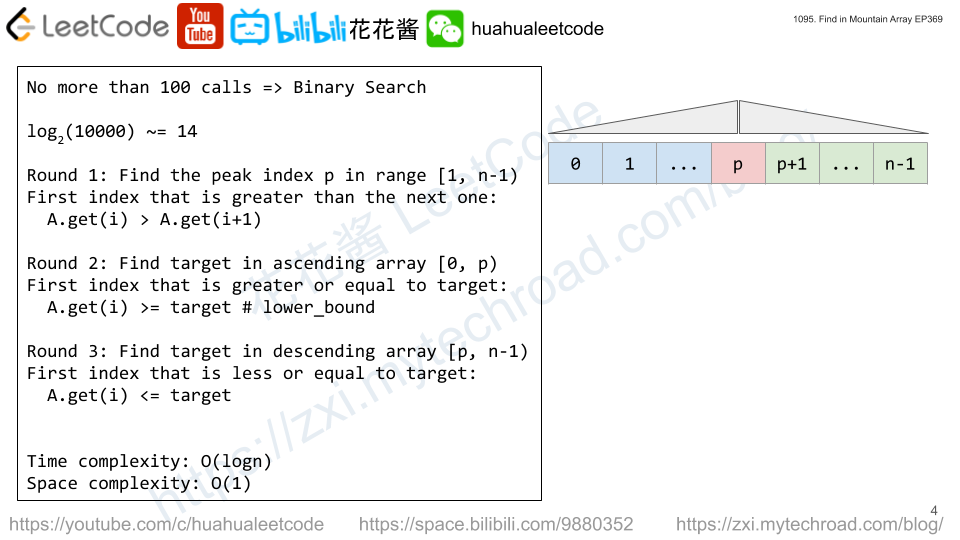
  1. Find the peak index of the mountain array using binary search.
  2. Perform two binary searches in two sorted subarrays (ascending one and descending one)

Time complexity: O(logn)
Space complexity: O(1)

C++

python3

花花酱 LeetCode 1649. Create Sorted Array through Instructions

Given an integer array instructions, you are asked to create a sorted array from the elements in instructions. You start with an empty container nums. For each element from left to right in instructions, insert it into nums. The cost of each insertion is the minimum of the following:

  • The number of elements currently in nums that are strictly less than instructions[i].
  • The number of elements currently in nums that are strictly greater than instructions[i].

For example, if inserting element 3 into nums = [1,2,3,5], the cost of insertion is min(2, 1) (elements 1 and 2 are less than 3, element 5 is greater than 3) and nums will become [1,2,3,3,5].

Return the total cost to insert all elements from instructions into nums. Since the answer may be large, return it modulo 109 + 7

Example 1:

Input: instructions = [1,5,6,2]
Output: 1
Explanation: Begin with nums = [].
Insert 1 with cost min(0, 0) = 0, now nums = [1].
Insert 5 with cost min(1, 0) = 0, now nums = [1,5].
Insert 6 with cost min(2, 0) = 0, now nums = [1,5,6].
Insert 2 with cost min(1, 2) = 1, now nums = [1,2,5,6].
The total cost is 0 + 0 + 0 + 1 = 1.

Example 2:

Input: instructions = [1,2,3,6,5,4]
Output: 3
Explanation: Begin with nums = [].
Insert 1 with cost min(0, 0) = 0, now nums = [1].
Insert 2 with cost min(1, 0) = 0, now nums = [1,2].
Insert 3 with cost min(2, 0) = 0, now nums = [1,2,3].
Insert 6 with cost min(3, 0) = 0, now nums = [1,2,3,6].
Insert 5 with cost min(3, 1) = 1, now nums = [1,2,3,5,6].
Insert 4 with cost min(3, 2) = 2, now nums = [1,2,3,4,5,6].
The total cost is 0 + 0 + 0 + 0 + 1 + 2 = 3.

Example 3:

Input: instructions = [1,3,3,3,2,4,2,1,2]
Output: 4
Explanation: Begin with nums = [].
Insert 1 with cost min(0, 0) = 0, now nums = [1].
Insert 3 with cost min(1, 0) = 0, now nums = [1,3].
Insert 3 with cost min(1, 0) = 0, now nums = [1,3,3].
Insert 3 with cost min(1, 0) = 0, now nums = [1,3,3,3].
Insert 2 with cost min(1, 3) = 1, now nums = [1,2,3,3,3].
Insert 4 with cost min(5, 0) = 0, now nums = [1,2,3,3,3,4].
​​​​​​​Insert 2 with cost min(1, 4) = 1, now nums = [1,2,2,3,3,3,4].
​​​​​​​Insert 1 with cost min(0, 6) = 0, now nums = [1,1,2,2,3,3,3,4].
​​​​​​​Insert 2 with cost min(2, 4) = 2, now nums = [1,1,2,2,2,3,3,3,4].
The total cost is 0 + 0 + 0 + 0 + 1 + 0 + 1 + 0 + 2 = 4.

Constraints:

  • 1 <= instructions.length <= 105
  • 1 <= instructions[i] <= 105

Solution: Fenwick Tree / Binary Indexed Tree

Time complexity: O(nlogm)
Space complexity: O(m + n)

m is the maximum value, n is number of values.

C++

花花酱 LeetCode 1648. Sell Diminishing-Valued Colored Balls

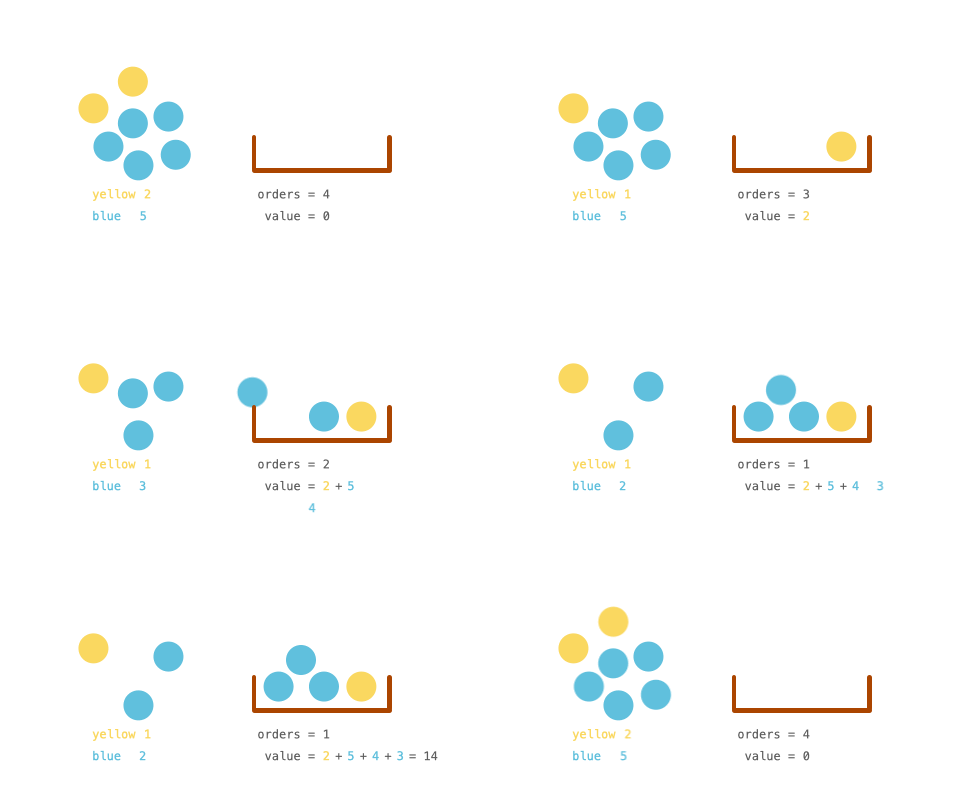
You have an inventory of different colored balls, and there is a customer that wants orders balls of any color.

The customer weirdly values the colored balls. Each colored ball’s value is the number of balls of that color you currently have in your inventory. For example, if you own 6 yellow balls, the customer would pay 6 for the first yellow ball. After the transaction, there are only 5 yellow balls left, so the next yellow ball is then valued at 5 (i.e., the value of the balls decreases as you sell more to the customer).

You are given an integer array, inventory, where inventory[i] represents the number of balls of the ith color that you initially own. You are also given an integer orders, which represents the total number of balls that the customer wants. You can sell the balls in any order.

Return the maximum total value that you can attain after selling orders colored balls. As the answer may be too large, return it modulo 10+ 7.

Example 1:

Input: inventory = [2,5], orders = 4
Output: 14
Explanation: Sell the 1st color 1 time (2) and the 2nd color 3 times (5 + 4 + 3).
The maximum total value is 2 + 5 + 4 + 3 = 14.

Example 2:

Input: inventory = [3,5], orders = 6
Output: 19
Explanation: Sell the 1st color 2 times (3 + 2) and the 2nd color 4 times (5 + 4 + 3 + 2).
The maximum total value is 3 + 2 + 5 + 4 + 3 + 2 = 19.

Example 3:

Input: inventory = [2,8,4,10,6], orders = 20
Output: 110

Example 4:

Input: inventory = [1000000000], orders = 1000000000
Output: 21
Explanation: Sell the 1st color 1000000000 times for a total value of 500000000500000000. 500000000500000000 modulo 109 + 7 = 21.

Constraints:

  • 1 <= inventory.length <= 105
  • 1 <= inventory[i] <= 109
  • 1 <= orders <= min(sum(inventory[i]), 109)

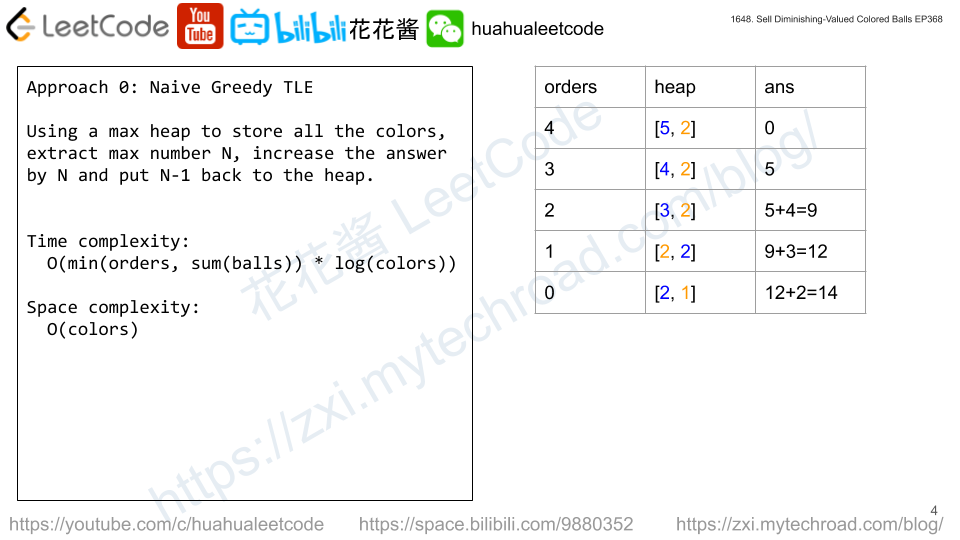
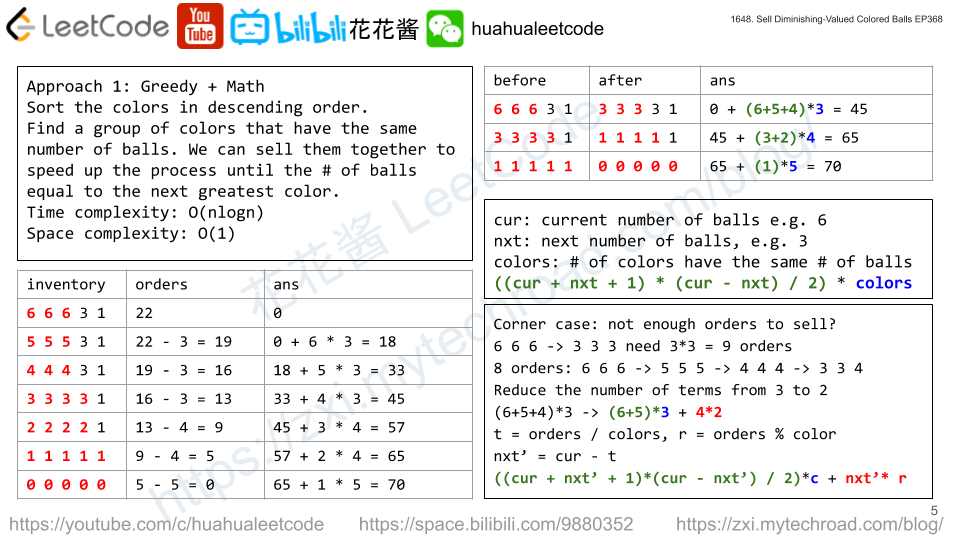
Solution: Greedy

  1. Sort the colors by # of balls in descending order.
    e.g. 3 7 5 1 => 7 5 3 1
  2. Sell the color with largest number of balls until it has the same number of balls of next color
    1. 7 5 3 1 => 6 5 3 1 => 5 5 3 1 # value = 7 + 6 = 13
    2. 5 5 3 1 => 4 4 3 1 => 3 3 3 1 # value = 13 + (5 + 4) * 2 = 31
    3. 3 3 3 1 => 2 2 2 1 => 1 1 1 1 # value = 31 + (3 + 2) * 3 = 46
    4. 1 1 1 1 => 0 0 0 0 # value = 46 + 1 * 4 = 50
  3. Need to handle the case if orders < total balls…

Time complexity: O(nlogn)
Space complexity: O(1)

C++

花花酱 LeetCode 1647. Minimum Deletions to Make Character Frequencies Unique

A string s is called good if there are no two different characters in s that have the same frequency.

Given a string s, return the minimum number of characters you need to delete to make s good.

The frequency of a character in a string is the number of times it appears in the string. For example, in the string "aab", the frequency of 'a' is 2, while the frequency of 'b' is 1.

Example 1:

Input: s = "aab"
Output: 0
Explanation: s is already good.

Example 2:

Input: s = "aaabbbcc"
Output: 2
Explanation: You can delete two 'b's resulting in the good string "aaabcc".
Another way it to delete one 'b' and one 'c' resulting in the good string "aaabbc".

Example 3:

Input: s = "ceabaacb"
Output: 2
Explanation: You can delete both 'c's resulting in the good string "eabaab".
Note that we only care about characters that are still in the string at the end (i.e. frequency of 0 is ignored).

Constraints:

  • 1 <= s.length <= 105
  • s contains only lowercase English letters.

Solution: Hashtable

The deletion order doesn’t matter, we can process from ‘a’ to ‘z’. Use a hashtable to store the “final frequency” so far, for each char, decrease its frequency until it becomes unique in the final frequency hashtable.

Time complexity: O(n + 26^2)
Space complexity: O(26)

C++

花花酱 1646. Get Maximum in Generated Array

You are given an integer n. An array nums of length n + 1 is generated in the following way:

  • nums[0] = 0
  • nums[1] = 1
  • nums[2 * i] = nums[i] when 2 <= 2 * i <= n
  • nums[2 * i + 1] = nums[i] + nums[i + 1] when 2 <= 2 * i + 1 <= n

Returnthe maximum integer in the array nums​​​.

Example 1:

Input: n = 7
Output: 3
Explanation: According to the given rules:
  nums[0] = 0
  nums[1] = 1
  nums[(1 * 2) = 2] = nums[1] = 1
  nums[(1 * 2) + 1 = 3] = nums[1] + nums[2] = 1 + 1 = 2
  nums[(2 * 2) = 4] = nums[2] = 1
  nums[(2 * 2) + 1 = 5] = nums[2] + nums[3] = 1 + 2 = 3
  nums[(3 * 2) = 6] = nums[3] = 2
  nums[(3 * 2) + 1 = 7] = nums[3] + nums[4] = 2 + 1 = 3
Hence, nums = [0,1,1,2,1,3,2,3], and the maximum is 3.

Example 2:

Input: n = 2
Output: 1
Explanation: According to the given rules, the maximum between nums[0], nums[1], and nums[2] is 1.

Example 3:

Input: n = 3
Output: 2
Explanation: According to the given rules, the maximum between nums[0], nums[1], nums[2], and nums[3] is 2.

Constraints:

  • 0 <= n <= 100

Solution: Simulation

Generate the array by the given rules.

Time complexity: O(n)
Space complexity: O(n)

C++