Press "Enter" to skip to content

Huahua's Tech Road

花花酱 LeetCode 1411. Number of Ways to Paint N × 3 Grid

You have a grid of size n x 3 and you want to paint each cell of the grid with exactly one of the three colours: RedYellow or Green while making sure that no two adjacent cells have the same colour (i.e no two cells that share vertical or horizontal sides have the same colour).

You are given n the number of rows of the grid.

Return the number of ways you can paint this grid. As the answer may grow large, the answer must be computed modulo 10^9 + 7.

Example 1:

Input: n = 1
Output: 12
Explanation: There are 12 possible way to paint the grid as shown:

Example 2:

Input: n = 2
Output: 54

Example 3:

Input: n = 3
Output: 246

Example 4:

Input: n = 7
Output: 106494

Example 5:

Input: n = 5000
Output: 30228214

Constraints:

  • n == grid.length
  • grid[i].length == 3
  • 1 <= n <= 5000

Solution: DP

dp[i][0] := # of ways to paint i rows with 2 different colors at the i-th row
dp[i][1] := # of ways to paint i rows with 3 different colors at the i-th row
dp[1][0] = dp[1][1] = 6
dp[i][0] = dp[i-1][0] * 3 + dp[i-1][1] * 2
dp[i][1] = dp[i-1][0] * 2 + dp[i-1][1] * 2

Time complexity: O(n)
Space complexity: O(n)

C++

Python3

Solution 2: DP w/ Matrix Chain Multiplication

ans = {6, 6} * {{3, 2}, {2,2}} ^ (n-1)

Time complexity: O(logn)
Space complexity: O(1)

C++

花花酱 LeetCode 1410. HTML Entity Parser

HTML entity parser is the parser that takes HTML code as input and replace all the entities of the special characters by the characters itself.

The special characters and their entities for HTML are:

  • Quotation Mark: the entity is &quot; and symbol character is ".
  • Single Quote Mark: the entity is &apos; and symbol character is '.
  • Ampersand: the entity is &amp; and symbol character is &.
  • Greater Than Sign: the entity is &gt; and symbol character is >.
  • Less Than Sign: the entity is &lt; and symbol character is <.
  • Slash: the entity is &frasl; and symbol character is /.

Given the input text string to the HTML parser, you have to implement the entity parser.

Return the text after replacing the entities by the special characters.

Example 1:

Input: text = "&amp; is an HTML entity but &ambassador; is not."
Output: "& is an HTML entity but &ambassador; is not."
Explanation: The parser will replace the &amp; entity by &

Example 2:

Input: text = "and I quote: &quot;...&quot;"
Output: "and I quote: \"...\""

Example 3:

Input: text = "Stay home! Practice on Leetcode :)"
Output: "Stay home! Practice on Leetcode :)"

Example 4:

Input: text = "x &gt; y &amp;&amp; x &lt; y is always false"
Output: "x > y && x < y is always false"

Example 5:

Input: text = "leetcode.com&frasl;problemset&frasl;all"
Output: "leetcode.com/problemset/all"

Constraints:

  • 1 <= text.length <= 10^5
  • The string may contain any possible characters out of all the 256 ASCII characters.

Solution: Simulation

Time complexity: O(n)
Space complexity: O(n)

C++

花花酱 LeetCode 1409. Queries on a Permutation With Key

Given the array queries of positive integers between 1 and m, you have to process all queries[i] (from i=0 to i=queries.length-1) according to the following rules:

  • In the beginning, you have the permutation P=[1,2,3,...,m].
  • For the current i, find the position of queries[i] in the permutation P (indexing from 0) and then move this at the beginning of the permutation P. Notice that the position of queries[i] in P is the result for queries[i].

Return an array containing the result for the given queries.

Example 1:

Input: queries = [3,1,2,1], m = 5
Output: [2,1,2,1] 
Explanation: The queries are processed as follow: 
For i=0: queries[i]=3, P=[1,2,3,4,5], position of 3 in P is 2, then we move 3 to the beginning of P resulting in P=[3,1,2,4,5]. 
For i=1: queries[i]=1, P=[3,1,2,4,5], position of 1 in P is 1, then we move 1 to the beginning of P resulting in P=[1,3,2,4,5]. 
For i=2: queries[i]=2, P=[1,3,2,4,5], position of 2 in P is 2, then we move 2 to the beginning of P resulting in P=[2,1,3,4,5]. 
For i=3: queries[i]=1, P=[2,1,3,4,5], position of 1 in P is 1, then we move 1 to the beginning of P resulting in P=[1,2,3,4,5]. 
Therefore, the array containing the result is [2,1,2,1].  

Example 2:

Input: queries = [4,1,2,2], m = 4
Output: [3,1,2,0]

Example 3:

Input: queries = [7,5,5,8,3], m = 8
Output: [6,5,0,7,5]

Constraints:

  • 1 <= m <= 10^3
  • 1 <= queries.length <= m
  • 1 <= queries[i] <= m

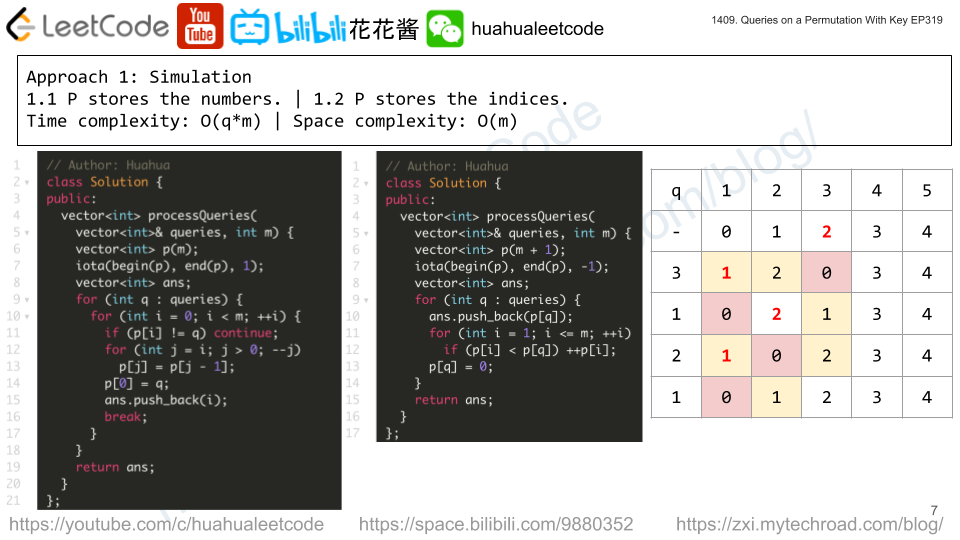
Solution1: Simulation + Hashtable

Use a hashtable to store the location of each key.
For each query q, use h[q] to get the index of q, for each key, if its current index is less than q, increase their indices by 1. (move right). Set h[q] to 0.

Time complexity: O(q*m)
Space complexity: O(m)

C++

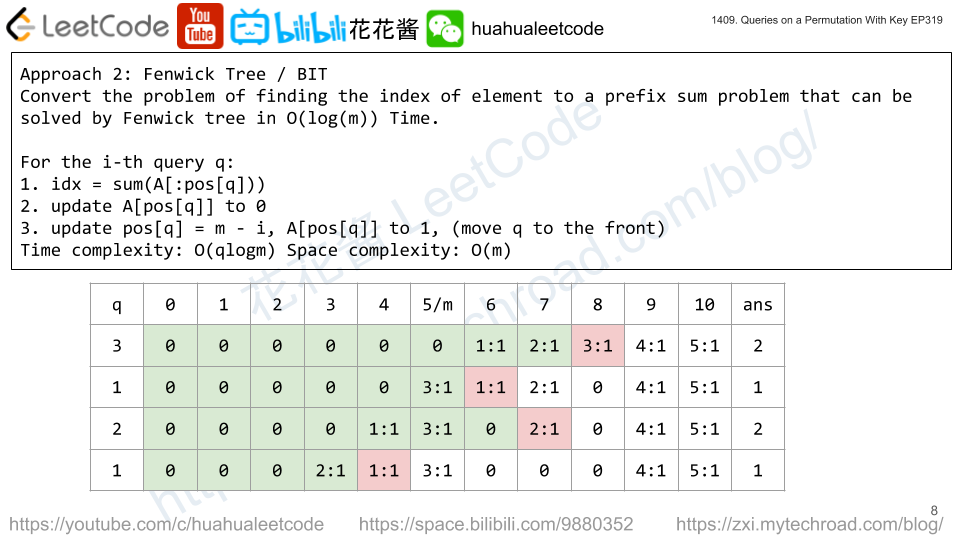
Solution 2: Fenwick Tree + HashTable

Time complexity: O(qlogm)
Space complexity: O(m)

C++

Python3

花花酱 LeetCode 1408. String Matching in an Array

Given an array of string words. Return all strings in words which is substring of another word in any order. 

String words[i] is substring of words[j], if can be obtained removing some characters to left and/or right side of words[j].

Example 1:

Input: words = ["mass","as","hero","superhero"]
Output: ["as","hero"]
Explanation: "as" is substring of "mass" and "hero" is substring of "superhero".
["hero","as"] is also a valid answer.

Example 2:

Input: words = ["leetcode","et","code"]
Output: ["et","code"]
Explanation: "et", "code" are substring of "leetcode".

Example 3:

Input: words = ["blue","green","bu"]
Output: []

Constraints:

  • 1 <= words.length <= 100
  • 1 <= words[i].length <= 30
  • words[i] contains only lowercase English letters.
  • It’s guaranteed that words[i] will be unique.

Solution: Brute Force

Time complexity: O(n^2)
Space complexity: O(1)

C++

花花酱 LeetCode 1406. Stone Game III

Alice and Bob continue their games with piles of stones. There are several stones arranged in a row, and each stone has an associated value which is an integer given in the array stoneValue.

Alice and Bob take turns, with Alice starting first. On each player’s turn, that player can take 1, 2 or 3 stones from the first remaining stones in the row.

The score of each player is the sum of values of the stones taken. The score of each player is 0 initially.

The objective of the game is to end with the highest score, and the winner is the player with the highest score and there could be a tie. The game continues until all the stones have been taken.

Assume Alice and Bob play optimally.

Return “Alice” if Alice will win, “Bob” if Bob will win or “Tie” if they end the game with the same score.

Example 1:

Input: values = [1,2,3,7]
Output: "Bob"
Explanation: Alice will always lose. Her best move will be to take three piles and the score become 6. Now the score of Bob is 7 and Bob wins.

Example 2:

Input: values = [1,2,3,-9]
Output: "Alice"
Explanation: Alice must choose all the three piles at the first move to win and leave Bob with negative score.
If Alice chooses one pile her score will be 1 and the next move Bob's score becomes 5. The next move Alice will take the pile with value = -9 and lose.
If Alice chooses two piles her score will be 3 and the next move Bob's score becomes 3. The next move Alice will take the pile with value = -9 and also lose.
Remember that both play optimally so here Alice will choose the scenario that makes her win.

Example 3:

Input: values = [1,2,3,6]
Output: "Tie"
Explanation: Alice cannot win this game. She can end the game in a draw if she decided to choose all the first three piles, otherwise she will lose.

Example 4:

Input: values = [1,2,3,-1,-2,-3,7]
Output: "Alice"

Example 5:

Input: values = [-1,-2,-3]
Output: "Tie"

Constraints:

  • 1 <= values.length <= 50000
  • -1000 <= values[i] <= 1000

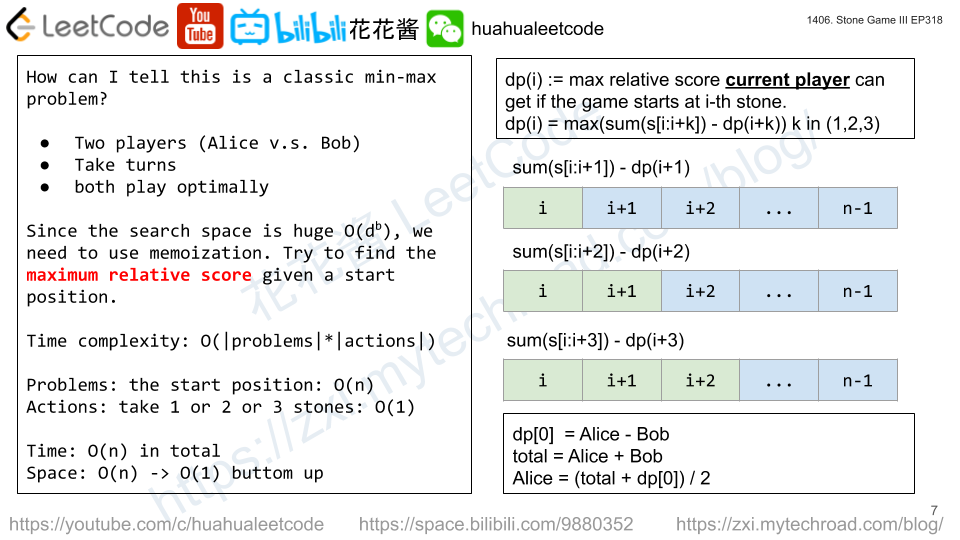
Solution: DP with memorization

dp(i) := max relative score the current player can get if start the game from the i-th stone.

dp(i) = max(sum(values[i:i+k]) – dp(i + k)) 1 <= k <= 3

Time complexity: O(n)
Space complexity: O(n)

C++

Python3

Related Problems