Press "Enter" to skip to content

Huahua's Tech Road

花花酱 LeetCode 1326. Minimum Number of Taps to Open to Water a Garden

There is a one-dimensional garden on the x-axis. The garden starts at the point 0 and ends at the point n. (i.e The length of the garden is n).

There are n + 1 taps located at points [0, 1, ..., n] in the garden.

Given an integer n and an integer array ranges of length n + 1 where ranges[i] (0-indexed) means the i-th tap can water the area [i - ranges[i], i + ranges[i]] if it was open.

Return the minimum number of taps that should be open to water the whole garden, If the garden cannot be watered return -1.

Example 1:
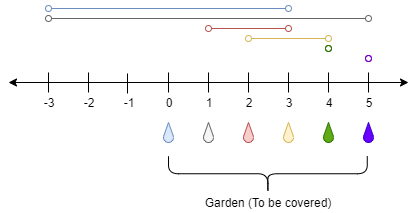
Input: n = 5, ranges = [3,4,1,1,0,0]
Output: 1
Explanation: The tap at point 0 can cover the interval [-3,3]
The tap at point 1 can cover the interval [-3,5]
The tap at point 2 can cover the interval [1,3]
The tap at point 3 can cover the interval [2,4]
The tap at point 4 can cover the interval [4,4]
The tap at point 5 can cover the interval [5,5]
Opening Only the second tap will water the whole garden [0,5]

Example 2:

Input: n = 3, ranges = [0,0,0,0]
Output: -1
Explanation: Even if you activate all the four taps you cannot water the whole garden.

Example 3:

Input: n = 7, ranges = [1,2,1,0,2,1,0,1]
Output: 3

Example 4:

Input: n = 8, ranges = [4,0,0,0,0,0,0,0,4]
Output: 2

Example 5:

Input: n = 8, ranges = [4,0,0,0,4,0,0,0,4]
Output: 1

Constraints:

  • 1 <= n <= 10^4
  • ranges.length == n + 1
  • 0 <= ranges[i] <= 100

Solution 1: Greedy

Reduce to 1024. Video Stitching

Time complexity: O(nlogn)
Space complexity: O(n)

C++

Solution 2: Greedy

Reduce to 45. Jump Game II

Time complexity: O(n)
Space complexity: O(n)

C++

花花酱 LeetCode 42. Trapping Rain Water

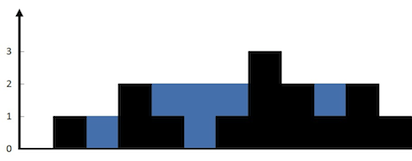
Given n non-negative integers representing an elevation map where the width of each bar is 1, compute how much water it is able to trap after raining.


The above elevation map is represented by array [0,1,0,2,1,0,1,3,2,1,2,1]. In this case, 6 units of rain water (blue section) are being trapped. Thanks Marcos for contributing this image!

Example:

Input: [0,1,0,2,1,0,1,3,2,1,2,1]
Output: 6

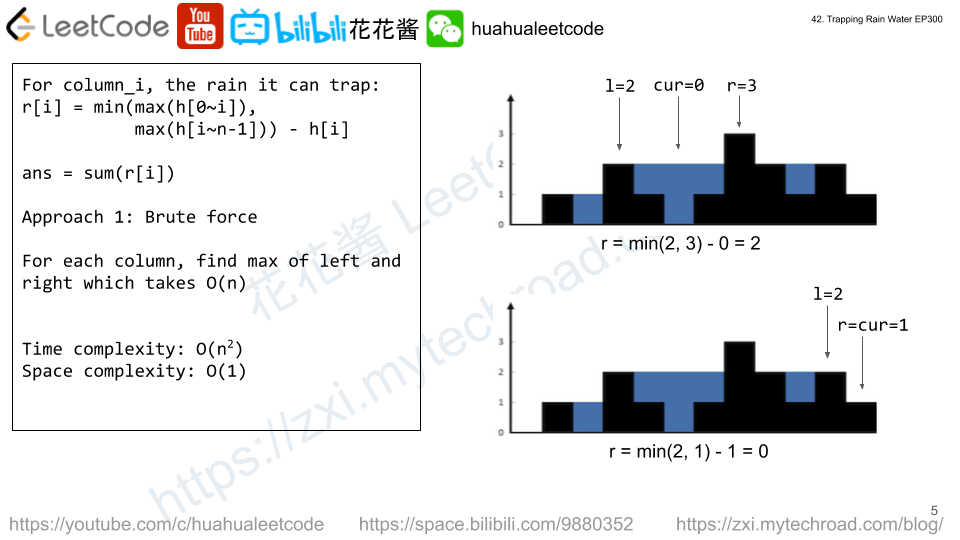
Solution 1: Brute Force

r[i] = min(max(h[0:i+1]), max(h[i:n]))
ans = sum(r[i])

Time complexity: O(n^2)
Space complexity: O(1)

C++

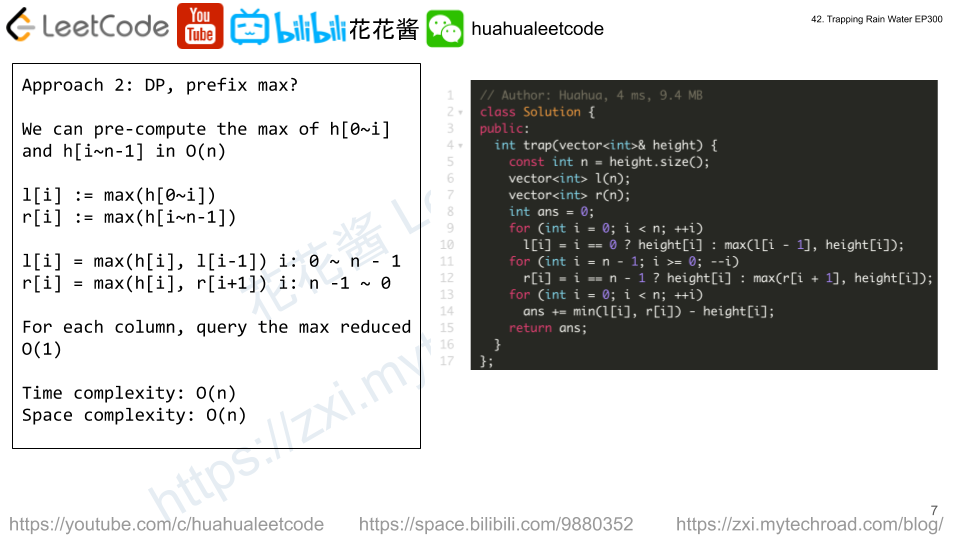
Solution 2: DP

l[i] := max(h[0:i+1])
r[i] := max(h[i:n])
ans = sum(min(l[i], r[i]) – h[i])

Time complexity: O(n)
Space complexity: O(n)

C++

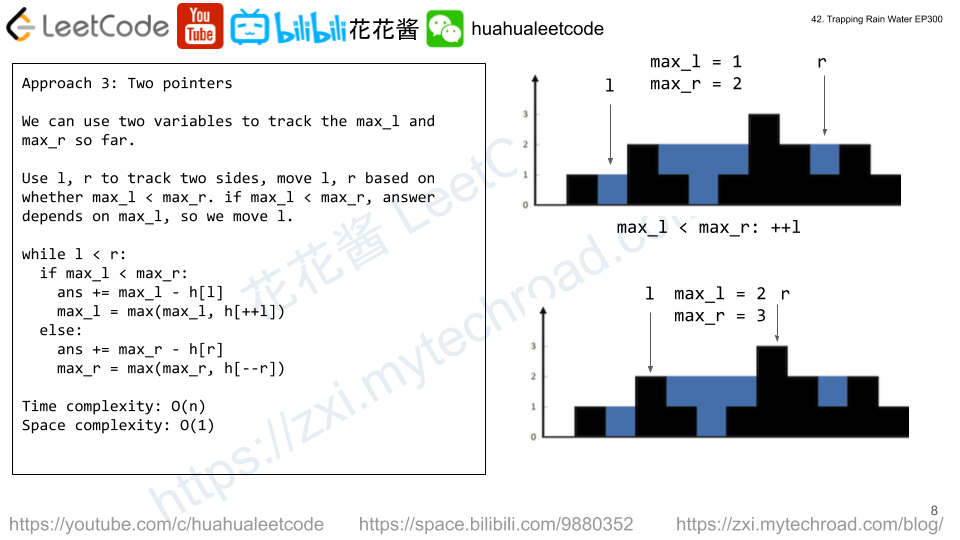
Solution 3: Two Pointers

Time complexity: O(n)
Space complexity: O(1)

C++

花花酱 LeetCode 1318. Minimum Flips to Make a OR b Equal to c

Given 3 positives numbers ab and c. Return the minimum flips required in some bits of a and b to make ( a OR b == c ). (bitwise OR operation).
Flip operation consists of change any single bit 1 to 0 or change the bit 0 to 1 in their binary representation.

Example 1:

Input: a = 2, b = 6, c = 5
Output: 3
Explanation: After flips a = 1 , b = 4 , c = 5 such that (a OR b == c)

Example 2:

Input: a = 4, b = 2, c = 7
Output: 1

Example 3:

Input: a = 1, b = 2, c = 3
Output: 0

Constraints:

  • 1 <= a <= 10^9
  • 1 <= b <= 10^9
  • 1 <= c <= 10^9

Solution: Bit operation

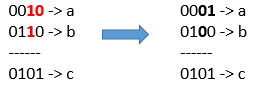
If the bit of c is 1, a / b at least has one 1. cost = 1 – ((a | b) & 1)
If the bit of c is 0, a / b must be 0, cost = (a & 1) + (b & 1)

Time complexity: O(32)
Space complexity: O(1)

C++

花花酱 LeetCode 1317. Convert Integer to the Sum of Two No-Zero Integers

Given an integer n. No-Zero integer is a positive integer which doesn’t contain any 0 in its decimal representation.

Return a list of two integers [A, B] where:

  • A and B are No-Zero integers.
  • A + B = n

It’s guarateed that there is at least one valid solution. If there are many valid solutions you can return any of them.

Example 1:

Example 2:

Example 3:

Example 4:

Example 5:

Constraints:

  • 2 <= n <= 10^4

Solution: Brute Force

Time complexity: O(nlogn)
Space complexity: O(1)

C++

花花酱 LeetCode 1320. Minimum Distance to Type a Word Using Two Fingers

You have a keyboard layout as shown above in the XY plane, where each English uppercase letter is located at some coordinate, for example, the letter A is located at coordinate (0,0), the letter B is located at coordinate (0,1), the letter P is located at coordinate (2,3) and the letter Z is located at coordinate (4,1).

Given the string word, return the minimum total distance to type such string using only two fingers. The distance between coordinates (x1,y1) and (x2,y2) is |x1 – x2| + |y1 – y2|

Note that the initial positions of your two fingers are considered free so don’t count towards your total distance, also your two fingers do not have to start at the first letter or the first two letters.

Example 1:

Input: word = "CAKE"
Output: 3
Explanation: 
Using two fingers, one optimal way to type "CAKE" is: 
Finger 1 on letter 'C' -> cost = 0 
Finger 1 on letter 'A' -> cost = Distance from letter 'C' to letter 'A' = 2 
Finger 2 on letter 'K' -> cost = 0 
Finger 2 on letter 'E' -> cost = Distance from letter 'K' to letter 'E' = 1 
Total distance = 3

Example 2:

Input: word = "HAPPY"
Output: 6
Explanation: 
Using two fingers, one optimal way to type "HAPPY" is:
Finger 1 on letter 'H' -> cost = 0
Finger 1 on letter 'A' -> cost = Distance from letter 'H' to letter 'A' = 2
Finger 2 on letter 'P' -> cost = 0
Finger 2 on letter 'P' -> cost = Distance from letter 'P' to letter 'P' = 0
Finger 1 on letter 'Y' -> cost = Distance from letter 'A' to letter 'Y' = 4
Total distance = 6

Example 3:

Input: word = "NEW"
Output: 3

Example 4:

Input: word = "YEAR"
Output: 7

Constraints:

  • 2 <= word.length <= 300
  • Each word[i] is an English uppercase letter.

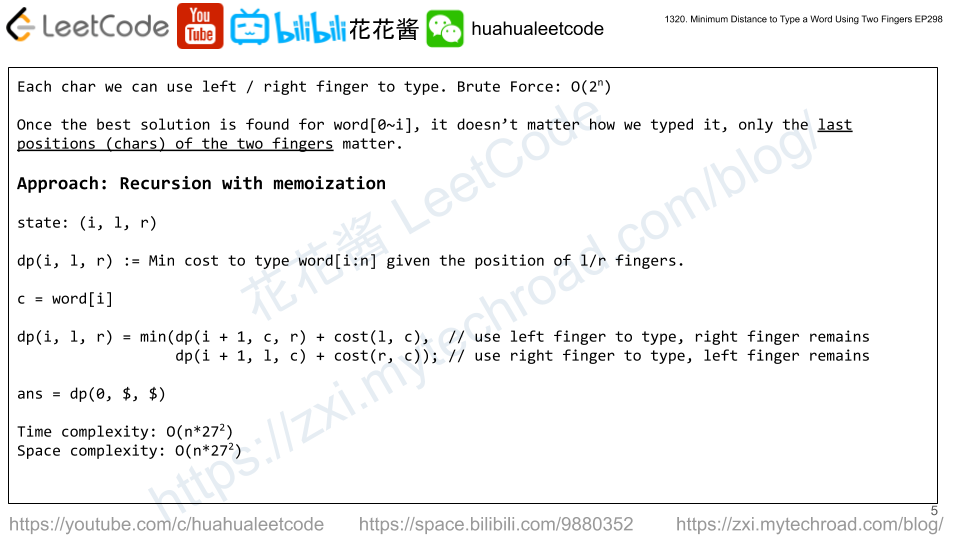
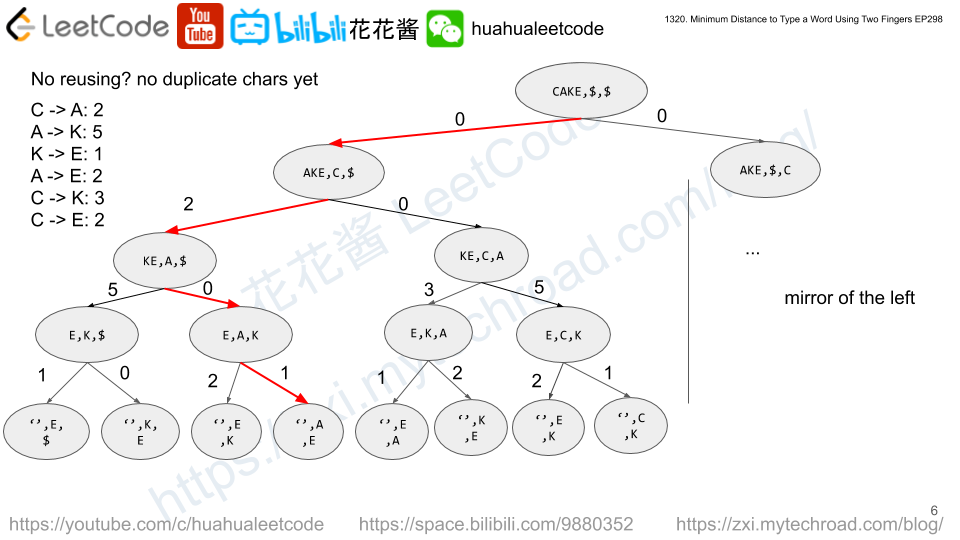
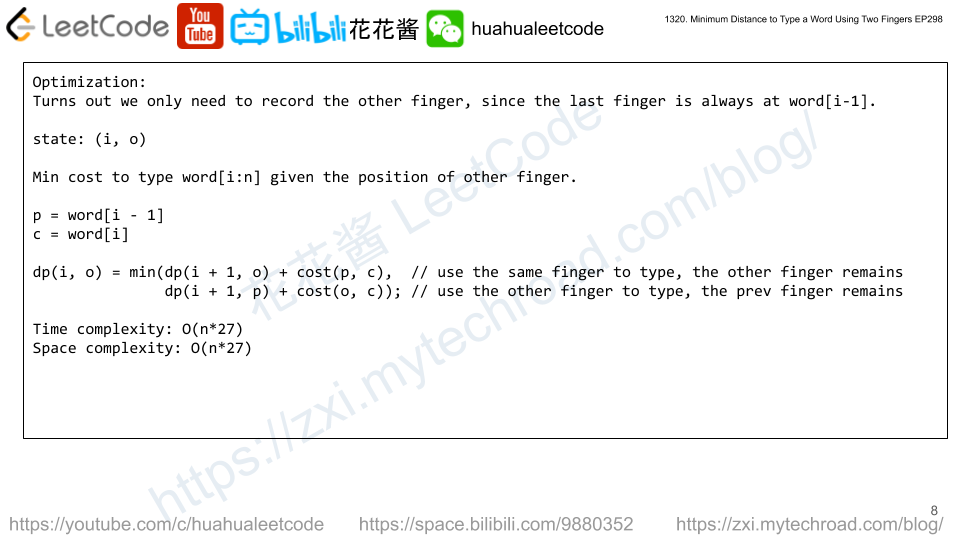
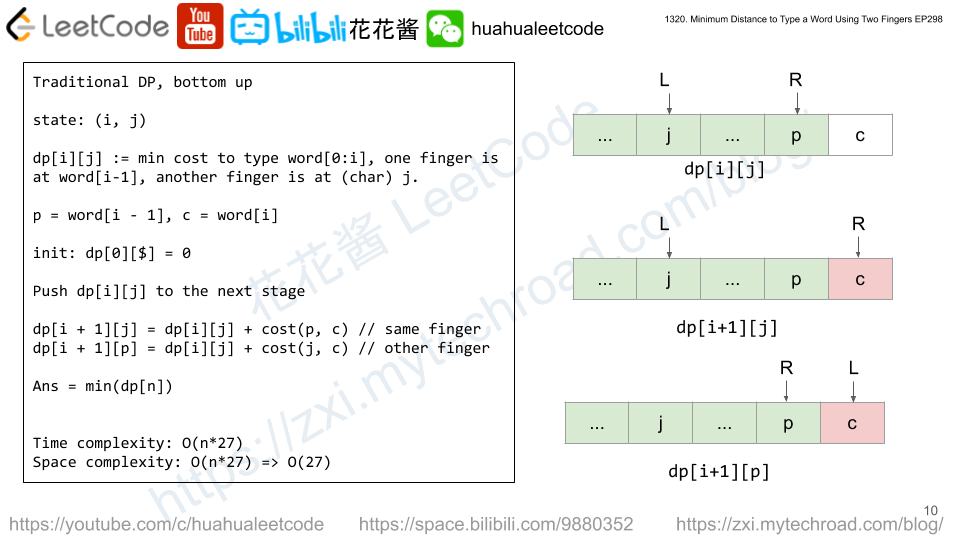
Solution: DP

Top down: O(n*27^2)

C++

C++

C++