Press "Enter" to skip to content

Huahua's Tech Road

花花酱 LeetCode 1222. Queens That Can Attack the King

On an 8×8 chessboard, there can be multiple Black Queens and one White King.

Given an array of integer coordinates queens that represents the positions of the Black Queens, and a pair of coordinates king that represent the position of the White King, return the coordinates of all the queens (in any order) that can attack the King.

Example 1:

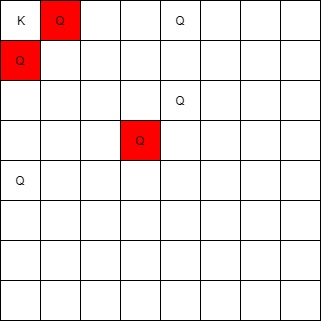
Input: queens = [[0,1],[1,0],[4,0],[0,4],[3,3],[2,4]], king = [0,0]
Output: [[0,1],[1,0],[3,3]]
Explanation:  
The queen at [0,1] can attack the king cause they're in the same row. 
The queen at [1,0] can attack the king cause they're in the same column. 
The queen at [3,3] can attack the king cause they're in the same diagnal. 
The queen at [0,4] can't attack the king cause it's blocked by the queen at [0,1]. 
The queen at [4,0] can't attack the king cause it's blocked by the queen at [1,0]. 
The queen at [2,4] can't attack the king cause it's not in the same row/column/diagnal as the king.

Example 2:

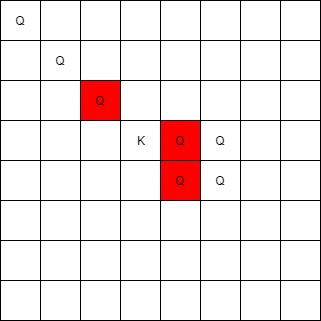
Input: queens = [[0,0],[1,1],[2,2],[3,4],[3,5],[4,4],[4,5]], king = [3,3]
Output: [[2,2],[3,4],[4,4]]

Example 3:

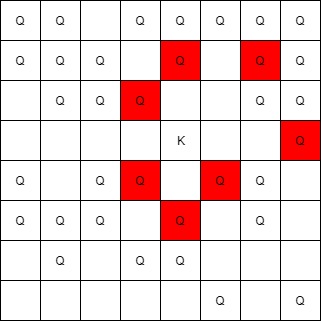
Input: queens = [[5,6],[7,7],[2,1],[0,7],[1,6],[5,1],[3,7],[0,3],[4,0],[1,2],[6,3],[5,0],[0,4],[2,2],[1,1],[6,4],[5,4],[0,0],[2,6],[4,5],[5,2],[1,4],[7,5],[2,3],[0,5],[4,2],[1,0],[2,7],[0,1],[4,6],[6,1],[0,6],[4,3],[1,7]], king = [3,4]
Output: [[2,3],[1,4],[1,6],[3,7],[4,3],[5,4],[4,5]]

Constraints:

  • 1 <= queens.length <= 63
  • queens[0].length == 2
  • 0 <= queens[i][j] < 8
  • king.length == 2
  • 0 <= king[0], king[1] < 8
  • At most one piece is allowed in a cell.

Solution2: Simulation

Time complexity: O(n)
Space complexity: O(1)

C++

Solution 2: HashTable + Binary Search

Time complexity: O(nlogn)
Space complexity: O(n)

Support arbitrarily large boards, e.g. 1e9 x 1e9 with 1e6 # of queens.

C++

花花酱 LeetCode 1221. Split a String in Balanced Strings

Balanced strings are those who have equal quantity of ‘L’ and ‘R’ characters.

Given a balanced string s split it in the maximum amount of balanced strings.

Return the maximum amount of splitted balanced strings.

Example 1:

Input: s = "RLRRLLRLRL"
Output: 4
Explanation: s can be split into "RL", "RRLL", "RL", "RL", each substring contains same number of 'L' and 'R'.

Example 2:

Input: s = "RLLLLRRRLR"
Output: 3
Explanation: s can be split into "RL", "LLLRRR", "LR", each substring contains same number of 'L' and 'R'.

Example 3:

Input: s = "LLLLRRRR"
Output: 1
Explanation: s can be split into "LLLLRRRR".

Constraints:

  • 1 <= s.length <= 1000
  • s[i] = 'L' or 'R'

Solution: Greedy

Time complexity: O(n)
Space complexity: O(1)

C++

花花酱 LeetCode 131. Palindrome Partitioning

Given a string s, partition s such that every substring of the partition is a palindrome.

Return all possible palindrome partitioning of s.

Example:

Input: "aab"
Output:
[
  ["aa","b"],
  ["a","a","b"]
]

Solution1: DP

dp[i] := ans of str[0:i]
dp[j] = { x + str[i:len] for x in dp[i] }, 0 <= i < len

Time complexity: O(2^n)
Space complexity: O(2^n)

C++

Solution 2: DFS

Time complexity: O(2^n)
Space complexity: O(n)

C++

花花酱 LeetCode 130. Surrounded Regions

Given a 2D board containing 'X' and 'O' (the letter O), capture all regions surrounded by 'X'.

A region is captured by flipping all 'O's into 'X's in that surrounded region.

Example:

X X X X
X O O X
X X O X
X O X X

After running your function, the board should be:

X X X X
X X X X
X X X X
X O X X

Explanation:

Surrounded regions shouldn’t be on the border, which means that any 'O' on the border of the board are not flipped to 'X'. Any 'O' that is not on the border and it is not connected to an 'O' on the border will be flipped to 'X'. Two cells are connected if they are adjacent cells connected horizontally or vertically.

Solution: DFS

Time complexity: O(m*n)
Space complexity: O(m*n)

Only starts DFS at border cells of O.

C++

花花酱 LeetCode 129. Sum Root to Leaf Numbers

Given a binary tree containing digits from 0-9 only, each root-to-leaf path could represent a number.

An example is the root-to-leaf path 1->2->3 which represents the number 123.

Find the total sum of all root-to-leaf numbers.

Note: A leaf is a node with no children.

Example:

Input: [1,2,3]
    1
   / \
  2   3
Output: 25
Explanation:
The root-to-leaf path 1->2 represents the number 12.
The root-to-leaf path 1->3 represents the number 13.
Therefore, sum = 12 + 13 = 25.

Example 2:

Input: [4,9,0,5,1]
    4
   / \
  9   0
 / \
5   1
Output: 1026
Explanation:
The root-to-leaf path 4->9->5 represents the number 495.
The root-to-leaf path 4->9->1 represents the number 491.
The root-to-leaf path 4->0 represents the number 40.
Therefore, sum = 495 + 491 + 40 = 1026.

Solution: Recursion

Time complexity: O(n)
Space complexity: O(h)

C++