Return the root node of a binary search tree that matches the given preorder traversal.
(Recall that a binary search tree is a binary tree where for every node, any descendant of node.left has a value <node.val, and any descendant of node.right has a value >node.val. Also recall that a preorder traversal displays the value of the node first, then traverses node.left, then traverses node.right.)
In a row of dominoes, A[i] and B[i] represent the top and bottom halves of the i-th domino. (A domino is a tile with two numbers from 1 to 6 – one on each half of the tile.)
We may rotate the i-th domino, so that A[i] and B[i] swap values.
Return the minimum number of rotations so that all the values in A are the same, or all the values in B are the same.
If it cannot be done, return -1.
Example 1:
Input: A = [2,1,2,4,2,2], B = [5,2,6,2,3,2]
Output: 2
Explanation:
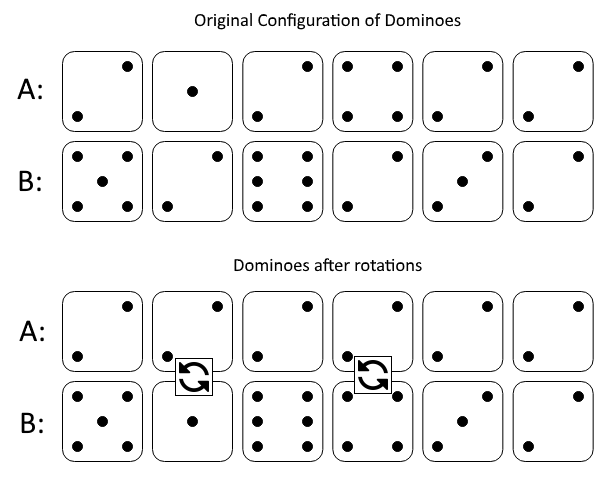
The first figure represents the dominoes as given by A and B: before we do any rotations.
If we rotate the second and fourth dominoes, we can make every value in the top row equal to 2, as indicated by the second figure.
Example 2:
Input: A = [3,5,1,2,3], B = [3,6,3,3,4]
Output: -1
Explanation:
In this case, it is not possible to rotate the dominoes to make one row of values equal.
Normally, the factorial of a positive integer n is the product of all positive integers less than or equal to n. For example, factorial(10) = 10 * 9 * 8 * 7 * 6 * 5 * 4 * 3 * 2 * 1.
We instead make a clumsy factorial: using the integers in decreasing order, we swap out the multiply operations for a fixed rotation of operations: multiply (*), divide (/), add (+) and subtract (-) in this order.
For example, clumsy(10) = 10 * 9 / 8 + 7 - 6 * 5 / 4 + 3 - 2 * 1. However, these operations are still applied using the usual order of operations of arithmetic: we do all multiplication and division steps before any addition or subtraction steps, and multiplication and division steps are processed left to right.
Additionally, the division that we use is floor division such that 10 * 9 / 8 equals 11. This guarantees the result is an integer.
Implement the clumsy function as defined above: given an integer N, it returns the clumsy factorial of N.
Given an array A of integers, we must modify the array in the following way: we choose an i and replace A[i] with -A[i], and we repeat this process K times in total. (We may choose the same index i multiple times.)
Return the largest possible sum of the array after modifying it in this way.
Example 1:
Input: A = [4,2,3], K = 1
Output: 5
Explanation: Choose indices (1,) and A becomes [4,-2,3].
Example 2:
Input: A = [3,-1,0,2], K = 3
Output: 6
Explanation: Choose indices (1, 2, 2) and A becomes [3,1,0,2].
Example 3:
Input: A = [2,-3,-1,5,-4], K = 2
Output: 13
Explanation: Choose indices (1, 4) and A becomes [2,3,-1,5,4].
Note:
1 <= A.length <= 10000
1 <= K <= 10000
-100 <= A[i] <= 100
Solution: Sorting
Flip as many as negative numbers as possible, if K > # of negative numbers and K is odd, flip the smallest element in the array.
There are N piles of stones arranged in a row. The i-th pile has stones[i] stones.
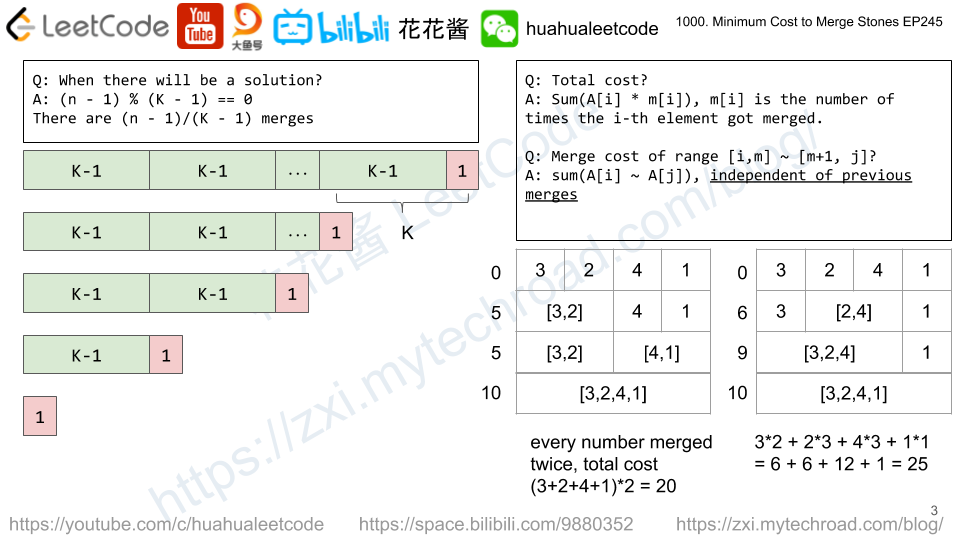
A move consists of merging exactly K consecutive piles into one pile, and the cost of this move is equal to the total number of stones in these K piles.
Find the minimum cost to merge all piles of stones into one pile. If it is impossible, return -1.
Example 1:
Input: stones = [3,2,4,1], K = 2
Output: 20
Explanation:
We start with [3, 2, 4, 1].
We merge [3, 2] for a cost of 5, and we are left with [5, 4, 1].
We merge [4, 1] for a cost of 5, and we are left with [5, 5].
We merge [5, 5] for a cost of 10, and we are left with [10].
The total cost was 20, and this is the minimum possible.
Example 2:
Input: stones = [3,2,4,1], K = 3
Output: -1
Explanation: After any merge operation, there are 2 piles left, and we can't merge anymore.  So the task is impossible.
Example 3:
Input: stones = [3,5,1,2,6], K = 3
Output: 25
Explanation:
We start with [3, 5, 1, 2, 6].
We merge [5, 1, 2] for a cost of 8, and we are left with [3, 8, 6].
We merge [3, 8, 6] for a cost of 17, and we are left with [17].
The total cost was 25, and this is the minimum possible.
Note:
1 <= stones.length <= 30
2 <= K <= 30
1 <= stones[i] <= 100
Solution: DP
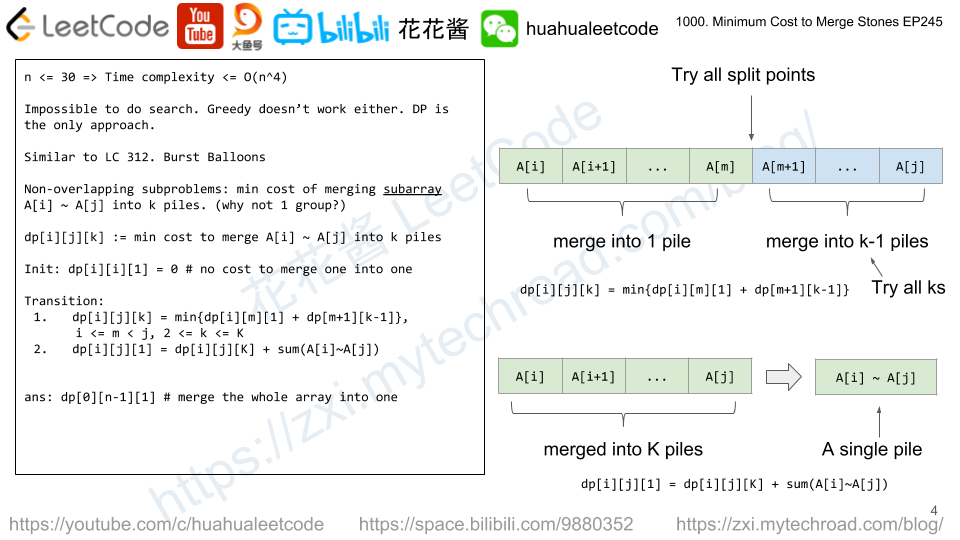
dp[i][j][k] := min cost to merge subarray i ~ j into k piles Init: dp[i][j][k] = 0 if i==j and k == 1 else inf ans: dp[0][n-1][1] transition: 1. dp[i][j][k] = min{dp[i][m][1] + dp[m+1][j][k-1]} for all i <= m < j 2. dp[i][j][1] = dp[i][j][K] + sum(A[i]~A[j])
Time complexity: O(n^3) Space complexity: O(n^2*K)
C++
1
2
3
4
5
6
7
8
9
10
11
12
13
14
15
16
17
18
19
20
21
22
23
24
25
26
// Running time: 12 ms, 12.1 MB
classSolution{
public:
intmergeStones(vector<int>&stones,intK){
constintn=stones.size();
if((n-1)%(K-1))return-1;
constintkInf=1e9;
vector<int>sums(n+1);
for(inti=0;i<stones.size();++i)
sums[i+1]=sums[i]+stones[i];
// dp[i][j][k] := min cost to merge subarray i~j into k piles.
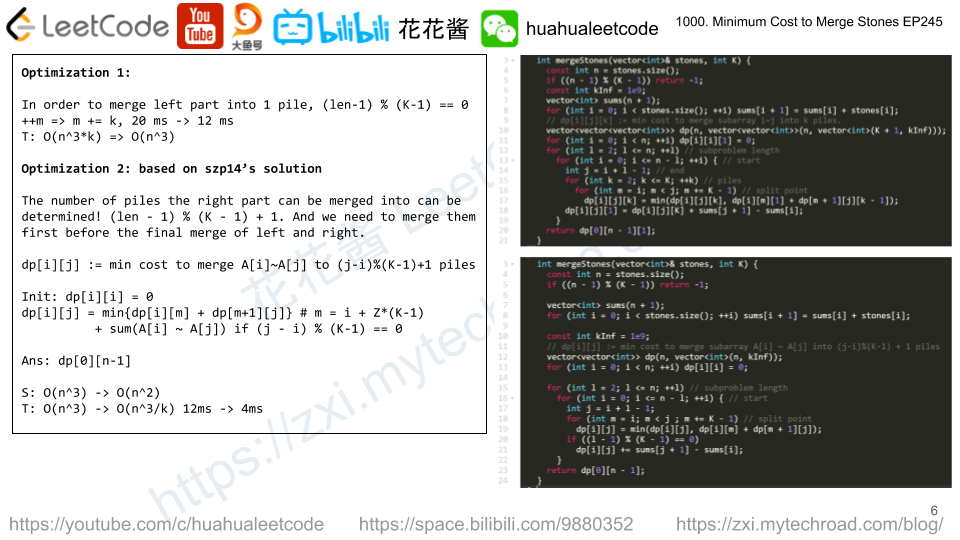
dp[l][i] := min cost to merge [i, i + l) into as less piles as possible. Number of merges will be (l-1) / (K – 1) and Transition: dp[l][i] = min(dp[m][i] + dp[l – m][i + m]) for 1 <= m < l if ((l – 1) % (K – 1) == 0) [i, i + l) can be merged into 1 pile, dp[l][i] += sum(A[i:i+l])
Time complexity: O(n^3 / k) Space complexity: O(n^2)
C++
1
2
3
4
5
6
7
8
9
10
11
12
13
14
15
16
17
18
19
20
21
22
23
24
25
26
27
28
29
// Author: Huahua 4ms, 9.6 MB
classSolution{
public:
intmergeStones(vector<int>&stones,intK){
constintn=stones.size();
if((n-1)%(K-1))return-1;
vector<int>sums(n+1);
for(inti=0;i<stones.size();++i)
sums[i+1]=sums[i]+stones[i];
constintkInf=1e9;
// dp[i][j] := min cost to merge subarray A[i] ~ A[j] into (j-i)%(K-1) + 1 piles
vector<vector<int>>dp(n,vector<int>(n,kInf));
for(inti=0;i<n;++i)dp[i][i]=0;
for(intl=2;l<=n;++l)// subproblem length
for(inti=0;i<=n-l;++i){// start
intj=i+l-1;
for(intm=i;m<j;m+=K-1)// split point
dp[i][j]=min(dp[i][j],dp[i][m]+dp[m+1][j]);
// If the current length can be merged into 1 pile