Press "Enter" to skip to content

Huahua's Tech Road

花花酱 LeetCode 999. Available Captures for Rook

On an 8 x 8 chessboard, there is one white rook.  There also may be empty squares, white bishops, and black pawns.  These are given as characters ‘R’, ‘.’, ‘B’, and ‘p’ respectively. Uppercase characters represent white pieces, and lowercase characters represent black pieces.

The rook moves as in the rules of Chess: it chooses one of four cardinal directions (north, east, west, and south), then moves in that direction until it chooses to stop, reaches the edge of the board, or captures an opposite colored pawn by moving to the same square it occupies.  Also, rooks cannot move into the same square as other friendly bishops.

Return the number of pawns the rook can capture in one move.

Example 1:

Input: [[".",".",".",".",".",".",".","."],[".",".",".","p",".",".",".","."],[".",".",".","R",".",".",".","p"],[".",".",".",".",".",".",".","."],[".",".",".",".",".",".",".","."],[".",".",".","p",".",".",".","."],[".",".",".",".",".",".",".","."],[".",".",".",".",".",".",".","."]]
Output: 3
Explanation: 
In this example the rook is able to capture all the pawns.

Example 2:

Input: [[".",".",".",".",".",".",".","."],[".","p","p","p","p","p",".","."],[".","p","p","B","p","p",".","."],[".","p","B","R","B","p",".","."],[".","p","p","B","p","p",".","."],[".","p","p","p","p","p",".","."],[".",".",".",".",".",".",".","."],[".",".",".",".",".",".",".","."]]
Output: 0
Explanation: 
Bishops are blocking the rook to capture any pawn.

Example 3:

Input: [[".",".",".",".",".",".",".","."],[".",".",".","p",".",".",".","."],[".",".",".","p",".",".",".","."],["p","p",".","R",".","p","B","."],[".",".",".",".",".",".",".","."],[".",".",".","B",".",".",".","."],[".",".",".","p",".",".",".","."],[".",".",".",".",".",".",".","."]]
Output: 3
Explanation: 
The rook can capture the pawns at positions b5, d6 and f5.

Note:

  1. board.length == board[i].length == 8
  2. board[i][j] is either 'R''.''B', or 'p'
  3. There is exactly one cell with board[i][j] == 'R'

Solution: Simulation

Time complexity: O(1)
Space complexity: O(1)

C++

花花酱 LeetCode 998. Maximum Binary Tree II

We are given the root node of a maximum tree: a tree where every node has a value greater than any other value in its subtree.

Just as in the previous problem, the given tree was constructed from an list A (root = Construct(A)) recursively with the following Construct(A) routine:

  • If A is empty, return null.
  • Otherwise, let A[i] be the largest element of A.  Create a root node with value A[i].
  • The left child of root will be Construct([A[0], A[1], ..., A[i-1]])
  • The right child of root will be Construct([A[i+1], A[i+2], ..., A[A.length - 1]])
  • Return root.

Note that we were not given A directly, only a root node root = Construct(A).

Suppose B is a copy of A with the value val appended to it.  It is guaranteed that B has unique values.

Return Construct(B).

Example 1:

Input: root = [4,1,3,null,null,2], val = 5
Output: [5,4,null,1,3,null,null,2]
Explanation: A = [1,4,2,3], B = [1,4,2,3,5]

Example 2:

Input: root = [5,2,4,null,1], val = 3
Output: [5,2,4,null,1,null,3]
Explanation: A = [2,1,5,4], B = [2,1,5,4,3]

Example 3:

Input: root = [5,2,3,null,1], val = 4
Output: [5,2,4,null,1,3]
Explanation: A = [2,1,5,3], B = [2,1,5,3,4]

Note:

  1. 1 <= B.length <= 100

Solution: Recursion

Since val is the last element of the array, we compare root->val with val, if root->val > val then val can be inserted into the right subtree recursively, otherwise, root will be the left subtree of val.

Time complexity: O(n)
Space complexity: O(n)

C++

花花酱 LeetCode 997. Find the Town Judge

In a town, there are N people labelled from 1 to N.  There is a rumor that one of these people is secretly the town judge.

If the town judge exists, then:

  1. The town judge trusts nobody.
  2. Everybody (except for the town judge) trusts the town judge.
  3. There is exactly one person that satisfies properties 1 and 2.

You are given trust, an array of pairs trust[i] = [a, b] representing that the person labelled a trusts the person labelled b.

If the town judge exists and can be identified, return the label of the town judge.  Otherwise, return -1.

Example 1:

Input: N = 2, trust = [[1,2]]
Output: 2

Example 2:

Input: N = 3, trust = [[1,3],[2,3]]
Output: 3

Example 3:

Input: N = 3, trust = [[1,3],[2,3],[3,1]]
Output: -1

Example 4:

Input: N = 3, trust = [[1,2],[2,3]]
Output: -1

Example 5:

Input: N = 4, trust = [[1,3],[1,4],[2,3],[2,4],[4,3]]
Output: 3

Note:

  1. 1 <= N <= 1000
  2. trust.length <= 10000
  3. trust[i] are all different
  4. trust[i][0] != trust[i][1]
  5. 1 <= trust[i][0], trust[i][1] <= N

Solution: Degree

node with degree (in_degree – out_degree) N – 1 is the judge.

Time complexity: O(N+T)
Space complexity: O(N)

C++

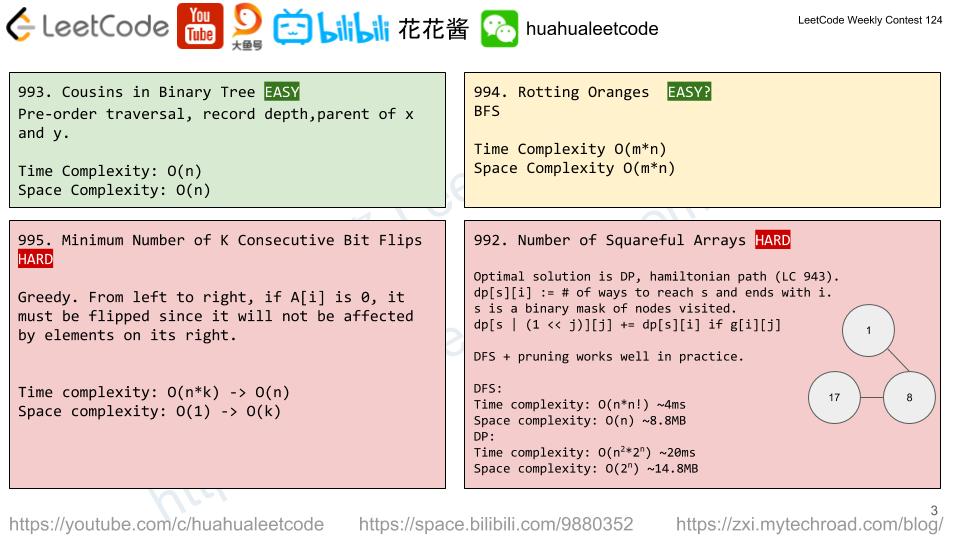
花花酱 LeetCode 996. Number of Squareful Arrays

Given an array A of non-negative integers, the array is squareful if for every pair of adjacent elements, their sum is a perfect square.

Return the number of permutations of A that are squareful.  Two permutations A1 and A2 differ if and only if there is some index i such that A1[i] != A2[i].

Example 1:

Input: [1,17,8]
Output: 2
Explanation: 
[1,8,17] and [17,8,1] are the valid permutations.

Example 2:

Input: [2,2,2]
Output: 1

Note:

  1. 1 <= A.length <= 12
  2. 0 <= A[i] <= 1e9

Solution1: DFS

Try all permutations with pruning.

Time complexity: O(n!)
Space complexity: O(n)

C++

Solution 2: DP Hamiltonian Path

dp[s][i] := # of ways to reach state s (binary mask of nodes visited) that ends with node i

dp[s | (1 << j)][j] += dp[s][i] if g[i][j]

Time complexity: O(n^2*2^n)
Space complexity: O(2^n)

C++

Related Problems