Press "Enter" to skip to content

Huahua's Tech Road

花花酱 LeetCode 937. Reorder Log Files

Problem

https://leetcode.com/problems/reorder-log-files/description/

You have an array of logs.  Each log is a space delimited string of words.

For each log, the first word in each log is an alphanumeric identifier.  Then, either:

  • Each word after the identifier will consist only of lowercase letters, or;
  • Each word after the identifier will consist only of digits.

We will call these two varieties of logs letter-logs and digit-logs.  It is guaranteed that each log has at least one word after its identifier.

Reorder the logs so that all of the letter-logs come before any digit-log.  The letter-logs are ordered lexicographically ignoring identifier, with the identifier used in case of ties.  The digit-logs should be put in their original order.

Return the final order of the logs.

Example 1:

Input: ["a1 9 2 3 1","g1 act car","zo4 4 7","ab1 off key dog","a8 act zoo"]
Output: ["g1 act car","a8 act zoo","ab1 off key dog","a1 9 2 3 1","zo4 4 7"]

Note:

  1. 0 <= logs.length <= 100
  2. 3 <= logs[i].length <= 100
  3. logs[i] is guaranteed to have an identifier, and a word after the identifier.

Solution: Partition + Sort

  1. partition the array such that all digit logs are after all letter logs
  2. sort the letter logs part based on the log content

Time complexity: O(n + aloga)

Space complexity: O(n)

C++

Knapsack Problem 背包问题

Videos

上期节目中我们对动态规划做了一个总结,这期节目我们来聊聊背包问题。

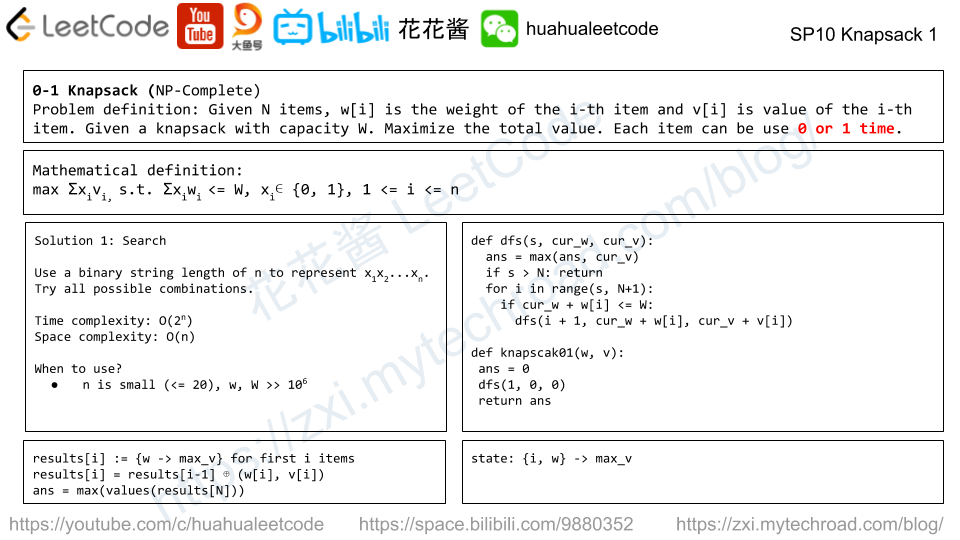
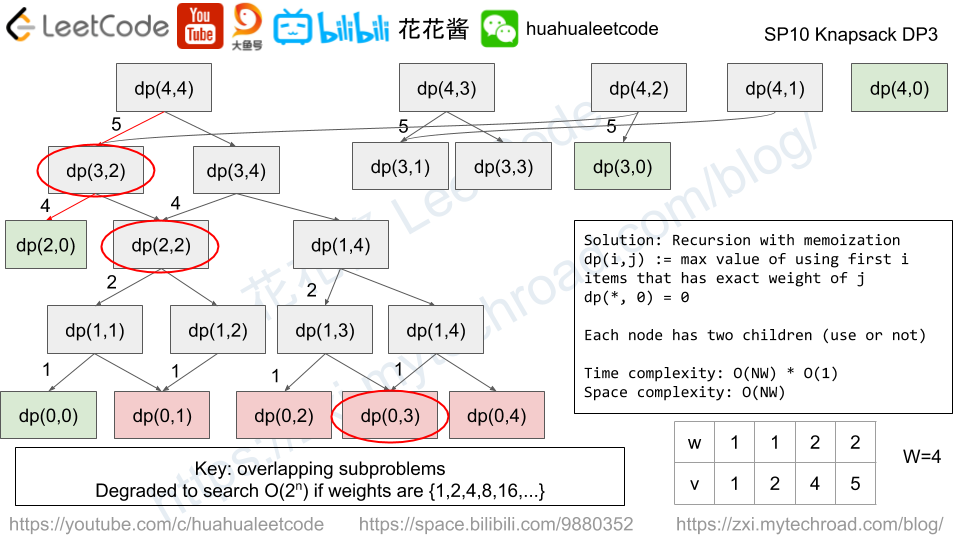
背包问题是一个NP-complete的组合优化问题,Search的方法需要O(2^N)时间才能获得最优解。而使用动态规划,我们可以在伪多项式(pseudo-polynomial time)时间内获得最优解。

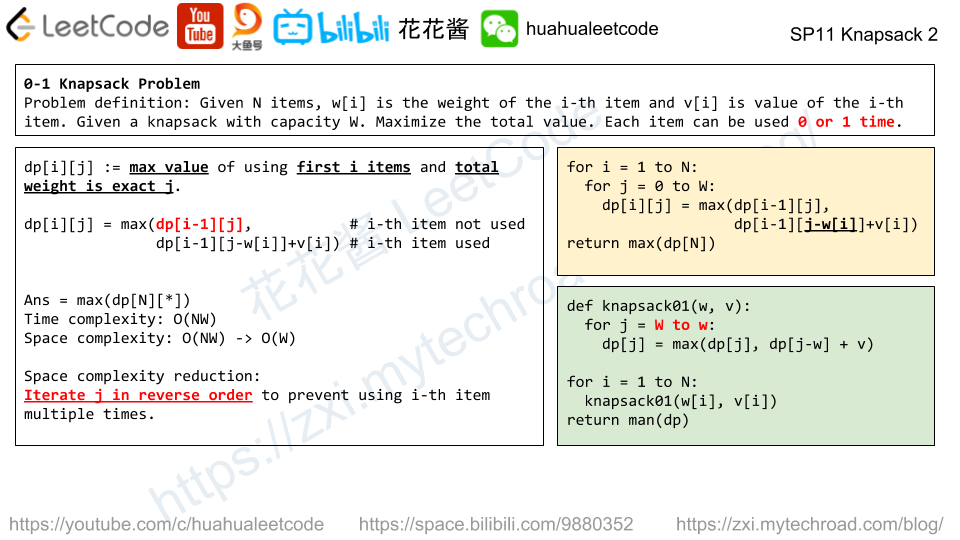
0-1 Knapsack Problem 0-1背包问题

Problem

Given N items, w[i] is the weight of the i-th item and v[i] is value of the i-th item. Given a knapsack with capacity W. Maximize the total value. Each item can be use 0 or 1 time.

0-1背包问题的通常定义是:一共有N件物品,第i件物品的重量为w[i],价值为v[i]。在总重量不超过背包承载上限W的情况下,能够获得的最大价值是多少?每件物品可以使用0次或者1次

例子:

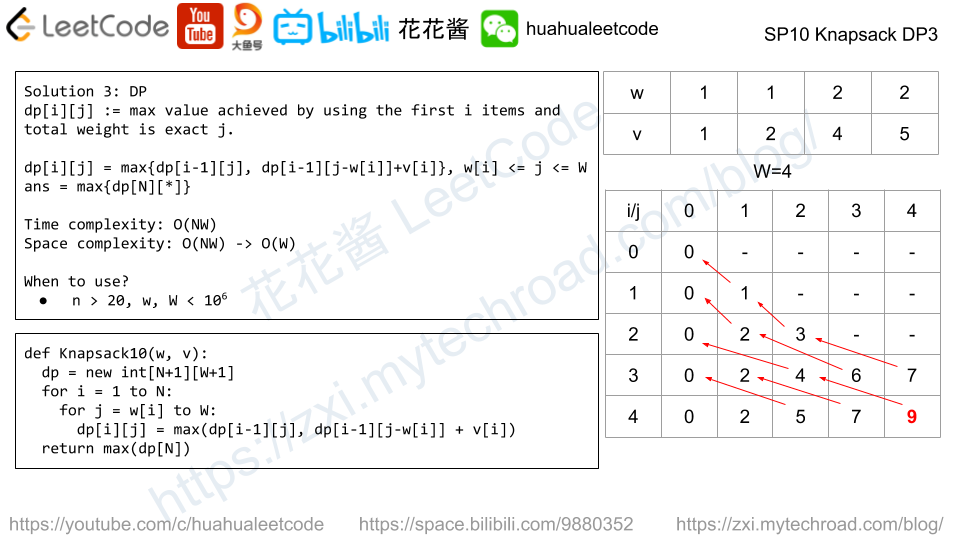
重量 w = [1, 1, 2, 2]

价值 v = [1, 3, 4, 5]

背包承重 W = 4

最大价值为9,可以选第1,2,4件物品,也可以选第3,4件物品;总重量为4,总价值为9。

动态规划的状态转移方程为:

Solutions

Search

DP2

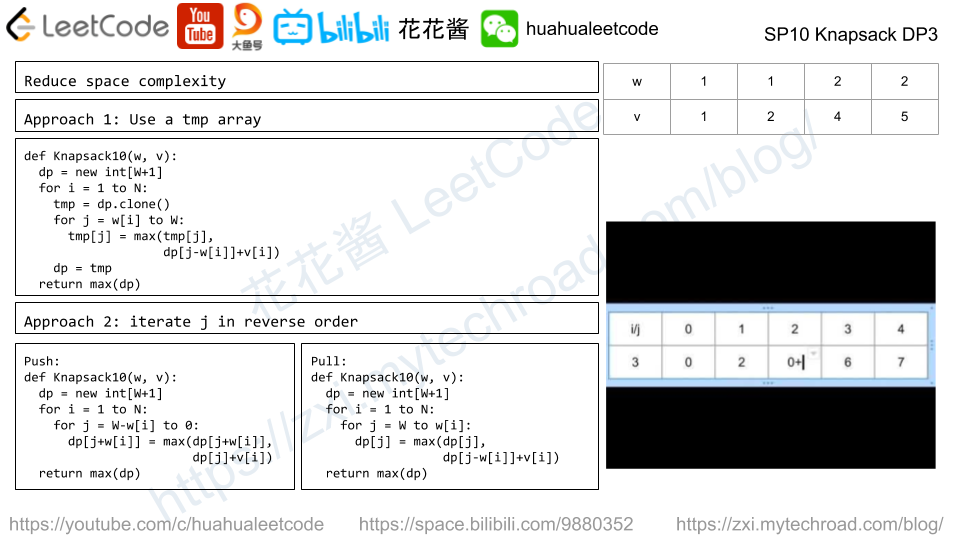
DP1/tmp

DP1/push

DP1/pull


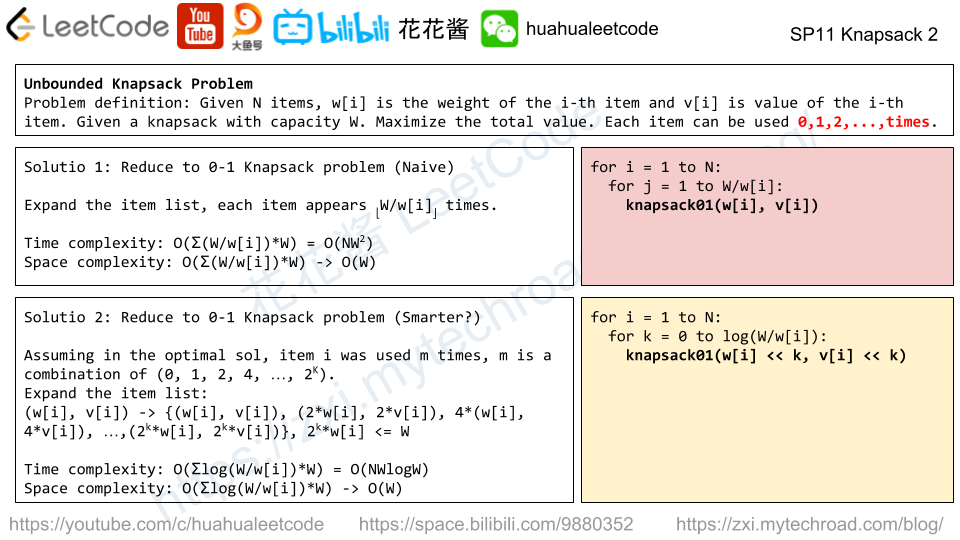
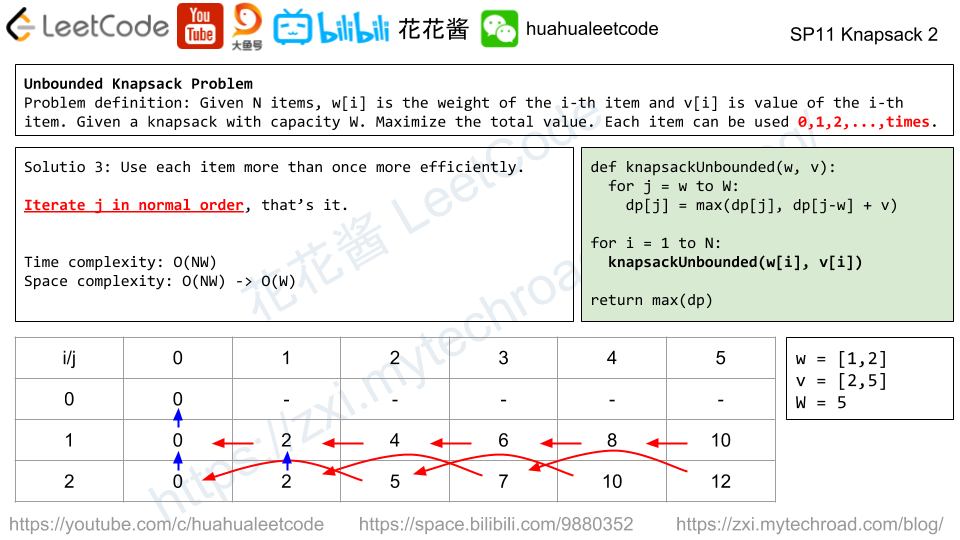
Unbounded Knapsack Problem 完全背包

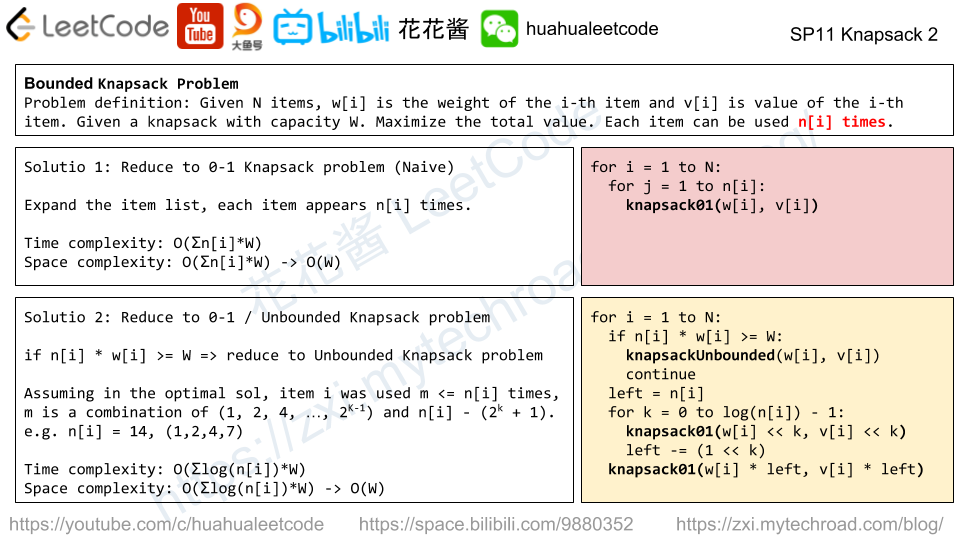
完全背包多重背包是常见的变形。和01背包的区别在于,完全背包每件物品可以使用无限多次,而多重背包每件物品最多可以使用n[i]次。两个问题都可以转换成01背包问题进行求解。

但是Naive的转换会大大增加时间复杂度:

完全背包:“复制”第i件物品到一共有 W/w[i] 件

多重背包:“复制”第i件物品到一共有 n[i] 件

然后直接调用01背包进行求解。

时间复杂度:

完全背包 O(Σ(W/w[i])*W)

多重背包 O(Σn[i]*W)

不难看出时间复杂度 = O(物品数量*背包承重)

背包承重是给定的,要降低运行时候,只有减少物品数量。但怎样才能减少总的物品数量呢?

这就涉及到二进制思想:任何一个正整数都可以用 (1, 2, 4, …, 2^K)的组合来表示。例如14 = 2 + 4 + 8。
原本需要放入14件相同的物品,现在只需要放入3件(重量和价值是原物品的2倍,4倍,8倍)。大幅降低了总的物品数量从而降低运行时间。

完全背包:对于第i件物品,我们只需要创建k = log(W/w[i])件虚拟物品即可。

每件虚拟物品的重量和价值为:1*(w[i], v[i]), 2*(w[i], v[i]), …, 2^k*(w[i], v[i])。

多重背包:对于第i件物品,我们只需要创建k + 1件虚拟物品即可,其中k = log(n[i])。

每件虚拟物品的重量和价值为:1*(w[i], v[i]), 2*(w[i], v[i]), …, 2^(k-1)*(w[i], v[i]), 以及 (n[i] – 2^k – 1) * (w[i], v[i])。

例如:n[i] = 14, k = 3, 虚拟物品的倍数为 1, 2, 4 和 7,这4个数组合可以组成1 ~ 14中的任何一个数,并且不会>14,即不超过n[i]。

二进制转换后直接调用01背包即可

时间复杂度:

完全背包 O(Σlog(W/w[i])*W)

多重背包 O(Σlog(n[i])*W)

空间复杂度 O(W)

其实完全背包和多重背包都可以在 O(NW)时间内完成,前者在视频中有讲到,后者属于超纲内容,以后有机会再和大家深入分享。

Bounded Knapsack Problem 多重背包


花花酱 LeetCode 648. Replace Words

Problem

https://leetcode.com/problems/replace-words/description/

In English, we have a concept called root, which can be followed by some other words to form another longer word – let’s call this word successor. For example, the root an, followed by other, which can form another word another.

Now, given a dictionary consisting of many roots and a sentence. You need to replace all the successor in the sentence with the root forming it. If a successor has many roots can form it, replace it with the root with the shortest length.

You need to output the sentence after the replacement.

Example 1:

Input: dict = ["cat", "bat", "rat"]
sentence = "the cattle was rattled by the battery"
Output: "the cat was rat by the bat"

Note:

  1. The input will only have lower-case letters.
  2. 1 <= dict words number <= 1000
  3. 1 <= sentence words number <= 1000
  4. 1 <= root length <= 100
  5. 1 <= sentence words length <= 1000

Solution 1: HashTable

Time complexity: O(sum(w^2))

Space complexity: O(sum(l))

Solution2: Trie

Time complexity: O(sum(l) + n)

Space complexity: O(sum(l) * 26)


花花酱 LeetCode 935. Knight Dialer

Problem

https://leetcode.com/problems/knight-dialer/description/

A chess knight can move as indicated in the chess diagram below:

 .           


This time, we place our chess knight on any numbered key of a phone pad (indicated above), and the knight makes N-1 hops.  Each hop must be from one key to another numbered key.

Each time it lands on a key (including the initial placement of the knight), it presses the number of that key, pressing N digits total.

How many distinct numbers can you dial in this manner?

Since the answer may be large, output the answer modulo 10^9 + 7.

Example 1:

Input: 1
Output: 10

Example 2:

Input: 2
Output: 20

Example 3:

Input: 3
Output: 46

Note:

  • 1 <= N <= 5000

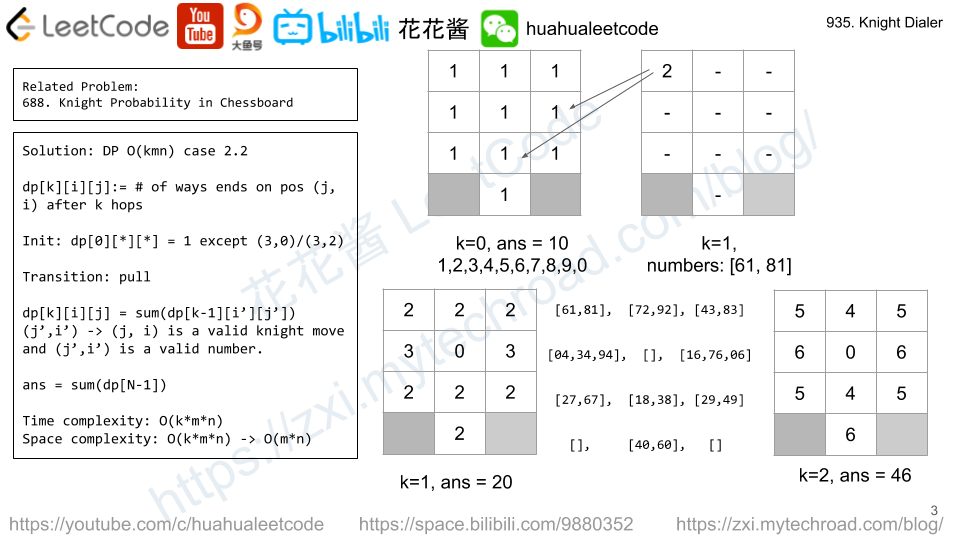
Solution: DP

V1

Similar to 花花酱 688. Knight Probability in Chessboard

We can define dp[k][i][j] as # of ways to dial and the last key is (j, i) after k steps

Note: dp[*][3][0], dp[*][3][2] are always zero for all the steps.

Init: dp[0][i][j] = 1

Transition: dp[k][i][j] = sum(dp[k – 1][i + dy][j + dx]) 8 ways of move from last step.

ans = sum(dp[k])

Time complexity: O(kmn) or O(k * 12 * 8) = O(k)

Space complexity: O(kmn) -> O(mn) or O(12*8) = O(1)

V2

define dp[k][i] as # of ways to dial and the last key is i after k steps

init: dp[0][0:10] = 1

transition: dp[k][i] = sum(dp[k-1][j]) that j can move to i

ans: sum(dp[k])

Time complexity: O(k * 10) = O(k)

Space complexity: O(k * 10) -> O(10) = O(1)

C++ V1

C++ V2

Related Problem

花花酱 LeetCode 933. Number of Recent Calls

Problem

Write a class RecentCounter to count recent requests.

It has only one method: ping(int t), where t represents some time in milliseconds.

Return the number of pings that have been made from 3000 milliseconds ago until now.

Any ping with time in [t - 3000, t] will count, including the current ping.

It is guaranteed that every call to ping uses a strictly larger value of t than before.

Example 1:

Input: inputs = ["RecentCounter","ping","ping","ping","ping"], inputs = [[],[1],[100],[3001],[3002]]
Output: [null,1,2,3,3]

Note:

  1. Each test case will have at most 10000 calls to ping.
  2. Each test case will call ping with strictly increasing values of t.
  3. Each call to ping will have 1 <= t <= 10^9.

Solution: Queue

Use a FIFO queue to track all the previous pings that are within 3000 ms to current.

Time complexity: Avg O(1), Total O(n)

Space complexity: O(n)

C++