Problem
A full binary tree is a binary tree where each node has exactly 0 or 2 children.
Return a list of all possible full binary trees with N nodes. Each element of the answer is the root node of one possible tree.
Each node of each tree in the answer must have node.val = 0.
You may return the final list of trees in any order.
Example 1:
Input: 7
Output: [[0,0,0,null,null,0,0,null,null,0,0],[0,0,0,null,null,0,0,0,0],[0,0,0,0,0,0,0],[0,0,0,0,0,null,null,null,null,0,0],[0,0,0,0,0,null,null,0,0]]
Explanation: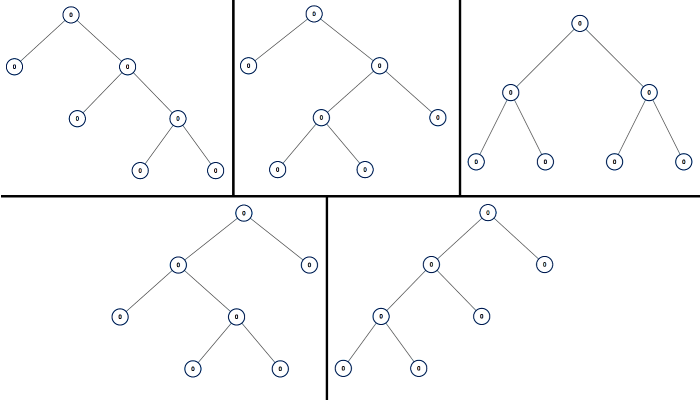
Note:
1 <= N <= 20
Solution: Recursion
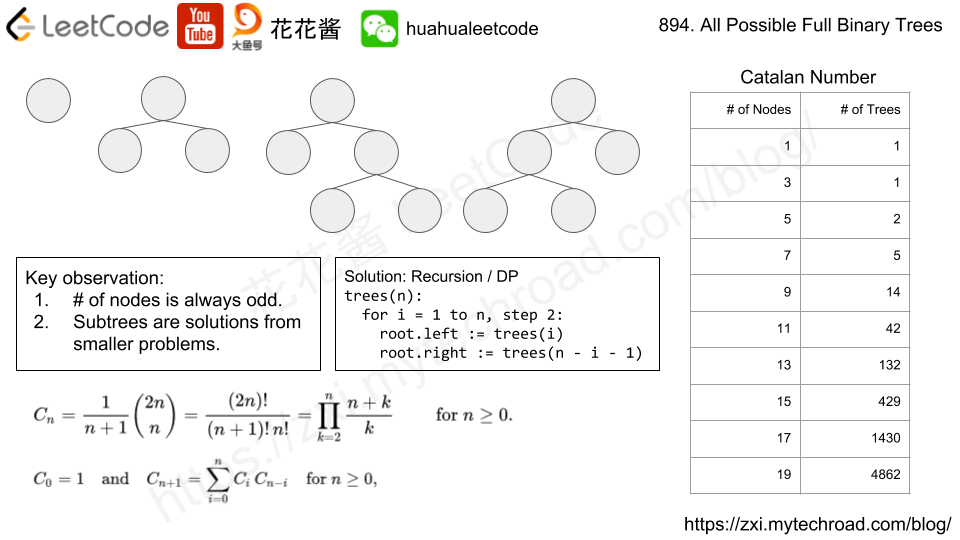
Key observations:
- n must be odd, If n is even, no possible trees
- ans is the cartesian product of trees(i) and trees(n-i-1). Ans = {Tree(0, l, r) for l, r in trees(i) X trees(N – i – 1)}.
w/o cache
C++
|
1 2 3 4 5 6 7 8 9 10 11 12 13 14 15 16 17 18 19 20 |
// Author: Huahua // Running time: 72 ms class Solution { public: vector<TreeNode*> allPossibleFBT(int N) { if (N % 2 == 0) return {}; if (N == 1) return {new TreeNode(0)}; vector<TreeNode*> ans; for (int i = 1; i < N; i += 2) { for (const auto& l : allPossibleFBT(i)) for (const auto& r : allPossibleFBT(N - i - 1)) { auto root = new TreeNode(0); root->left = l; root->right = r; ans.push_back(root); } } return ans; } }; |
Java
|
1 2 3 4 5 6 7 8 9 10 11 12 13 14 15 16 17 18 19 20 21 |
// Author: Huahua // Running time: 20 ms class Solution { public List<TreeNode> allPossibleFBT(int N) { List<TreeNode> ans = new ArrayList<>(); if (N % 2 == 0) return ans; if (N == 1) { ans.add(new TreeNode(0)); return ans; } for (int i = 1; i < N; i += 2) { for (TreeNode l : allPossibleFBT(i)) for (TreeNode r : allPossibleFBT(N - i - 1)) { TreeNode root = new TreeNode(0); root.left = l; root.right = r; ans.add(root); } } return ans; } |
Python
|
1 2 3 4 5 6 7 8 9 10 11 12 13 14 15 16 17 |
""" Author: Huahua Running time: 396 ms """ class Solution: def allPossibleFBT(self, N): if N % 2 == 0: return [] if N == 1: return [TreeNode(0)] ans = [] for i in range(1, N, 2): for l in self.allPossibleFBT(i): for r in self.allPossibleFBT(N - i - 1): root = TreeNode(0) root.left = l root.right = r ans.append(root) return ans |
w/cache
C++
|
1 2 3 4 5 6 7 8 9 10 11 12 13 14 15 16 17 18 19 20 21 22 23 24 25 26 27 28 |
// Author: Huahua // Running time: 68 ms static constexpr int kMaxN = 20 + 1; static array<vector<TreeNode*>, kMaxN> m; class Solution { public: vector<TreeNode*> allPossibleFBT(int N) { return trees(N); } private: vector<TreeNode*>& trees(int N) { if (m[N].size() > 0) return m[N]; vector<TreeNode*>& ans = m[N]; if (N % 2 == 0) return ans = {}; if (N == 1) ans = {new TreeNode(0)}; for (int i = 1; i < N; i += 2) { for (const auto& l : trees(i)) for (const auto& r : trees(N - i - 1)) { auto root = new TreeNode(0); root->left = l; root->right = r; ans.push_back(root); } } return ans; } }; |
Python
using itertools.product w/ cache
|
1 2 3 4 5 6 7 8 9 10 11 12 13 14 15 16 17 18 19 20 |
""" Author: Huahua Running time: 188 ms """ m = [[] for _ in range(21)] class Solution: def allPossibleFBT(self, N): if N % 2 == 0: return [] if N == 1: return [TreeNode(0)] if len(m[N]) > 0: return m[N] ans = [] for i in range(1, N, 2): for l, r in itertools.product(self.allPossibleFBT(i), self.allPossibleFBT(N - i - 1)): root = TreeNode(0) root.left = l root.right = r ans.append(root) m[N] = ans return ans |
DP
C++
|
1 2 3 4 5 6 7 8 9 10 11 12 13 14 15 16 17 18 19 20 21 22 |
// Author: Huahua // Running time: 100 ms class Solution { public: vector<TreeNode*> allPossibleFBT(int N) { if (N % 2 == 0) return {}; vector<vector<TreeNode*>> dp(N + 1); dp[1] = {new TreeNode(0)}; for (int i = 3; i <= N; i += 2) for (int j = 1; j < i; j += 2) { int k = i - j - 1; for (const auto& l : dp[j]) for (const auto& r : dp[k]) { auto root = new TreeNode(0); root->left = l; root->right = r; dp[i].push_back(root); } } return dp[N]; } }; |
Benchmark
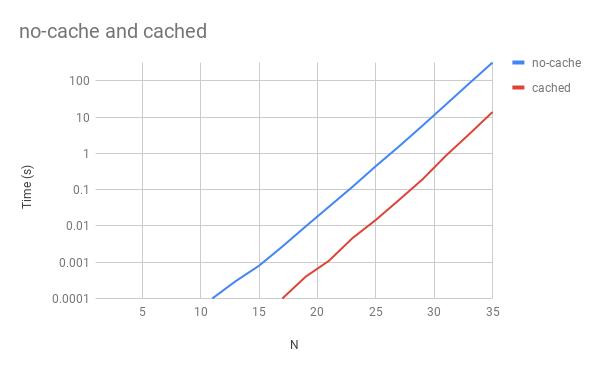
No-cache vs cached
C++
|
1 2 3 4 5 6 7 8 9 10 11 12 13 14 15 16 17 18 19 20 21 22 23 24 25 26 27 28 29 30 31 32 33 34 35 36 37 38 39 40 41 42 43 44 45 46 47 48 49 50 51 52 53 54 55 56 57 58 59 60 61 62 63 64 65 66 67 68 69 70 71 72 73 74 75 76 77 78 79 80 |
#include <iostream> #include <vector> #include <array> #include <ctime> #include <cstdio> using namespace std; struct TreeNode { int val; TreeNode *left; TreeNode *right; TreeNode(int x) : val(x), left(NULL), right(NULL) {} }; static constexpr int kMaxN = 101 + 1; static array<vector<TreeNode*>, kMaxN> m; class NoCache { public: vector<TreeNode*> allPossibleFBT(int N) { if (N % 2 == 0) return {}; if (N == 1) return {new TreeNode(0)}; vector<TreeNode*> ans; for (int i = 1; i < N; i += 2) { for (const auto& l : allPossibleFBT(i)) for (const auto& r : allPossibleFBT(N - i - 1)) { auto root = new TreeNode(0); root->left = l; root->right = r; ans.push_back(root); } } return ans; } }; class Cached { public: vector<TreeNode*> allPossibleFBT(int N) { return trees(N); } private: vector<TreeNode*>& trees(int N) { if (m[N].size() > 0) return m[N]; vector<TreeNode*>& ans = m[N]; if (N % 2 == 0) return ans = {}; if (N == 1) ans = {new TreeNode(0)}; for (int i = 1; i < N; i += 2) { for (const auto& l : trees(i)) for (const auto& r : trees(N - i - 1)) { auto root = new TreeNode(0); root->left = l; root->right = r; ans.push_back(root); } } return ans; } }; int main(int argc, char** argv) { printf("N\tno-cache\tcached\n"); for (int i = 1; i <= 35; i += 2) { printf("%02d\t", i); { auto start = clock(); (void)(NoCache().allPossibleFBT(i)); printf("%8.4f\t", static_cast<double>(clock() - start) / CLOCKS_PER_SEC); } { // Clear the cache. for (int j = 0; j < kMaxN; ++j) m[i].clear(); auto start = clock(); (void)(Cached().allPossibleFBT(i)); printf("%8.4f\n", static_cast<double>(clock() - start) / CLOCKS_PER_SEC); } } return 0; } |