Given an array of integers A, consider all non-empty subsequences of A.
For any sequence S, let the width of S be the difference between the maximum and minimum element of S.
Return the sum of the widths of all subsequences of A.
As the answer may be very large, return the answer modulo 10^9 + 7.
Example 1:
Input: [2,1,3]Output: 6Explanation:
Subsequences are [1], [2], [3], [2,1], [2,3], [1,3], [2,1,3].
The corresponding widths are 0, 0, 0, 1, 1, 2, 2.
The sum of these widths is 6.
Note:
1 <= A.length <= 20000
1 <= A[i] <= 20000
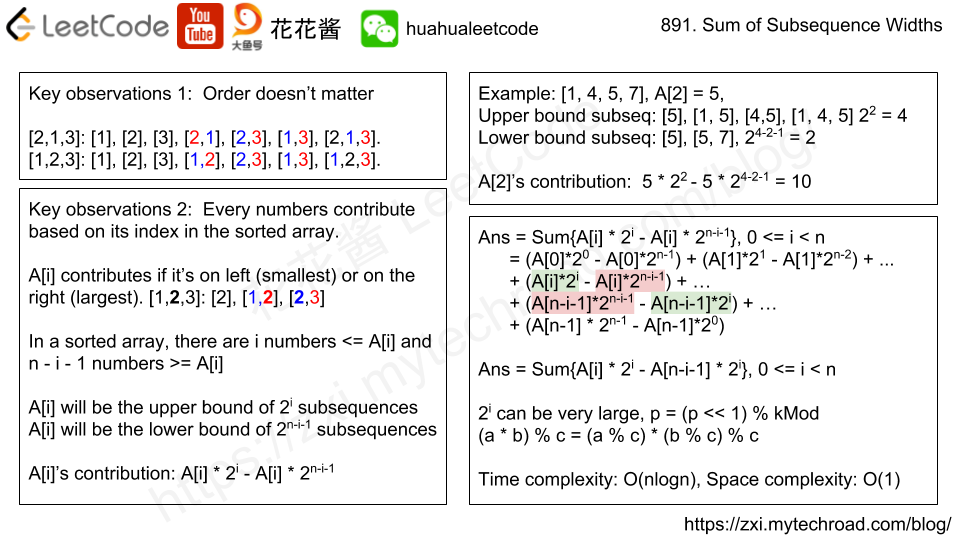
Solution: Math
Sort the array, for A[i]:
i numbers <= A[i]. A[i] is the upper bound of 2^i subsequences.
n – i – 1 numbers >= A[i]. A[i] is the lower bound of 2^(n – i – 1) subsequences.
A[i] contributes A[i] * 2^i – A[i] * 2^(n – i – 1) to the ans.
You have a list of words and a pattern, and you want to know which words in words matches the pattern.
A word matches the pattern if there exists a permutation of letters p so that after replacing every letter x in the pattern with p(x), we get the desired word.
(Recall that a permutation of letters is a bijection from letters to letters: every letter maps to another letter, and no two letters map to the same letter.)
Return a list of the words in words that match the given pattern.
You may return the answer in any order.
Example 1:
Input: words = ["abc","deq","mee","aqq","dkd","ccc"], pattern = "abb"Output: ["mee","aqq"]Explanation: "mee" matches the pattern because there is a permutation {a -> m, b -> e, ...}.
"ccc" does not match the pattern because {a -> c, b -> c, ...} is not a permutation,
since a and b map to the same letter.
Alice and Bob have candy bars of different sizes: A[i] is the size of the i-th bar of candy that Alice has, and B[j] is the size of the j-th bar of candy that Bob has.
Since they are friends, they would like to exchange one candy bar each so that after the exchange, they both have the same total amount of candy. (The total amount of candy a person has is the sum of the sizes of candy bars they have.)
Return an integer array ans where ans[0] is the size of the candy bar that Alice must exchange, and ans[1] is the size of the candy bar that Bob must exchange.
If there are multiple answers, you may return any one of them. It is guaranteed an answer exists.
Example 1:
Input: A = [1,1], B = [2,2]Output: [1,2]
Example 2:
Input: A = [1,2], B = [2,3]Output: [1,2]
Example 3:
Input: A = [2], B = [1,3]Output: [2,3]
Example 4:
Input: A = [1,2,5], B = [2,4]Output: [5,4]
Note:
1 <= A.length <= 10000
1 <= B.length <= 10000
1 <= A[i] <= 100000
1 <= B[i] <= 100000
It is guaranteed that Alice and Bob have different total amounts of candy.
Given two binary trees and imagine that when you put one of them to cover the other, some nodes of the two trees are overlapped while the others are not.
You need to merge them into a new binary tree. The merge rule is that if two nodes overlap, then sum node values up as the new value of the merged node. Otherwise, the NOT null node will be used as the node of new tree.