Given an array, rotate the array to the right by k steps, where k is non-negative.
Example 1:
Input: [1,2,3,4,5,6,7] and k = 3
Output: [5,6,7,1,2,3,4]
Explanation: rotate 1 steps to the right: [7,1,2,3,4,5,6] rotate 2 steps to the right: [6,7,1,2,3,4,5]
rotate 3 steps to the right: [5,6,7,1,2,3,4]
Example 2:
Input:[-1,-100,3,99] and k = 2
Output: [3,99,-1,-100]
Explanation: rotate 1 steps to the right: [99,-1,-100,3] rotate 2 steps to the right: [3,99,-1,-100]
Note:
Try to come up as many solutions as you can, there are at least 3 different ways to solve this problem.
Could you do it in-place with O(1) extra space?
Solution 1: Simulate rotation with three reverses.
If k >= n, rotating k times has the same effect as rotating k % n times.
[1,2,3,4,5,6,7], K = 3
[5,6,7,1,2,3,4]
We can simulate the rotation with three reverses.
reverse the whole array O(n) [7,6,5,4,3,2,1]
reverse the left part 0 ~ k – 1 O(k) [5,6,7,4,3,2,1]
reverse the right part k ~ n – 1 O(n-k) [5,6,7,1,2,3,4]
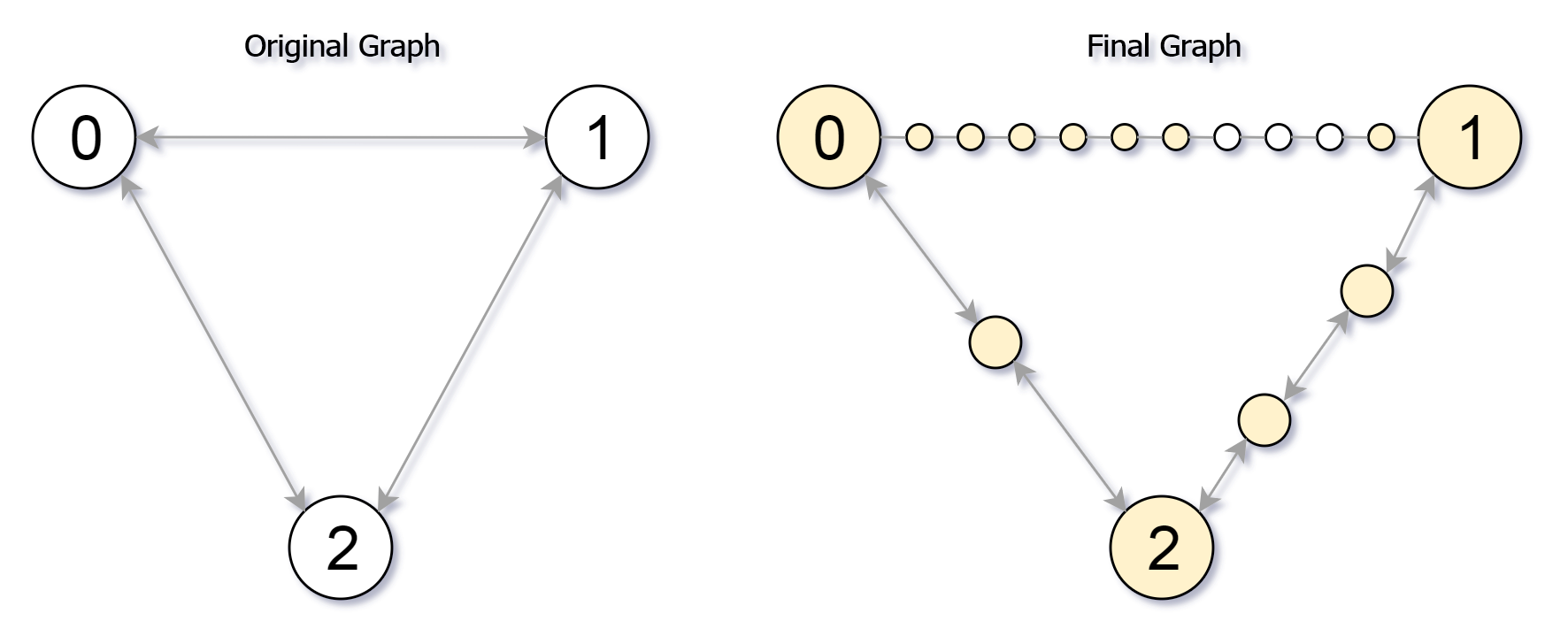
Starting with an undirected graph (the “original graph”) with nodes from 0 to N-1, subdivisions are made to some of the edges.
The graph is given as follows: edges[k] is a list of integer pairs (i, j, n) such that (i, j) is an edge of the original graph,
and n is the total number of new nodes on that edge.
Then, the edge (i, j) is deleted from the original graph, n new nodes (x_1, x_2, ..., x_n) are added to the original graph,
and n+1 new edges (i, x_1), (x_1, x_2), (x_2, x_3), ..., (x_{n-1}, x_n), (x_n, j) are added to the original graph.
Now, you start at node 0 from the original graph, and in each move, you travel along one edge.
Return how many nodes you can reach in at most M moves.
Example 1:
Input: edge = [[0,1,10],[0,2,1],[1,2,2]], M = 6, N = 3Output: 13Explanation: The nodes that are reachable in the final graph after M = 6 moves are indicated below.
Example 2:
Input: edges = [[0,1,4],[1,2,6],[0,2,8],[1,3,1]], M = 10, N = 4
Output: 23
Note:
0 <= edges.length <= 10000
0 <= edges[i][0] < edges[i][1] < N
There does not exist any i != j for which edges[i][0] == edges[j][0] and edges[i][1] == edges[j][1].
The original graph has no parallel edges.
0 <= edges[i][2] <= 10000
0 <= M <= 10^9
1 <= N <= 3000
Solution: Dijkstra Shortest Path
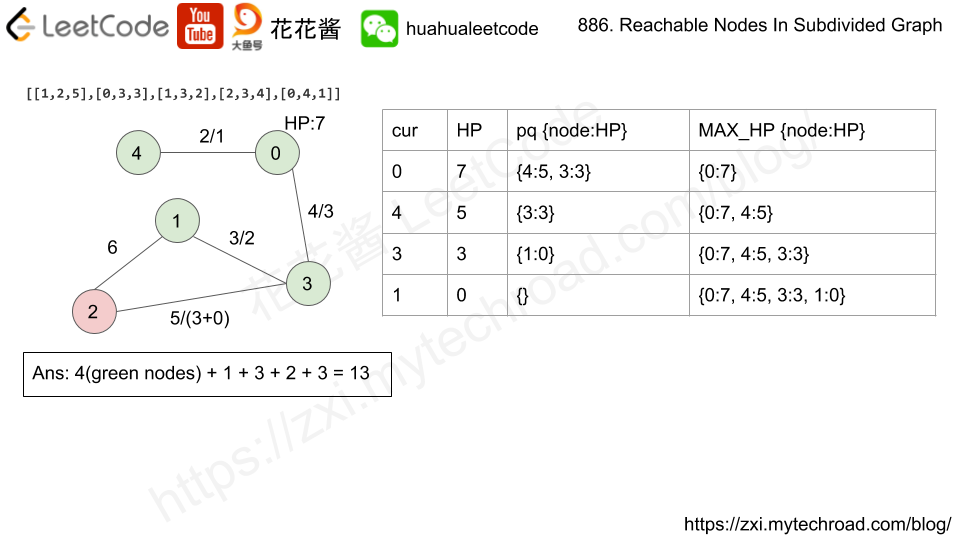
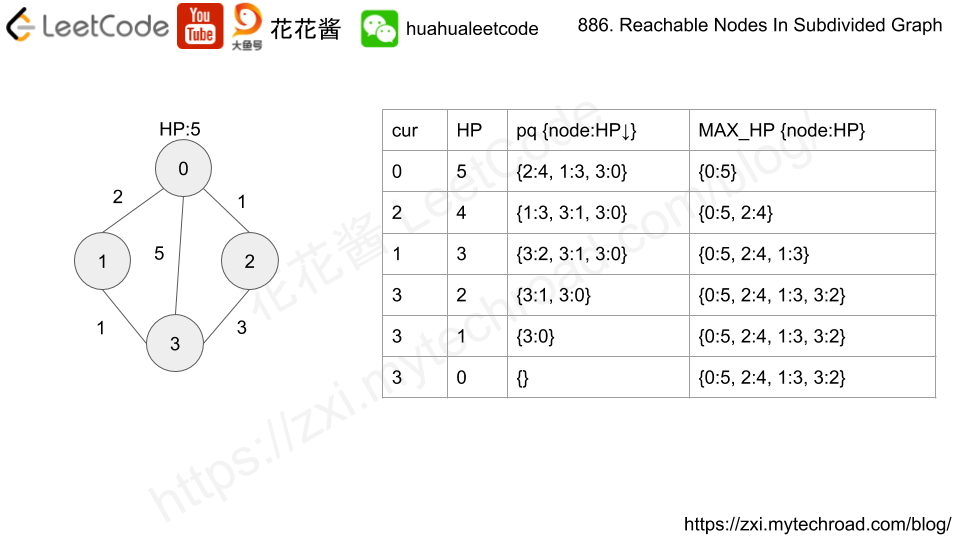
Compute the shortest from 0 to rest of the nodes. Use HP to mark the maximum moves left to reach each node.