Press "Enter" to skip to content

Huahua's Tech Road

花花酱 LeetCode 2373. Largest Local Values in a Matrix

You are given an n x n integer matrix grid.

Generate an integer matrix maxLocal of size (n - 2) x (n - 2) such that:

  • maxLocal[i][j] is equal to the largest value of the 3 x 3 matrix in grid centered around row i + 1 and column j + 1.

In other words, we want to find the largest value in every contiguous 3 x 3 matrix in grid.

Return the generated matrix.

Example 1:

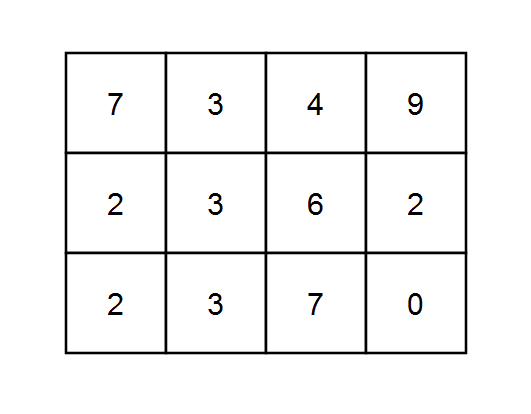
Input: grid = [[9,9,8,1],[5,6,2,6],[8,2,6,4],[6,2,2,2]]
Output: [[9,9],[8,6]]
Explanation: The diagram above shows the original matrix and the generated matrix.
Notice that each value in the generated matrix corresponds to the largest value of a contiguous 3 x 3 matrix in grid.

Example 2:

Input: grid = [[1,1,1,1,1],[1,1,1,1,1],[1,1,2,1,1],[1,1,1,1,1],[1,1,1,1,1]]
Output: [[2,2,2],[2,2,2],[2,2,2]]
Explanation: Notice that the 2 is contained within every contiguous 3 x 3 matrix in grid.

Constraints:

  • n == grid.length == grid[i].length
  • 3 <= n <= 100
  • 1 <= grid[i][j] <= 100

Solution: Brute Force

Time complexity: O(n*n*9)
Space complexity: O(n*n)

C++

花花酱 LeetCode 133. Clone Graph

Given a reference of a node in a connected undirected graph.

Return a deep copy (clone) of the graph.

Each node in the graph contains a value (int) and a list (List[Node]) of its neighbors.

class Node {
    public int val;
    public List neighbors;
}

Test case format:

For simplicity, each node’s value is the same as the node’s index (1-indexed). For example, the first node with val == 1, the second node with val == 2, and so on. The graph is represented in the test case using an adjacency list.

An adjacency list is a collection of unordered lists used to represent a finite graph. Each list describes the set of neighbors of a node in the graph.

The given node will always be the first node with val = 1. You must return the copy of the given node as a reference to the cloned graph.

Example 1:

Input: adjList = [[2,4],[1,3],[2,4],[1,3]]
Output: [[2,4],[1,3],[2,4],[1,3]]
Explanation: There are 4 nodes in the graph.
1st node (val = 1)'s neighbors are 2nd node (val = 2) and 4th node (val = 4).
2nd node (val = 2)'s neighbors are 1st node (val = 1) and 3rd node (val = 3).
3rd node (val = 3)'s neighbors are 2nd node (val = 2) and 4th node (val = 4).
4th node (val = 4)'s neighbors are 1st node (val = 1) and 3rd node (val = 3).

Example 2:

Input: adjList = [[]]
Output: [[]]
Explanation: Note that the input contains one empty list. The graph consists of only one node with val = 1 and it does not have any neighbors.

Example 3:

Input: adjList = []
Output: []
Explanation: This an empty graph, it does not have any nodes.

Constraints:

  • The number of nodes in the graph is in the range [0, 100].
  • 1 <= Node.val <= 100
  • Node.val is unique for each node.
  • There are no repeated edges and no self-loops in the graph.
  • The Graph is connected and all nodes can be visited starting from the given node.

Solution: DFS + Hashtable

Time complexity: O(V+E)
Space complexity: O(V+E)

C++

花花酱 LeetCode 2317. Maximum XOR After Operations

You are given a 0-indexed integer array nums. In one operation, select any non-negative integer x and an index i, then update nums[i] to be equal to nums[i] AND (nums[i] XOR x).

Note that AND is the bitwise AND operation and XOR is the bitwise XOR operation.

Return the maximum possible bitwise XOR of all elements of nums after applying the operation any number of times.

Example 1:

Input: nums = [3,2,4,6]
Output: 7
Explanation: Apply the operation with x = 4 and i = 3, num[3] = 6 AND (6 XOR 4) = 6 AND 2 = 2.
Now, nums = [3, 2, 4, 2] and the bitwise XOR of all the elements = 3 XOR 2 XOR 4 XOR 2 = 7.
It can be shown that 7 is the maximum possible bitwise XOR.
Note that other operations may be used to achieve a bitwise XOR of 7.

Example 2:

Input: nums = [1,2,3,9,2]
Output: 11
Explanation: Apply the operation zero times.
The bitwise XOR of all the elements = 1 XOR 2 XOR 3 XOR 9 XOR 2 = 11.
It can be shown that 11 is the maximum possible bitwise XOR.

Constraints:

  • 1 <= nums.length <= 105
  • 0 <= nums[i] <= 108

Solution: Bitwise OR

The maximum possible number MAX = nums[0] | nums[1] | … | nums[n – 1].

We need to prove:
1) MAX is achievable.
2) MAX is the largest number we can get.

nums[i] AND (nums[i] XOR x) means that we can turn any 1 bits to 0 for nums[i].

1) If the i-th bit of MAX is 1, which means there are at least one number with i-th bit equals to 1, however, for XOR, if there are even numbers with i-th bit equal to one, the final results will be 0 for i-th bit, we get a smaller number. By using the operation, we can choose one of them and flip the bit.

**1** XOR **1** XOR **1** XOR **1** = **0** =>
**0** XOR **1** XOR **1** XOR **1** = **1**

2) If the i-th bit of MAX is 0, which means the i-th bit of all the numbers is 0, there is nothing we can do with the operation, and the XOR will be 0 as well.
e.g. **0** XOR **0** XOR **0** XOR **0** = **0**

Time complexity: O(n)
Space complexity: O(1)

C++

花花酱 LeetCode 2316. Count Unreachable Pairs of Nodes in an Undirected Graph

You are given an integer n. There is an undirected graph with n nodes, numbered from 0 to n - 1. You are given a 2D integer array edges where edges[i] = [ai, bi] denotes that there exists an undirected edge connecting nodes ai and bi.

Return the number of pairs of different nodes that are unreachable from each other.

Example 1:

Input: n = 3, edges = [[0,1],[0,2],[1,2]]
Output: 0
Explanation: There are no pairs of nodes that are unreachable from each other. Therefore, we return 0.

Example 2:

Input: n = 7, edges = [[0,2],[0,5],[2,4],[1,6],[5,4]]
Output: 14
Explanation: There are 14 pairs of nodes that are unreachable from each other:
[[0,1],[0,3],[0,6],[1,2],[1,3],[1,4],[1,5],[2,3],[2,6],[3,4],[3,5],[3,6],[4,6],[5,6]].
Therefore, we return 14.

Constraints:

  • 1 <= n <= 105
  • 0 <= edges.length <= 2 * 105
  • edges[i].length == 2
  • 0 <= ai, bi < n
  • ai != bi
  • There are no repeated edges.

Solution 1: DFS

Use DFS to find all CCs

Time complexity: O(V+E)
Space complexity: O(V+E)

C++

Solution 2: Union Find

Time complexity: O(V+E)
Space complexity: O(V)

C++

花花酱 LeetCode 2315. Count Asterisks

You are given a string s, where every two consecutive vertical bars '|' are grouped into a pair. In other words, the 1st and 2nd '|' make a pair, the 3rd and 4th '|' make a pair, and so forth.

Return the number of '*' in sexcluding the '*' between each pair of '|'.

Note that each '|' will belong to exactly one pair.

Example 1:

Input: s = "l|*e*et|c**o|*de|"
Output: 2
Explanation: The considered characters are underlined: "l|*e*et|c**o|*de|".
The characters between the first and second '|' are excluded from the answer.
Also, the characters between the third and fourth '|' are excluded from the answer.
There are 2 asterisks considered. Therefore, we return 2.

Example 2:

Input: s = "iamprogrammer"
Output: 0
Explanation: In this example, there are no asterisks in s. Therefore, we return 0.

Example 3:

Input: s = "yo|uar|e**|b|e***au|tifu|l"
Output: 5
Explanation: The considered characters are underlined: "yo|uar|e**|b|e***au|tifu|l". There are 5 asterisks considered. Therefore, we return 5.

Constraints:

  • 1 <= s.length <= 1000
  • s consists of lowercase English letters, vertical bars '|', and asterisks '*'.
  • s contains an even number of vertical bars '|'.

Solution: Counting

Count the number of bars so far, and only count ‘*’ when there are even number of bars on the left.

Time complexity: O(n)
Space complexity: O(1)

C++