Press "Enter" to skip to content

Huahua's Tech Road

花花酱 LeetCode 2399. Check Distances Between Same Letters

You are given a 0-indexed string s consisting of only lowercase English letters, where each letter in s appears exactly twice. You are also given a 0-indexed integer array distance of length 26.

Each letter in the alphabet is numbered from 0 to 25 (i.e. 'a' -> 0, 'b' -> 1, 'c' -> 2, … , 'z' -> 25).

In a well-spaced string, the number of letters between the two occurrences of the ith letter is distance[i]. If the ith letter does not appear in s, then distance[i] can be ignored.

Return true if s is a well-spaced string, otherwise return false.

Example 1:

Input: s = "abaccb", distance = [1,3,0,5,0,0,0,0,0,0,0,0,0,0,0,0,0,0,0,0,0,0,0,0,0,0]
Output: true
Explanation:
- 'a' appears at indices 0 and 2 so it satisfies distance[0] = 1.
- 'b' appears at indices 1 and 5 so it satisfies distance[1] = 3.
- 'c' appears at indices 3 and 4 so it satisfies distance[2] = 0.
Note that distance[3] = 5, but since 'd' does not appear in s, it can be ignored.
Return true because s is a well-spaced string.

Example 2:

Input: s = "aa", distance = [1,0,0,0,0,0,0,0,0,0,0,0,0,0,0,0,0,0,0,0,0,0,0,0,0,0]
Output: false
Explanation:
- 'a' appears at indices 0 and 1 so there are zero letters between them.
Because distance[0] = 1, s is not a well-spaced string.

Constraints:

  • 2 <= s.length <= 52
  • s consists only of lowercase English letters.
  • Each letter appears in s exactly twice.
  • distance.length == 26
  • 0 <= distance[i] <= 50

Solution: Hashtable

Use a hastable to store the index of first occurrence of each letter.

Time complexity: O(n)
Space complexity: O(26)

C++

花花酱 LeetCode 2407. Longest Increasing Subsequence II

You are given an integer array nums and an integer k.

Find the longest subsequence of nums that meets the following requirements:

  • The subsequence is strictly increasing and
  • The difference between adjacent elements in the subsequence is at most k.

Return the length of the longest subsequence that meets the requirements.

A subsequence is an array that can be derived from another array by deleting some or no elements without changing the order of the remaining elements.

Example 1:

Input: nums = [4,2,1,4,3,4,5,8,15], k = 3
Output: 5
Explanation:
The longest subsequence that meets the requirements is [1,3,4,5,8].
The subsequence has a length of 5, so we return 5.
Note that the subsequence [1,3,4,5,8,15] does not meet the requirements because 15 - 8 = 7 is larger than 3.

Example 2:

Input: nums = [7,4,5,1,8,12,4,7], k = 5
Output: 4
Explanation:
The longest subsequence that meets the requirements is [4,5,8,12].
The subsequence has a length of 4, so we return 4.

Example 3:

Input: nums = [1,5], k = 1
Output: 1
Explanation:
The longest subsequence that meets the requirements is [1].
The subsequence has a length of 1, so we return 1.

Constraints:

  • 1 <= nums.length <= 105
  • 1 <= nums[i], k <= 105

Solution: DP + Segment Tree | Max range query

Let dp[i] := length of LIS end with number i.
dp[i] = 1 + max(dp[i-k:i])

Naive dp takes O(n*k) time which will cause TLE.

We can use segment tree to speed up the max range query to log(m), where m is the max value of the array.

Time complexity: O(n*logm)
Space complexity: O(m)

C++

花花酱 LeetCode 2405. Optimal Partition of String

Given a string s, partition the string into one or more substrings such that the characters in each substring are unique. That is, no letter appears in a single substring more than once.

Return the minimum number of substrings in such a partition.

Note that each character should belong to exactly one substring in a partition.

Example 1:

Input: s = "abacaba"
Output: 4
Explanation:
Two possible partitions are ("a","ba","cab","a") and ("ab","a","ca","ba").
It can be shown that 4 is the minimum number of substrings needed.

Example 2:

Input: s = "ssssss"
Output: 6
Explanation:
The only valid partition is ("s","s","s","s","s","s").

Constraints:

  • 1 <= s.length <= 105
  • s consists of only English lowercase letters.

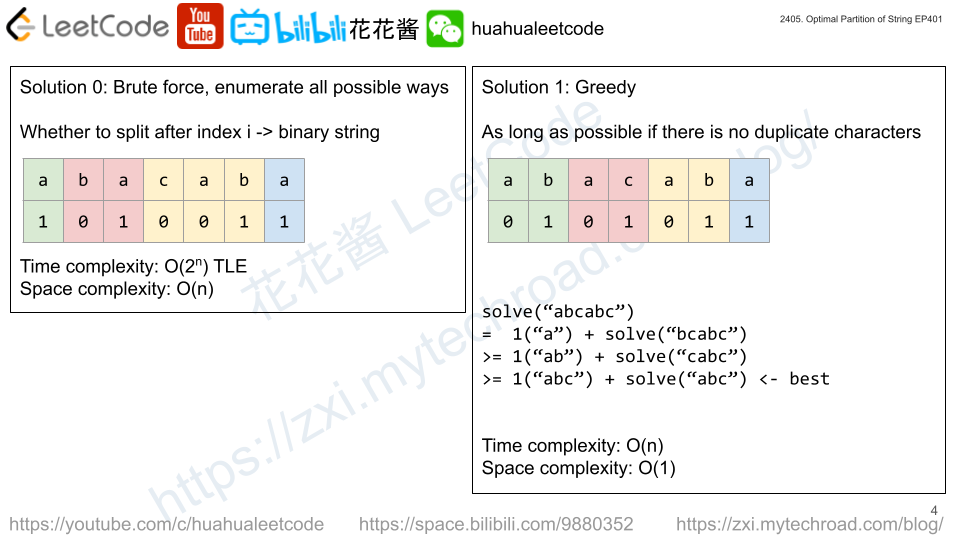
Solution: Greedy

Extend the cur string as long as possible unless a duplicate character occurs.

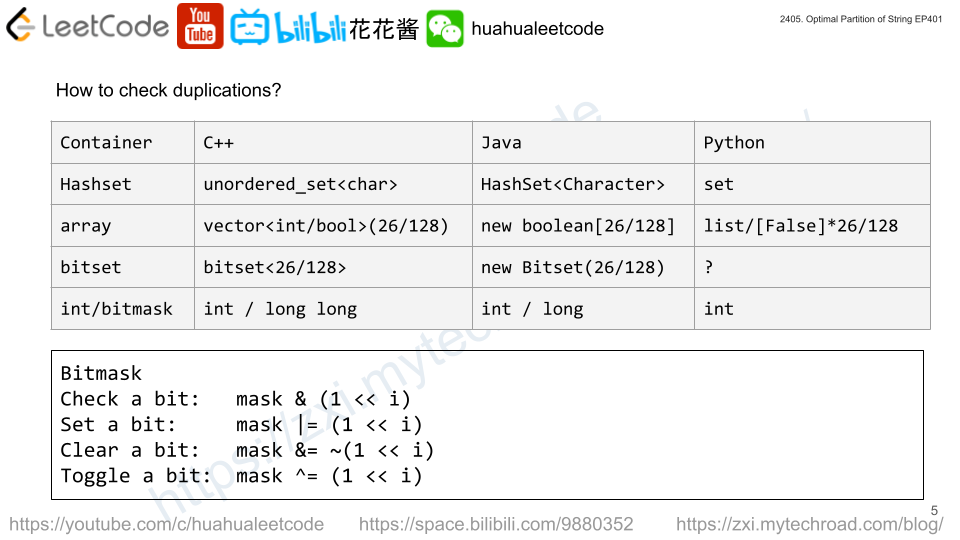
You can use hashtable / array or bitmask to mark whether a character has been seen so far.

Time complexity: O(n)
Space complexity: O(1)

C++

C++

C++

花花酱 LeetCode 2404. Most Frequent Even Element

Given an integer array nums, return the most frequent even element.

If there is a tie, return the smallest one. If there is no such element, return -1.

Example 1:

Input: nums = [0,1,2,2,4,4,1]
Output: 2
Explanation:
The even elements are 0, 2, and 4. Of these, 2 and 4 appear the most.
We return the smallest one, which is 2.

Example 2:

Input: nums = [4,4,4,9,2,4]
Output: 4
Explanation: 4 is the even element appears the most.

Example 3:

Input: nums = [29,47,21,41,13,37,25,7]
Output: -1
Explanation: There is no even element.

Constraints:

  • 1 <= nums.length <= 2000
  • 0 <= nums[i] <= 105

Solution: Hashtable

Use a hashtable to store the frequency of even numbers.

Time complexity: O(n)
Space complexity: O(n)

C++

花花酱 LeetCode 2396. Strictly Palindromic Number

An integer n is strictly palindromic if, for every base b between 2 and n - 2 (inclusive), the string representation of the integer n in base b is palindromic.

Given an integer n, return true if n is strictly palindromic and false otherwise.

A string is palindromic if it reads the same forward and backward.

Example 1:

Input: n = 9
Output: false
Explanation: In base 2: 9 = 1001 (base 2), which is palindromic.
In base 3: 9 = 100 (base 3), which is not palindromic.
Therefore, 9 is not strictly palindromic so we return false.
Note that in bases 4, 5, 6, and 7, n = 9 is also not palindromic.

Example 2:

Input: n = 4
Output: false
Explanation: We only consider base 2: 4 = 100 (base 2), which is not palindromic.
Therefore, we return false.

Constraints:

  • 4 <= n <= 105

Solution: Just return false

No such number.

Time complexity: O(1)
Space complexity: O(1)

C++