Given an integer array nums, return the number of elements that have both a strictly smaller and a strictly greater element appear in nums.
Example 1:
Input: nums = [11,7,2,15]
Output: 2
Explanation: The element 7 has the element 2 strictly smaller than it and the element 11 strictly greater than it.
Element 11 has element 7 strictly smaller than it and element 15 strictly greater than it.
In total there are 2 elements having both a strictly smaller and a strictly greater element appear in nums.
Example 2:
Input: nums = [-3,3,3,90]
Output: 2
Explanation: The element 3 has the element -3 strictly smaller than it and the element 90 strictly greater than it.
Since there are two elements with the value 3, in total there are 2 elements having both a strictly smaller and a strictly greater element appear in nums.
Constraints:
1 <= nums.length <= 100
-105 <= nums[i] <= 105
Solution: Min / Max elements
Find min and max of the array, count elements other than those two.
Along a long library corridor, there is a line of seats and decorative plants. You are given a 0-indexed string corridor of length n consisting of letters 'S' and 'P' where each 'S' represents a seat and each 'P' represents a plant.
One room divider has already been installed to the left of index 0, and another to the right of index n - 1. Additional room dividers can be installed. For each position between indices i - 1 and i (1 <= i <= n - 1), at most one divider can be installed.
Divide the corridor into non-overlapping sections, where each section has exactly two seats with any number of plants. There may be multiple ways to perform the division. Two ways are different if there is a position with a room divider installed in the first way but not in the second way.
Return the number of ways to divide the corridor. Since the answer may be very large, return it modulo109 + 7. If there is no way, return 0.
Example 1:
Input: corridor = "SSPPSPS"
Output: 3
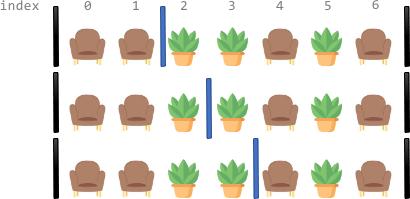
Explanation: There are 3 different ways to divide the corridor.
The black bars in the above image indicate the two room dividers already installed.
Note that in each of the ways, each section has exactly two seats.
Example 2:
Input: corridor = "PPSPSP"
Output: 1
Explanation: There is only 1 way to divide the corridor, by not installing any additional dividers.
Installing any would create some section that does not have exactly two seats.
Example 3:
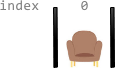
Input: corridor = "S"
Output: 0
Explanation: There is no way to divide the corridor because there will always be a section that does not have exactly two seats.
Constraints:
n == corridor.length
1 <= n <= 105
corridor[i] is either 'S' or 'P'.
Solution: Combination
If the 2k-th seat is positioned at j, and the 2k+1-th seat is at i. There are (i – j) ways to split between these two groups.
You are given a 0-indexed 2D integer array grid of size m x n that represents a map of the items in a shop. The integers in the grid represent the following:
0 represents a wall that you cannot pass through.
1 represents an empty cell that you can freely move to and from.
All other positive integers represent the price of an item in that cell. You may also freely move to and from these item cells.
It takes 1 step to travel between adjacent grid cells.
You are also given integer arrays pricing and start where pricing = [low, high] and start = [row, col] indicates that you start at the position (row, col) and are interested only in items with a price in the range of [low, high] (inclusive). You are further given an integer k.
You are interested in the positions of the khighest-ranked items whose prices are within the given price range. The rank is determined by the first of these criteria that is different:
Distance, defined as the length of the shortest path from the start (shorter distance has a higher rank).
Price (lower price has a higher rank, but it must be in the price range).
The row number (smaller row number has a higher rank).
The column number (smaller column number has a higher rank).
Return the k highest-ranked items within the price range sorted by their rank (highest to lowest). If there are fewer than k reachable items within the price range, return all of them.
Example 1:
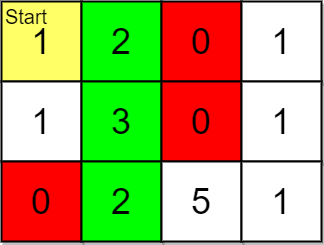
Input: grid = [[1,2,0,1],[1,3,0,1],[0,2,5,1]], pricing = [2,5], start = [0,0], k = 3
Output: [[0,1],[1,1],[2,1]]
Explanation: You start at (0,0).
With a price range of [2,5], we can take items from (0,1), (1,1), (2,1) and (2,2).
The ranks of these items are:
- (0,1) with distance 1
- (1,1) with distance 2
- (2,1) with distance 3
- (2,2) with distance 4
Thus, the 3 highest ranked items in the price range are (0,1), (1,1), and (2,1).
Example 2:
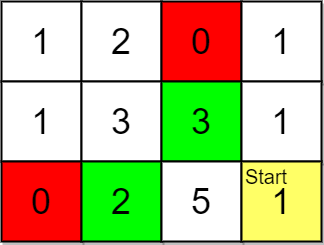
Input: grid = [[1,2,0,1],[1,3,3,1],[0,2,5,1]], pricing = [2,3], start = [2,3], k = 2
Output: [[2,1],[1,2]]
Explanation: You start at (2,3).
With a price range of [2,3], we can take items from (0,1), (1,1), (1,2) and (2,1).
The ranks of these items are:
- (2,1) with distance 2, price 2
- (1,2) with distance 2, price 3
- (1,1) with distance 3
- (0,1) with distance 4
Thus, the 2 highest ranked items in the price range are (2,1) and (1,2).
Example 3:
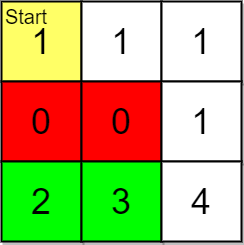
Input: grid = [[1,1,1],[0,0,1],[2,3,4]], pricing = [2,3], start = [0,0], k = 3
Output: [[2,1],[2,0]]
Explanation: You start at (0,0).
With a price range of [2,3], we can take items from (2,0) and (2,1).
The ranks of these items are:
- (2,1) with distance 5
- (2,0) with distance 6
Thus, the 2 highest ranked items in the price range are (2,1) and (2,0).
Note that k = 3 but there are only 2 reachable items within the price range.
Constraints:
m == grid.length
n == grid[i].length
1 <= m, n <= 105
1 <= m * n <= 105
0 <= grid[i][j] <= 105
pricing.length == 2
2 <= low <= high <= 105
start.length == 2
0 <= row <= m - 1
0 <= col <= n - 1
grid[row][col] > 0
1 <= k <= m * n
Solution: BFS + Sorting
Use BFS to collect reachable cells and sort afterwards.
Time complexity: O(mn + KlogK) where K = # of reachable cells.
You are given a 0-indexed array of n integers differences, which describes the differences between each pair of consecutive integers of a hidden sequence of length (n + 1). More formally, call the hidden sequence hidden, then we have that differences[i] = hidden[i + 1] - hidden[i].
You are further given two integers lower and upper that describe the inclusive range of values [lower, upper] that the hidden sequence can contain.
For example, given differences = [1, -3, 4], lower = 1, upper = 6, the hidden sequence is a sequence of length 4 whose elements are in between 1 and 6 (inclusive).
[3, 4, 1, 5] and [4, 5, 2, 6] are possible hidden sequences.
[5, 6, 3, 7] is not possible since it contains an element greater than 6.
[1, 2, 3, 4] is not possible since the differences are not correct.
Return the number of possible hidden sequences there are. If there are no possible sequences, return 0.
A shop is selling candies at a discount. For every two candies sold, the shop gives a third candy for free.
The customer can choose any candy to take away for free as long as the cost of the chosen candy is less than or equal to the minimum cost of the two candies bought.
For example, if there are 4 candies with costs 1, 2, 3, and 4, and the customer buys candies with costs 2 and 3, they can take the candy with cost 1 for free, but not the candy with cost 4.
Given a 0-indexed integer array cost, where cost[i] denotes the cost of the ith candy, return the minimum cost of buying all the candies.
Example 1:
Input: cost = [1,2,3]
Output: 5
Explanation: We buy the candies with costs 2 and 3, and take the candy with cost 1 for free.
The total cost of buying all candies is 2 + 3 = 5. This is the only way we can buy the candies.
Note that we cannot buy candies with costs 1 and 3, and then take the candy with cost 2 for free.
The cost of the free candy has to be less than or equal to the minimum cost of the purchased candies.
Example 2:
Input: cost = [6,5,7,9,2,2]
Output: 23
Explanation: The way in which we can get the minimum cost is described below:
- Buy candies with costs 9 and 7
- Take the candy with cost 6 for free
- We buy candies with costs 5 and 2
- Take the last remaining candy with cost 2 for free
Hence, the minimum cost to buy all candies is 9 + 7 + 5 + 2 = 23.
Example 3:
Input: cost = [5,5]
Output: 10
Explanation: Since there are only 2 candies, we buy both of them. There is not a third candy we can take for free.
Hence, the minimum cost to buy all candies is 5 + 5 = 10.
Constraints:
1 <= cost.length <= 100
1 <= cost[i] <= 100
Solution: Greedy
Sort candies in descending order. Buy 1st, 2nd, take 3rd, buy 4th, 5th take 6th, …