Press "Enter" to skip to content

Huahua's Tech Road

花花酱 LeetCode 1844. Replace All Digits with Characters

You are given a 0-indexed string s that has lowercase English letters in its even indices and digits in its odd indices.

There is a function shift(c, x), where c is a character and x is a digit, that returns the xth character after c.

  • For example, shift('a', 5) = 'f' and shift('x', 0) = 'x'.

For every odd index i, you want to replace the digit s[i] with shift(s[i-1], s[i]).

Return s after replacing all digits. It is guaranteed that shift(s[i-1], s[i]) will never exceed 'z'.

Example 1:

Input: s = "a1c1e1"
Output: "abcdef"
Explanation: The digits are replaced as follows:
- s[1] -> shift('a',1) = 'b'
- s[3] -> shift('c',1) = 'd'
- s[5] -> shift('e',1) = 'f'

Example 2:

Input: s = "a1b2c3d4e"
Output: "abbdcfdhe"
Explanation: The digits are replaced as follows:
- s[1] -> shift('a',1) = 'b'
- s[3] -> shift('b',2) = 'd'
- s[5] -> shift('c',3) = 'f'
- s[7] -> shift('d',4) = 'h'

Constraints:

  • 1 <= s.length <= 100
  • s consists only of lowercase English letters and digits.
  • shift(s[i-1], s[i]) <= 'z' for all odd indices i.

Solution: Simulation

Time complexity: O(n)
Space complexity: O(1)

C++

花花酱 LeetCode 1840. Maximum Building Height

You want to build n new buildings in a city. The new buildings will be built in a line and are labeled from 1 to n.

However, there are city restrictions on the heights of the new buildings:

  • The height of each building must be a non-negative integer.
  • The height of the first building must be 0.
  • The height difference between any two adjacent buildings cannot exceed 1.

Additionally, there are city restrictions on the maximum height of specific buildings. These restrictions are given as a 2D integer array restrictions where restrictions[i] = [idi, maxHeighti] indicates that building idi must have a height less than or equal to maxHeighti.

It is guaranteed that each building will appear at most once in restrictions, and building 1 will not be in restrictions.

Return the maximum possible height of the tallest building.

Example 1:

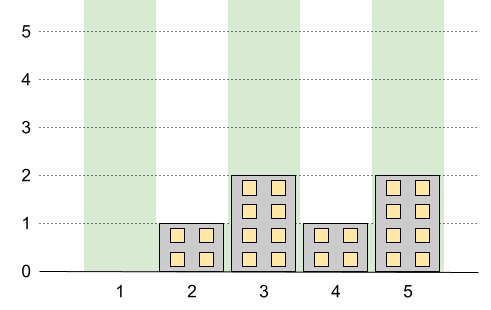
Input: n = 5, restrictions = [[2,1],[4,1]]
Output: 2
Explanation: The green area in the image indicates the maximum allowed height for each building.
We can build the buildings with heights [0,1,2,1,2], and the tallest building has a height of 2.

Example 2:

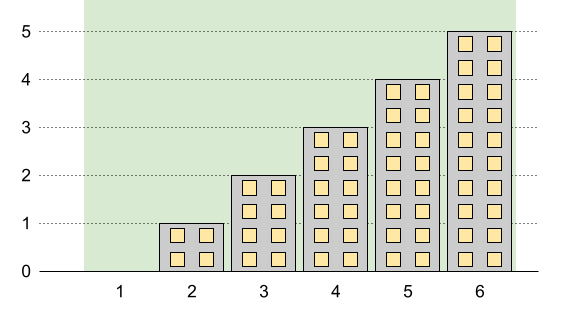
Input: n = 6, restrictions = []
Output: 5
Explanation: The green area in the image indicates the maximum allowed height for each building.
We can build the buildings with heights [0,1,2,3,4,5], and the tallest building has a height of 5.

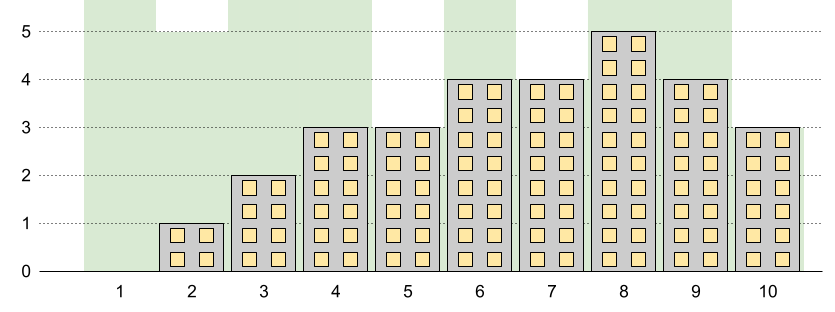
Example 3:

Constraints:

  • 2 <= n <= 109
  • 0 <= restrictions.length <= min(n - 1, 105)
  • 2 <= idi <= n
  • idi is unique.
  • 0 <= maxHeighti <= 109

Solution: Two Passes

Trim the max heights based on neighboring max heights.
Two passes: left to right, right to left.

Time complexity: O(n)
Space complexity: O(1)

C++

花花酱 LeetCode 1839. Longest Substring Of All Vowels in Order

A string is considered beautiful if it satisfies the following conditions:

  • Each of the 5 English vowels ('a''e''i''o''u') must appear at least once in it.
  • The letters must be sorted in alphabetical order (i.e. all 'a's before 'e's, all 'e's before 'i's, etc.).

For example, strings "aeiou" and "aaaaaaeiiiioou" are considered beautiful, but "uaeio""aeoiu", and "aaaeeeooo" are not beautiful.

Given a string word consisting of English vowels, return the length of the longest beautiful substring of word. If no such substring exists, return 0.

substring is a contiguous sequence of characters in a string.

Example 1:

Input: word = "aeiaaioaaaaeiiiiouuuooaauuaeiu"
Output: 13
Explanation: The longest beautiful substring in word is "aaaaeiiiiouuu" of length 13.

Example 2:

Input: word = "aeeeiiiioooauuuaeiou"
Output: 5
Explanation: The longest beautiful substring in word is "aeiou" of length 5.

Example 3:

Input: word = "a"
Output: 0
Explanation: There is no beautiful substring, so return 0.

Constraints:

  • 1 <= word.length <= 5 * 105
  • word consists of characters 'a''e''i''o', and 'u'.

Solution: Counter

Use a counter to track how many unique vowels we saw so far. Reset the counter whenever the s[i] < s[i-1]. Incase the counter if s[i] > s[i – 1]. When counter becomes 5, we know we found a valid substring.

Time complexity: O(n)
Space complexity: O(1)

C++

花花酱 LeetCode 1838. Frequency of the Most Frequent Element

The frequency of an element is the number of times it occurs in an array.

You are given an integer array nums and an integer k. In one operation, you can choose an index of nums and increment the element at that index by 1.

Return the maximum possible frequency of an element after performing at most k operations.

Example 1:

Input: nums = [1,2,4], k = 5
Output: 3
Explanation: Increment the first element three times and the second element two times to make nums = [4,4,4].
4 has a frequency of 3.

Example 2:

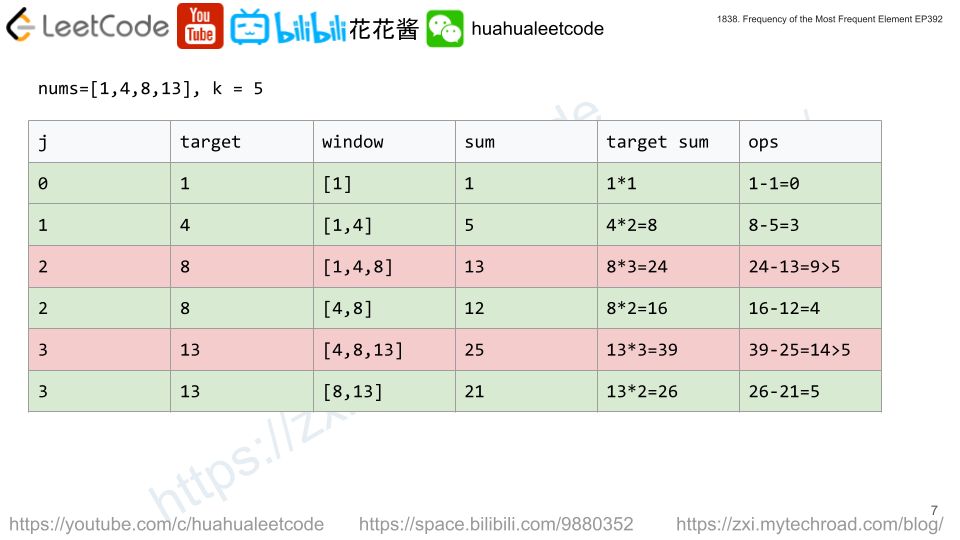
Input: nums = [1,4,8,13], k = 5
Output: 2
Explanation: There are multiple optimal solutions:
- Increment the first element three times to make nums = [4,4,8,13]. 4 has a frequency of 2.
- Increment the second element four times to make nums = [1,8,8,13]. 8 has a frequency of 2.
- Increment the third element five times to make nums = [1,4,13,13]. 13 has a frequency of 2.

Example 3:

Input: nums = [3,9,6], k = 2
Output: 1

Constraints:

  • 1 <= nums.length <= 105
  • 1 <= nums[i] <= 105
  • 1 <= k <= 105

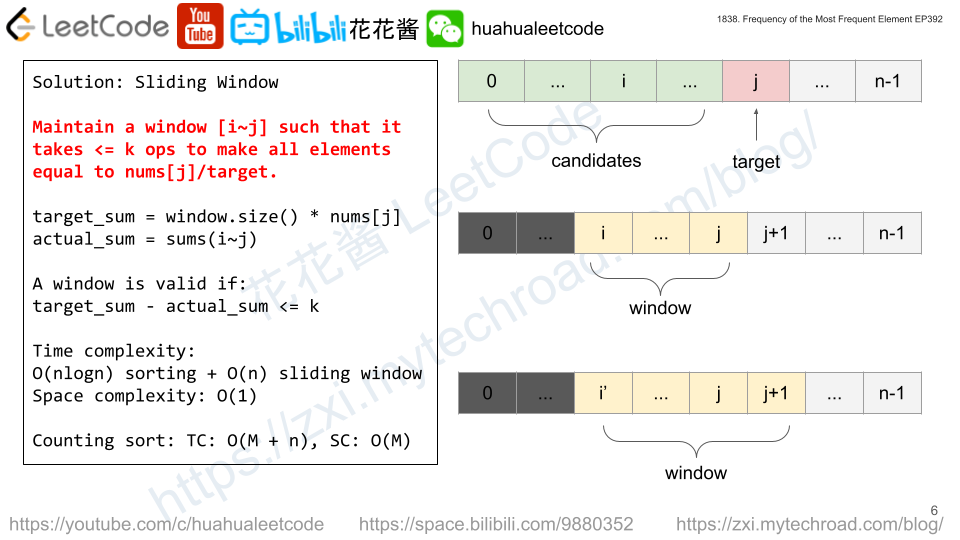
Solution: Sliding Window

Sort the elements, maintain a window such that it takes at most k ops to make the all the elements equal to nums[i].

Time complexity: O(nlogn)
Space complexity: O(1)

C++

花花酱 LeetCode 1837. Sum of Digits in Base K

Given an integer n (in base 10) and a base k, return the sum of the digits of n after converting n from base 10 to base k.

After converting, each digit should be interpreted as a base 10 number, and the sum should be returned in base 10.

Example 1:

Input: n = 34, k = 6
Output: 9
Explanation: 34 (base 10) expressed in base 6 is 54. 5 + 4 = 9.

Example 2:

Input: n = 10, k = 10
Output: 1
Explanation: n is already in base 10. 1 + 0 = 1.

Constraints:

  • 1 <= n <= 100
  • 2 <= k <= 10

Solution: Base Conversion

Time complexity: O(logn)
Space complexity: O(1)

C++