The pair sum of a pair (a,b) is equal to a + b. The maximum pair sum is the largest pair sum in a list of pairs.
For example, if we have pairs (1,5), (2,3), and (4,4), the maximum pair sum would be max(1+5, 2+3, 4+4) = max(6, 5, 8) = 8.
Given an array nums of even length n, pair up the elements of nums into n / 2 pairs such that:
Each element of nums is in exactly one pair, and
The maximum pair sum is minimized.
Return the minimized maximum pair sum after optimally pairing up the elements.
Example 1:
Input: nums = [3,5,2,3]
Output: 7
Explanation: The elements can be paired up into pairs (3,3) and (5,2).
The maximum pair sum is max(3+3, 5+2) = max(6, 7) = 7.
Example 2:
Input: nums = [3,5,4,2,4,6]
Output: 8
Explanation: The elements can be paired up into pairs (3,5), (4,4), and (6,2).
The maximum pair sum is max(3+5, 4+4, 6+2) = max(8, 8, 8) = 8.
Constraints:
n == nums.length
2 <= n <= 105
n is even.
1 <= nums[i] <= 105
Solution: Greedy
Sort the elements, pair nums[i] with nums[n – i – 1] and find the max pair.
Time complexity: O(nlogn) -> O(n) counting sort. Space complexity: O(1)
A string is good if there are no repeated characters.
Given a string s, return the number of good substrings of length three in s.
Note that if there are multiple occurrences of the same substring, every occurrence should be counted.
A substring is a contiguous sequence of characters in a string.
Example 1:
Input: s = "xyzzaz"
Output: 1
Explanation: There are 4 substrings of size 3: "xyz", "yzz", "zza", and "zaz".
The only good substring of length 3 is "xyz".
Example 2:
Input: s = "aababcabc"
Output: 4
Explanation: There are 7 substrings of size 3: "aab", "aba", "bab", "abc", "bca", "cab", and "abc".
The good substrings are "abc", "bca", "cab", and "abc".
Alice and Bob take turns playing a game, with Alice starting first.
There are n stones arranged in a row. On each player’s turn, while the number of stones is more than one, they will do the following:
Choose an integer x > 1, and remove the leftmost x stones from the row.
Add the sum of the removed stones’ values to the player’s score.
Place a new stone, whose value is equal to that sum, on the left side of the row.
The game stops when onlyone stone is left in the row.
The score difference between Alice and Bob is (Alice's score - Bob's score). Alice’s goal is to maximize the score difference, and Bob’s goal is the minimize the score difference.
Given an integer array stones of length n where stones[i] represents the value of the ith stone from the left, return the score difference between Alice and Bob if they both play optimally.
Example 1:
Input: stones = [-1,2,-3,4,-5]
Output: 5
Explanation:
- Alice removes the first 4 stones, adds (-1) + 2 + (-3) + 4 = 2 to her score, and places a stone of
  value 2 on the left. stones = [2,-5].
- Bob removes the first 2 stones, adds 2 + (-5) = -3 to his score, and places a stone of value -3 on
  the left. stones = [-3].
The difference between their scores is 2 - (-3) = 5.
Example 2:
Input: stones = [7,-6,5,10,5,-2,-6]
Output: 13
Explanation:
- Alice removes all stones, adds 7 + (-6) + 5 + 10 + 5 + (-2) + (-6) = 13 to her score, and places a
  stone of value 13 on the left. stones = [13].
The difference between their scores is 13 - 0 = 13.
Example 3:
Input: stones = [-10,-12]
Output: -22
Explanation:
- Alice can only make one move, which is to remove both stones. She adds (-10) + (-12) = -22 to her
  score and places a stone of value -22 on the left. stones = [-22].
The difference between their scores is (-22) - 0 = -22.
Constraints:
n == stones.length
2 <= n <= 105
-104 <= stones[i] <= 104
Solution: Prefix Sum + DP
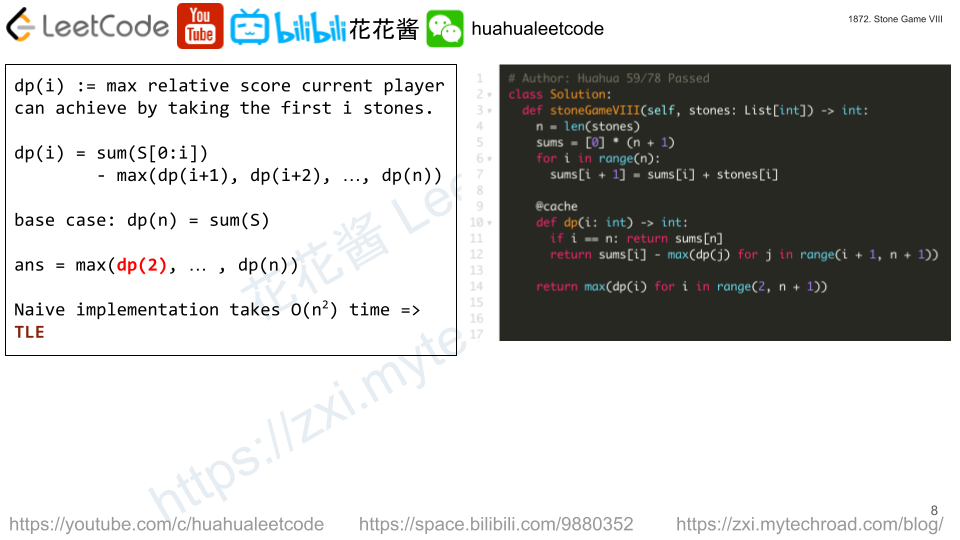
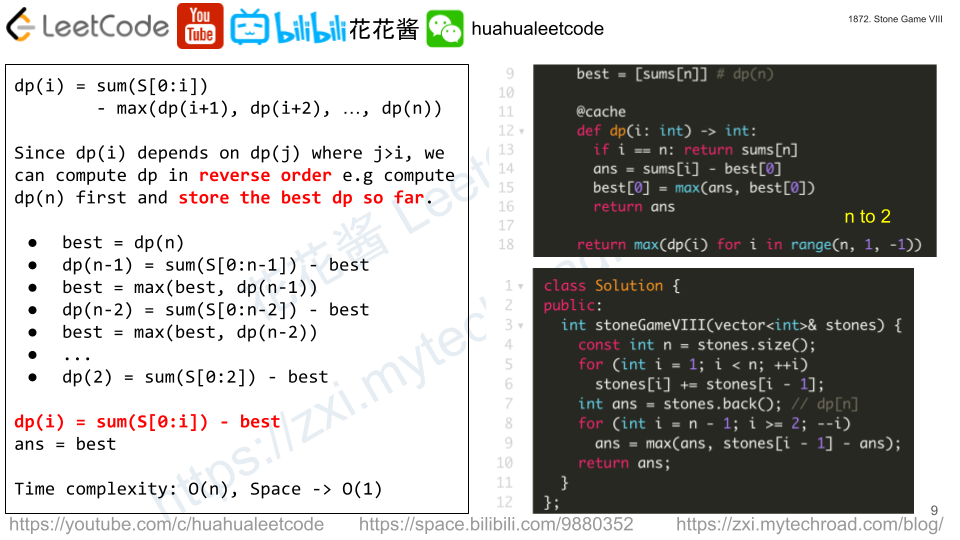
Note: Naive DP (min-max) takes O(n2) which leads to TLE. The key of this problem is that each player takes k stones, but put their sum back as a new stone, so you can assume all the original stones are still there, but opponent has to start from the k+1 th stone.
Let dp[i] denote the max score diff that current player can achieve by taking stones[0~i] (or equivalent)
dp[n-1] = sum(A[0~n-1]) // Alice takes all the stones. dp[n-2] = sum(A[0~n-2]) – (A[n-1] + sum(A[0~n-2])) = sum(A[0~n-2]) – dp[n-1] // Alice takes n-1 stones, Bob take the last one (A[n-1]) + put-back-stone. dp[n-3] = sum(A[0~n-3]) – max(dp[n-2], dp[n-1]) // Alice takes n-2 stones, Bob has two options (takes n-1 stones or takes n stones) … dp[0] = A[0] – max(dp[n-1], dp[n-1], …, dp[1]) // Alice takes the first stone, Bob has n-1 options.
You are given a 0-indexed binary string s and two integers minJump and maxJump. In the beginning, you are standing at index 0, which is equal to '0'. You can move from index i to index j if the following conditions are fulfilled:
i + minJump <= j <= min(i + maxJump, s.length - 1), and
s[j] == '0'.
Return true if you can reach index s.length - 1 in s, or false otherwise.
Example 1:
Input: s = "011010", minJump = 2, maxJump = 3
Output: true
Explanation:
In the first step, move from index 0 to index 3.
In the second step, move from index 3 to index 5.
You are given a floating-point number hour, representing the amount of time you have to reach the office. To commute to the office, you must take n trains in sequential order. You are also given an integer array dist of length n, where dist[i] describes the distance (in kilometers) of the ith train ride.
Each train can only depart at an integer hour, so you may need to wait in between each train ride.
For example, if the 1st train ride takes 1.5 hours, you must wait for an additional 0.5 hours before you can depart on the 2nd train ride at the 2 hour mark.
Return the minimum positive integer speed (in kilometers per hour) that all the trains must travel at for you to reach the office on time, or -1 if it is impossible to be on time.
Tests are generated such that the answer will not exceed 107 and hour will have at most two digits after the decimal point.
Example 1:
Input: dist = [1,3,2], hour = 6
Output: 1
Explanation: At speed 1:
- The first train ride takes 1/1 = 1 hour.
- Since we are already at an integer hour, we depart immediately at the 1 hour mark. The second train takes 3/1 = 3 hours.
- Since we are already at an integer hour, we depart immediately at the 4 hour mark. The third train takes 2/1 = 2 hours.
- You will arrive at exactly the 6 hour mark.
Example 2:
Input: dist = [1,3,2], hour = 2.7
Output: 3
Explanation: At speed 3:
- The first train ride takes 1/3 = 0.33333 hours.
- Since we are not at an integer hour, we wait until the 1 hour mark to depart. The second train ride takes 3/3 = 1 hour.
- Since we are already at an integer hour, we depart immediately at the 2 hour mark. The third train takes 2/3 = 0.66667 hours.
- You will arrive at the 2.66667 hour mark.
Example 3:
Input: dist = [1,3,2], hour = 1.9
Output: -1
Explanation: It is impossible because the earliest the third train can depart is at the 2 hour mark.
Constraints:
n == dist.length
1 <= n <= 105
1 <= dist[i] <= 105
1 <= hour <= 109
There will be at most two digits after the decimal point in hour.
Solution: Binary Search
l = speedmin=1 r = speedmax+1 = 1e7 + 1
Find the min valid speed m such that t(m) <= hour.