Press "Enter" to skip to content

Huahua's Tech Road

花花酱 LeetCode 1720. Decode XORed Array

There is a hidden integer array arr that consists of n non-negative integers.

It was encoded into another integer array encoded of length n - 1, such that encoded[i] = arr[i] XOR arr[i + 1]. For example, if arr = [1,0,2,1], then encoded = [1,2,3].

You are given the encoded array. You are also given an integer first, that is the first element of arr, i.e. arr[0].

Return the original array arr. It can be proved that the answer exists and is unique.

Example 1:

Input: encoded = [1,2,3], first = 1
Output: [1,0,2,1]
Explanation: If arr = [1,0,2,1], then first = 1 and encoded = [1 XOR 0, 0 XOR 2, 2 XOR 1] = [1,2,3]

Example 2:

Input: encoded = [6,2,7,3], first = 4
Output: [4,2,0,7,4]

Constraints:

  • 2 <= n <= 104
  • encoded.length == n - 1
  • 0 <= encoded[i] <= 105
  • 0 <= first <= 105

Solution: XOR

encoded[i] = arr[i] ^ arr[i + 1]
encoded[i] ^ arr[i] = arr[i] ^ arr[i] ^ arr[i + 1]
arr[i+1] = encoded[i]^arr[i]

Time complexity: O(n)
Space complexity: O(n)

C++

花花酱 LeetCode 1719. Number Of Ways To Reconstruct A Tree

You are given an array pairs, where pairs[i] = [xi, yi], and:

  • There are no duplicates.
  • xi < yi

Let ways be the number of rooted trees that satisfy the following conditions:

  • The tree consists of nodes whose values appeared in pairs.
  • A pair [xi, yi] exists in pairs if and only if xi is an ancestor of yi or yi is an ancestor of xi.
  • Note: the tree does not have to be a binary tree.

Two ways are considered to be different if there is at least one node that has different parents in both ways.

Return:

  • 0 if ways == 0
  • 1 if ways == 1
  • 2 if ways > 1

rooted tree is a tree that has a single root node, and all edges are oriented to be outgoing from the root.

An ancestor of a node is any node on the path from the root to that node (excluding the node itself). The root has no ancestors.

Example 1:

Input: pairs = [[1,2],[2,3]]
Output: 1
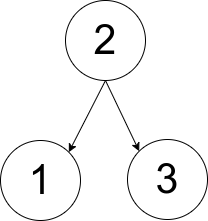
Explanation: There is exactly one valid rooted tree, which is shown in the above figure.

Example 2:

Input: pairs = [[1,2],[2,3],[1,3]]
Output: 2
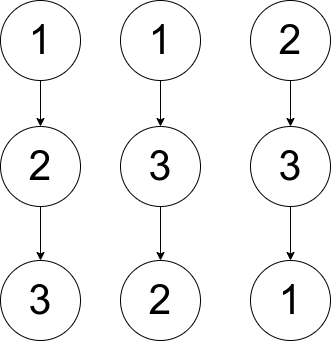
Explanation: There are multiple valid rooted trees. Three of them are shown in the above figures.

Example 3:

Input: pairs = [[1,2],[2,3],[2,4],[1,5]]
Output: 0
Explanation: There are no valid rooted trees.

Constraints:

  • 1 <= pairs.length <= 105
  • 1 <= x< yi <= 500
  • The elements in pairs are unique.

Solution: Bitset

Time complexity: O(E*V)
Space complexity: O(V^2)

C++

Python3

花花酱 LeetCode 1718. Construct the Lexicographically Largest Valid Sequence

Given an integer n, find a sequence that satisfies all of the following:

  • The integer 1 occurs once in the sequence.
  • Each integer between 2 and n occurs twice in the sequence.
  • For every integer i between 2 and n, the distance between the two occurrences of i is exactly i.

The distance between two numbers on the sequence, a[i] and a[j], is the absolute difference of their indices, |j - i|.

Return the lexicographically largest sequence. It is guaranteed that under the given constraints, there is always a solution.

A sequence a is lexicographically larger than a sequence b (of the same length) if in the first position where a and b differ, sequence a has a number greater than the corresponding number in b. For example, [0,1,9,0] is lexicographically larger than [0,1,5,6] because the first position they differ is at the third number, and 9 is greater than 5.

Example 1:

Input: n = 3
Output: [3,1,2,3,2]
Explanation: [2,3,2,1,3] is also a valid sequence, but [3,1,2,3,2] is the lexicographically largest valid sequence.

Example 2:

Input: n = 5
Output: [5,3,1,4,3,5,2,4,2]

Constraints:

  • 1 <= n <= 20

Solution: Search

Search from left to right, largest to smallest.

Time complexity: O(n!)?
Space complexity: O(n)

C++

Java

Python3

花花酱 LeetCode 1717. Maximum Score From Removing Substrings

You are given a string s and two integers x and y. You can perform two types of operations any number of times.

  • Remove substring "ab" and gain x points.
    • For example, when removing "ab" from "cabxbae" it becomes "cxbae".
  • Remove substring "ba" and gain y points.
    • For example, when removing "ba" from "cabxbae" it becomes "cabxe".

Return the maximum points you can gain after applying the above operations on s.

Example 1:

Input: s = "cdbcbbaaabab", x = 4, y = 5
Output: 19
Explanation:
- Remove the "ba" underlined in "cdbcbbaaabab". Now, s = "cdbcbbaaab" and 5 points are added to the score.
- Remove the "ab" underlined in "cdbcbbaaab". Now, s = "cdbcbbaa" and 4 points are added to the score.
- Remove the "ba" underlined in "cdbcbbaa". Now, s = "cdbcba" and 5 points are added to the score.
- Remove the "ba" underlined in "cdbcba". Now, s = "cdbc" and 5 points are added to the score.
Total score = 5 + 4 + 5 + 5 = 19.

Example 2:

Input: s = "aabbaaxybbaabb", x = 5, y = 4
Output: 20

Constraints:

  • 1 <= s.length <= 105
  • 1 <= x, y <= 104
  • s consists of lowercase English letters.

Solution: Greedy + Stack

Remove the pattern with the larger score first.

Using a stack to remove all occurrences of a pattern in place in O(n) Time.

Time complexity: O(n)
Space complexity: O(1)

C++

花花酱 LeetCode 1716. Calculate Money in Leetcode Bank

Hercy wants to save money for his first car. He puts money in the Leetcode bank every day.

He starts by putting in $1 on Monday, the first day. Every day from Tuesday to Sunday, he will put in $1 more than the day before. On every subsequent Monday, he will put in $1 more than the previous Monday.

Given n, return the total amount of money he will have in the Leetcode bank at the end of the nth day.

Example 1:

Input: n = 4
Output: 10
Explanation: After the 4th day, the total is 1 + 2 + 3 + 4 = 10.

Example 2:

Input: n = 10
Output: 37
Explanation: After the 10th day, the total is (1 + 2 + 3 + 4 + 5 + 6 + 7) + (2 + 3 + 4) = 37. Notice that on the 2nd Monday, Hercy only puts in $2.

Example 3:

Input: n = 20
Output: 96
Explanation: After the 20th day, the total is (1 + 2 + 3 + 4 + 5 + 6 + 7) + (2 + 3 + 4 + 5 + 6 + 7 + 8) + (3 + 4 + 5 + 6 + 7 + 8) = 96.

Constraints:

  • 1 <= n <= 1000

Solution 1: Simulation

Increase the amount by 1 everyday, the decrease 6 after every sunday.

Time complexity: O(n)
Space complexity: O(1)

C++

Could also be solved using Math in O(1)