Press "Enter" to skip to content

Huahua's Tech Road

花花酱 LeetCode 1690. Stone Game VII

Alice and Bob take turns playing a game, with Alice starting first.

There are n stones arranged in a row. On each player’s turn, they can remove either the leftmost stone or the rightmost stone from the row and receive points equal to the sum of the remaining stones’ values in the row. The winner is the one with the higher score when there are no stones left to remove.

Bob found that he will always lose this game (poor Bob, he always loses), so he decided to minimize the score’s difference. Alice’s goal is to maximize the difference in the score.

Given an array of integers stones where stones[i] represents the value of the ith stone from the left, return the difference in Alice and Bob’s score if they both play optimally.

Example 1:

Input: stones = [5,3,1,4,2]
Output: 6
Explanation: 
- Alice removes 2 and gets 5 + 3 + 1 + 4 = 13 points. Alice = 13, Bob = 0, stones = [5,3,1,4].
- Bob removes 5 and gets 3 + 1 + 4 = 8 points. Alice = 13, Bob = 8, stones = [3,1,4].
- Alice removes 3 and gets 1 + 4 = 5 points. Alice = 18, Bob = 8, stones = [1,4].
- Bob removes 1 and gets 4 points. Alice = 18, Bob = 12, stones = [4].
- Alice removes 4 and gets 0 points. Alice = 18, Bob = 12, stones = [].
The score difference is 18 - 12 = 6.

Example 2:

Input: stones = [7,90,5,1,100,10,10,2]
Output: 122

Constraints:

  • n == stones.length
  • 2 <= n <= 1000
  • 1 <= stones[i] <= 1000

Solution: MinMax + DP
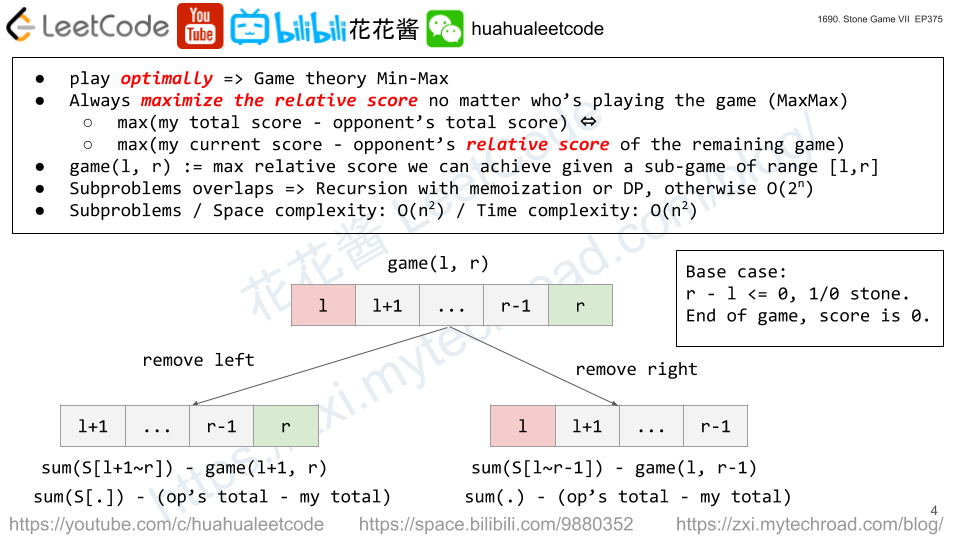
For a sub game of stones[l~r] game(l, r), we have two choices:
Remove the left one: sum(stones[l + 1 ~ r]) – game(l + 1, r)
Remove the right one: sum(stones[l ~ r – 1]) – game(l, r – 1)
And take the best choice.

Time complexity: O(n^2)
Space complexity: O(n^2)

C++/Top Down

C++/Bottom-Up

Python3

Related Problems

花花酱 LeetCode 1689. Partitioning Into Minimum Number Of Deci-Binary Numbers

A decimal number is called deci-binary if each of its digits is either 0 or 1 without any leading zeros. For example, 101 and 1100 are deci-binary, while 112 and 3001 are not.

Given a string n that represents a positive decimal integer, return the minimum number of positive deci-binary numbers needed so that they sum up to n.

Example 1:

Input: n = "32"
Output: 3
Explanation: 10 + 11 + 11 = 32

Example 2:

Input: n = "82734"
Output: 8

Example 3:

Input: n = "27346209830709182346"
Output: 9

Constraints:

  • 1 <= n.length <= 105
  • n consists of only digits.
  • n does not contain any leading zeros and represents a positive integer.

Solution: Return the max digit

Proof: For a given string, we find the maximum number m, we create m binary strings.
for each one, check each digit, if it’s greater than 0, we mark 1 at that position and decrease the digit by 1.

e.g. 21534
max is 5, we need five binary strings.
1. 11111: 21534 -> 10423
2. 10111: 10423 -> 00312
3: 00111: 00312 -> 00201
4: 00101: 00201 -> 00100
5: 00100: 00100 -> 00000

We can ignore the leading zeros.

Time complexity: O(n)
Space complexity: O(1)

C++

花花酱 LeetCode 1688. Count of Matches in Tournament

You are given an integer n, the number of teams in a tournament that has strange rules:

  • If the current number of teams is even, each team gets paired with another team. A total of n / 2 matches are played, and n / 2 teams advance to the next round.
  • If the current number of teams is odd, one team randomly advances in the tournament, and the rest gets paired. A total of (n - 1) / 2 matches are played, and (n - 1) / 2 + 1 teams advance to the next round.

Return the number of matches played in the tournament until a winner is decided.

Example 1:

Input: n = 7
Output: 6
Explanation: Details of the tournament: 
- 1st Round: Teams = 7, Matches = 3, and 4 teams advance.
- 2nd Round: Teams = 4, Matches = 2, and 2 teams advance.
- 3rd Round: Teams = 2, Matches = 1, and 1 team is declared the winner.
Total number of matches = 3 + 2 + 1 = 6.

Example 2:

Input: n = 14
Output: 13
Explanation: Details of the tournament:
- 1st Round: Teams = 14, Matches = 7, and 7 teams advance.
- 2nd Round: Teams = 7, Matches = 3, and 4 teams advance.
- 3rd Round: Teams = 4, Matches = 2, and 2 teams advance.
- 4th Round: Teams = 2, Matches = 1, and 1 team is declared the winner.
Total number of matches = 7 + 3 + 2 + 1 = 13.

Constraints:

  • 1 <= n <= 200

Solution: Simulation / Recursion

Time complexity: O(logn)
Space complexity: O(1)

C++

花花酱 LeetCode 1687. Delivering Boxes from Storage to Ports

You have the task of delivering some boxes from storage to their ports using only one ship. However, this ship has a limit on the number of boxes and the total weight that it can carry.

You are given an array boxes, where boxes[i] = [ports​​i​, weighti], and three integers portsCountmaxBoxes, and maxWeight.

  • ports​​i is the port where you need to deliver the ith box and weightsi is the weight of the ith box.
  • portsCount is the number of ports.
  • maxBoxes and maxWeight are the respective box and weight limits of the ship.

The boxes need to be delivered in the order they are given. The ship will follow these steps:

  • The ship will take some number of boxes from the boxes queue, not violating the maxBoxes and maxWeight constraints.
  • For each loaded box in order, the ship will make a trip to the port the box needs to be delivered to and deliver it. If the ship is already at the correct port, no trip is needed, and the box can immediately be delivered.
  • The ship then makes a return trip to storage to take more boxes from the queue.

The ship must end at storage after all the boxes have been delivered.

Return the minimum number of trips the ship needs to make to deliver all boxes to their respective ports.

Example 1:

Input: boxes = [[1,1],[2,1],[1,1]], portsCount = 2, maxBoxes = 3, maxWeight = 3
Output: 4
Explanation: The optimal strategy is as follows: 
- The ship takes all the boxes in the queue, goes to port 1, then port 2, then port 1 again, then returns to storage. 4 trips.
So the total number of trips is 4.
Note that the first and third boxes cannot be delivered together because the boxes need to be delivered in order (i.e. the second box needs to be delivered at port 2 before the third box).

Example 2:

Input: boxes = [[1,2],[3,3],[3,1],[3,1],[2,4]], portsCount = 3, maxBoxes = 3, maxWeight = 6
Output: 6
Explanation: The optimal strategy is as follows: 
- The ship takes the first box, goes to port 1, then returns to storage. 2 trips.
- The ship takes the second, third and fourth boxes, goes to port 3, then returns to storage. 2 trips.
- The ship takes the fifth box, goes to port 3, then returns to storage. 2 trips.
So the total number of trips is 2 + 2 + 2 = 6.

Example 3:

Input: boxes = [[1,4],[1,2],[2,1],[2,1],[3,2],[3,4]], portsCount = 3, maxBoxes = 6, maxWeight = 7
Output: 6
Explanation: The optimal strategy is as follows:
- The ship takes the first and second boxes, goes to port 1, then returns to storage. 2 trips.
- The ship takes the third and fourth boxes, goes to port 2, then returns to storage. 2 trips.
- The ship takes the fifth and sixth boxes, goes to port 3, then returns to storage. 2 trips.
So the total number of trips is 2 + 2 + 2 = 6.

Example 4:

Input: boxes = [[2,4],[2,5],[3,1],[3,2],[3,7],[3,1],[4,4],[1,3],[5,2]], portsCount = 5, maxBoxes = 5, maxWeight = 7
Output: 14
Explanation: The optimal strategy is as follows:
- The ship takes the first box, goes to port 2, then storage. 2 trips.
- The ship takes the second box, goes to port 2, then storage. 2 trips.
- The ship takes the third and fourth boxes, goes to port 3, then storage. 2 trips.
- The ship takes the fifth box, goes to port 3, then storage. 2 trips.
- The ship takes the sixth and seventh boxes, goes to port 3, then port 4, then storage. 3 trips. 
- The ship takes the eighth and ninth boxes, goes to port 1, then port 5, then storage. 3 trips.
So the total number of trips is 2 + 2 + 2 + 2 + 3 + 3 = 14.

Constraints:

  • 1 <= boxes.length <= 105
  • 1 <= portsCount, maxBoxes, maxWeight <= 105
  • 1 <= ports​​i <= portsCount
  • 1 <= weightsi <= maxWeight

Solution: Sliding Window

Time complexity: O(n)
Space complexity: O(n)

C++

花花酱 LeetCode 1686. Stone Game VI

Alice and Bob take turns playing a game, with Alice starting first.

There are n stones in a pile. On each player’s turn, they can remove a stone from the pile and receive points based on the stone’s value. Alice and Bob may value the stones differently.

You are given two integer arrays of length naliceValues and bobValues. Each aliceValues[i] and bobValues[i] represents how Alice and Bob, respectively, value the ith stone.

The winner is the person with the most points after all the stones are chosen. If both players have the same amount of points, the game results in a draw. Both players will play optimally.

Determine the result of the game, and:

  • If Alice wins, return 1.
  • If Bob wins, return -1.
  • If the game results in a draw, return 0.

Example 1:

Input: aliceValues = [1,3], bobValues = [2,1]
Output: 1
Explanation:
If Alice takes stone 1 (0-indexed) first, Alice will receive 3 points.
Bob can only choose stone 0, and will only receive 2 points.
Alice wins.

Example 2:

Input: aliceValues = [1,2], bobValues = [3,1]
Output: 0
Explanation:
If Alice takes stone 0, and Bob takes stone 1, they will both have 1 point.
Draw.

Example 3:

Input: aliceValues = [2,4,3], bobValues = [1,6,7]
Output: -1
Explanation:
Regardless of how Alice plays, Bob will be able to have more points than Alice.
For example, if Alice takes stone 1, Bob can take stone 2, and Alice takes stone 0, Alice will have 6 points to Bob's 7.
Bob wins.

Constraints:

  • n == aliceValues.length == bobValues.length
  • 1 <= n <= 105
  • 1 <= aliceValues[i], bobValues[i] <= 100

Solution: Greedy

Sort by the sum of stone values.

Time complexity: O(nlogn)
Space complexity: O(n)

C++