A value arr[i] is said to be stronger than a value arr[j] if |arr[i] - m| > |arr[j] - m| where m is the median of the array. If |arr[i] - m| == |arr[j] - m|, then arr[i] is said to be stronger than arr[j] if arr[i] > arr[j].
Return a list of the strongest k values in the array. return the answer in any arbitrary order.
Median is the middle value in an ordered integer list. More formally, if the length of the list is n, the median is the element in position ((n - 1) / 2) in the sorted list (0-indexed).
For arr = [6, -3, 7, 2, 11], n = 5 and the median is obtained by sorting the array arr = [-3, 2, 6, 7, 11] and the median is arr[m] where m = ((5 - 1) / 2) = 2. The median is 6.
For arr = [-7, 22, 17, 3], n = 4 and the median is obtained by sorting the array arr = [-7, 3, 17, 22] and the median is arr[m] where m = ((4 - 1) / 2) = 1. The median is 3.
Example 1:
Input: arr = [1,2,3,4,5], k = 2
Output: [5,1]
Explanation: Median is 3, the elements of the array sorted by the strongest are [5,1,4,2,3]. The strongest 2 elements are [5, 1]. [1, 5] is also accepted answer.
Please note that although |5 - 3| == |1 - 3| but 5 is stronger than 1 because 5 > 1.
Example 2:
Input: arr = [1,1,3,5,5], k = 2
Output: [5,5]
Explanation: Median is 3, the elements of the array sorted by the strongest are [5,5,1,1,3]. The strongest 2 elements are [5, 5].
Example 3:
Input: arr = [6,7,11,7,6,8], k = 5
Output: [11,8,6,6,7]
Explanation: Median is 7, the elements of the array sorted by the strongest are [11,8,6,6,7,7].
Any permutation of [11,8,6,6,7] is accepted.
Example 4:
Input: arr = [6,-3,7,2,11], k = 3
Output: [-3,11,2]
Example 5:
Input: arr = [-7,22,17,3], k = 2
Output: [22,17]
Constraints:
1 <= arr.length <= 10^5
-10^5 <= arr[i] <= 10^5
1 <= k <= arr.length
Solution 1: quick selection + sort
Step 1: find the median element m Step 2: Sort the array according to m Step 3: output the first k elements of the sorted array.
Given 2n balls of k distinct colors. You will be given an integer array balls of size k where balls[i] is the number of balls of color i.
All the balls will be shuffled uniformly at random, then we will distribute the first n balls to the first box and the remaining n balls to the other box (Please read the explanation of the second example carefully).
Please note that the two boxes are considered different. For example, if we have two balls of colors a and b, and two boxes [] and (), then the distribution [a] (b) is considered different than the distribution [b] (a) (Please read the explanation of the first example carefully).
We want to calculate the probability that the two boxes have the same number of distinct balls.
Example 1:
Input: balls = [1,1]
Output: 1.00000
Explanation: Only 2 ways to divide the balls equally:
- A ball of color 1 to box 1 and a ball of color 2 to box 2
- A ball of color 2 to box 1 and a ball of color 1 to box 2
In both ways, the number of distinct colors in each box is equal. The probability is 2/2 = 1
Example 2:
Input: balls = [2,1,1]
Output: 0.66667
Explanation: We have the set of balls [1, 1, 2, 3]
This set of balls will be shuffled randomly and we may have one of the 12 distinct shuffles with equale probability (i.e. 1/12):
[1,1 / 2,3], [1,1 / 3,2], [1,2 / 1,3], [1,2 / 3,1], [1,3 / 1,2], [1,3 / 2,1], [2,1 / 1,3], [2,1 / 3,1], [2,3 / 1,1], [3,1 / 1,2], [3,1 / 2,1], [3,2 / 1,1]
After that we add the first two balls to the first box and the second two balls to the second box.
We can see that 8 of these 12 possible random distributions have the same number of distinct colors of balls in each box.
Probability is 8/12 = 0.66667
Example 3:
Input: balls = [1,2,1,2]
Output: 0.60000
Explanation: The set of balls is [1, 2, 2, 3, 4, 4]. It is hard to display all the 180 possible random shuffles of this set but it is easy to check that 108 of them will have the same number of distinct colors in each box.
Probability = 108 / 180 = 0.6
Example 4:
Input: balls = [3,2,1]
Output: 0.30000
Explanation: The set of balls is [1, 1, 1, 2, 2, 3]. It is hard to display all the 60 possible random shuffles of this set but it is easy to check that 18 of them will have the same number of distinct colors in each box.
Probability = 18 / 60 = 0.3
Example 5:
Input: balls = [6,6,6,6,6,6]
Output: 0.90327
Constraints:
1 <= balls.length <= 8
1 <= balls[i] <= 6
sum(balls) is even.
Answers within 10^-5 of the actual value will be accepted as correct.
Solution 0: Permutation (TLE)
Enumerate all permutations of the balls, count valid ones and divide that by the total.
Time complexity: O((8*6)!) = O(48!) After deduplication: O(48!/(6!)^8) ~ 1.7e38 Space complexity: O(8*6)
There are n cities numbered from 0 to n-1 and n-1 roads such that there is only one way to travel between two different cities (this network form a tree). Last year, The ministry of transport decided to orient the roads in one direction because they are too narrow.
Roads are represented by connections where connections[i] = [a, b] represents a road from city a to b.
This year, there will be a big event in the capital (city 0), and many people want to travel to this city.
Your task consists of reorienting some roads such that each city can visit the city 0. Return the minimum number of edges changed.
It’s guaranteed that each city can reach the city 0 after reorder.
Example 1:
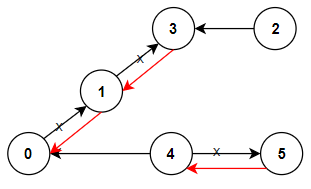
Input: n = 6, connections = [[0,1],[1,3],[2,3],[4,0],[4,5]]
Output: 3
Explanation: Change the direction of edges show in red such that each node can reach the node 0 (capital).
Example 2:
Input: n = 5, connections = [[1,0],[1,2],[3,2],[3,4]]
Output: 2
Explanation: Change the direction of edges show in red such that each node can reach the node 0 (capital).
Example 3:
Input: n = 3, connections = [[1,0],[2,0]]
Output: 0
Constraints:
2 <= n <= 5 * 10^4
connections.length == n-1
connections[i].length == 2
0 <= connections[i][0], connections[i][1] <= n-1
connections[i][0] != connections[i][1]
Solution: BFS
Augment the graph g[u][v] = 1, g[v][u] = 0, u->v is an edge in the original graph.
BFS from 0, sum up all the edge costs to visit all the nodes.
Given a rectangular cake with height h and width w, and two arrays of integers horizontalCuts and verticalCuts where horizontalCuts[i] is the distance from the top of the rectangular cake to the ith horizontal cut and similarly, verticalCuts[j] is the distance from the left of the rectangular cake to the jth vertical cut.
Return the maximum area of a piece of cake after you cut at each horizontal and vertical position provided in the arrays horizontalCuts and verticalCuts. Since the answer can be a huge number, return this modulo 10^9 + 7.
Example 1:
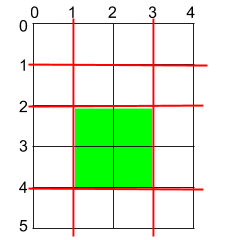
Input: h = 5, w = 4, horizontalCuts = [1,2,4], verticalCuts = [1,3]
Output: 4
Explanation: The figure above represents the given rectangular cake. Red lines are the horizontal and vertical cuts. After you cut the cake, the green piece of cake has the maximum area.
Example 2:
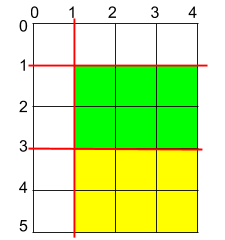
Input: h = 5, w = 4, horizontalCuts = [3,1], verticalCuts = [1]
Output: 6
Explanation: The figure above represents the given rectangular cake. Red lines are the horizontal and vertical cuts. After you cut the cake, the green and yellow pieces of cake have the maximum area.
Example 3:
Input: h = 5, w = 4, horizontalCuts = [3], verticalCuts = [3]
Output: 9
Constraints:
2 <= h, w <= 10^9
1 <= horizontalCuts.length < min(h, 10^5)
1 <= verticalCuts.length < min(w, 10^5)
1 <= horizontalCuts[i] < h
1 <= verticalCuts[i] < w
It is guaranteed that all elements in horizontalCuts are distinct.
It is guaranteed that all elements in verticalCuts are distinct.
Solution: Geometry
Find the max gap between vertical cuts mx and max gap between horizontal cuts my. ans = mx * my
Time complexity: O(nlogn) Space complexity: O(1) if sort in place otherweise O(n)