Given the array of integers nums, you will choose two different indices i and j of that array. Return the maximum value of(nums[i]-1)*(nums[j]-1).
Example 1:
Input: nums = [3,4,5,2]
Output: 12
Explanation: If you choose the indices i=1 and j=2 (indexed from 0), you will get the maximum value, that is, (nums[1]-1)*(nums[2]-1) = (4-1)*(5-1) = 3*4 = 12.
Example 2:
Input: nums = [1,5,4,5]
Output: 16
Explanation: Choosing the indices i=1 and j=3 (indexed from 0), you will get the maximum value of (5-1)*(5-1) = 16.
Example 3:
Input: nums = [3,7]
Output: 12
Constraints:
2 <= nums.length <= 500
1 <= nums[i] <= 10^3
Solution 1: Sort
We want to find the largest and second largest elements.
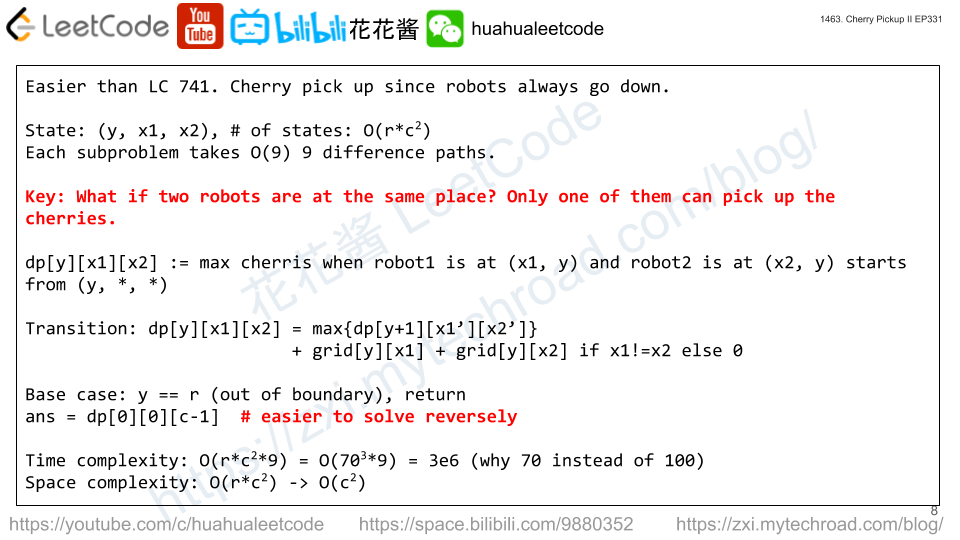
Given a rows x cols matrix grid representing a field of cherries. Each cell in grid represents the number of cherries that you can collect.
You have two robots that can collect cherries for you, Robot #1 is located at the top-left corner (0,0) , and Robot #2 is located at the top-right corner (0, cols-1) of the grid.
Return the maximum number of cherries collection using both robots by following the rules below:
From a cell (i,j), robots can move to cell (i+1, j-1) , (i+1, j) or (i+1, j+1).
When any robot is passing through a cell, It picks it up all cherries, and the cell becomes an empty cell (0).
When both robots stay on the same cell, only one of them takes the cherries.
Both robots cannot move outside of the grid at any moment.
Both robots should reach the bottom row in the grid.
Example 1:
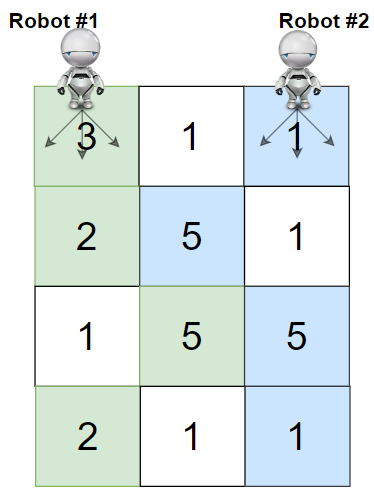
Input: grid = [[3,1,1],[2,5,1],[1,5,5],[2,1,1]]
Output: 24
Explanation: Path of robot #1 and #2 are described in color green and blue respectively.
Cherries taken by Robot #1, (3 + 2 + 5 + 2) = 12.
Cherries taken by Robot #2, (1 + 5 + 5 + 1) = 12.
Total of cherries: 12 + 12 = 24.
Example 2:
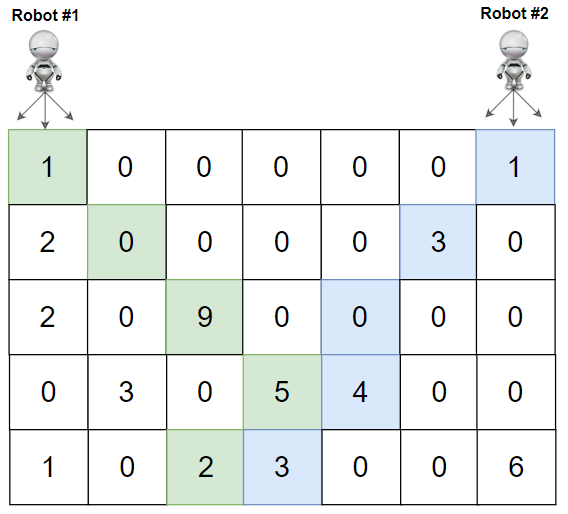
Input: grid = [[1,0,0,0,0,0,1],[2,0,0,0,0,3,0],[2,0,9,0,0,0,0],[0,3,0,5,4,0,0],[1,0,2,3,0,0,6]]
Output: 28
Explanation: Path of robot #1 and #2 are described in color green and blue respectively.
Cherries taken by Robot #1, (1 + 9 + 5 + 2) = 17.
Cherries taken by Robot #2, (1 + 3 + 4 + 3) = 11.
Total of cherries: 17 + 11 = 28.
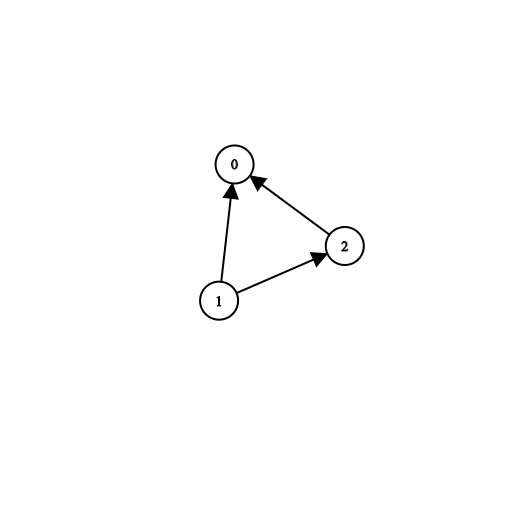
There are a total of n courses you have to take, labeled from 0 to n-1.
Some courses may have direct prerequisites, for example, to take course 0 you have first to take course 1, which is expressed as a pair: [1,0]
Given the total number of courses n, a list of direct prerequisitepairs and a list of queriespairs.
You should answer for each queries[i] whether the course queries[i][0] is a prerequisite of the course queries[i][1] or not.
Return a list of boolean, the answers to the given queries.
Please note that if course a is a prerequisite of course b and course b is a prerequisite of course c, then, course a is a prerequisite of course c.
Example 1:
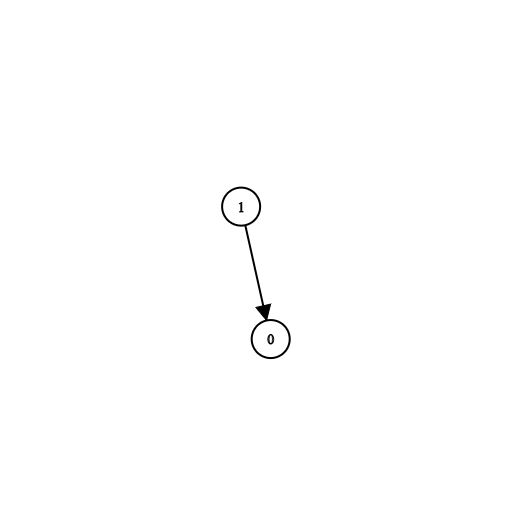
Input: n = 2, prerequisites = [[1,0]], queries = [[0,1],[1,0]]
Output: [false,true]
Explanation: course 0 is not a prerequisite of course 1 but the opposite is true.
Example 2:
Input: n = 2, prerequisites = [], queries = [[1,0],[0,1]]
Output: [false,false]
Explanation: There are no prerequisites and each course is independent.
Return True if any binary code of length k is a substring of s. Otherwise, return False.
Example 1:
Input: s = "00110110", k = 2
Output: true
Explanation: The binary codes of length 2 are "00", "01", "10" and "11". They can be all found as substrings at indicies 0, 1, 3 and 2 respectively.
Example 2:
Input: s = "00110", k = 2
Output: true
Example 3:
Input: s = "0110", k = 1
Output: true
Explanation: The binary codes of length 1 are "0" and "1", it is clear that both exist as a substring.
Example 4:
Input: s = "0110", k = 2
Output: false
Explanation: The binary code "00" is of length 2 and doesn't exist in the array.
Example 5:
Input: s = "0000000001011100", k = 4
Output: false
Constraints:
1 <= s.length <= 5 * 10^5
s consists of 0’s and 1’s only.
1 <= k <= 20
Solution: Hashtable
Insert all possible substrings into a hashtable, the size of the hashtable should be 2^k.
Time complexity: O(n*k) Space complexity: O(2^k*k) -> O(2^k)
Given two integer arrays of equal length target and arr.
In one step, you can select any non-empty sub-array of arr and reverse it. You are allowed to make any number of steps.
Return True if you can make arr equal to target, or False otherwise.
Example 1:
Input: target = [1,2,3,4], arr = [2,4,1,3]
Output: true
Explanation: You can follow the next steps to convert arr to target:
1- Reverse sub-array [2,4,1], arr becomes [1,4,2,3]
2- Reverse sub-array [4,2], arr becomes [1,2,4,3]
3- Reverse sub-array [4,3], arr becomes [1,2,3,4]
There are multiple ways to convert arr to target, this is not the only way to do so.
Example 2:
Input: target = [7], arr = [7]
Output: true
Explanation: arr is equal to target without any reverses.
Example 3:
Input: target = [1,12], arr = [12,1]
Output: true
Example 4:
Input: target = [3,7,9], arr = [3,7,11]
Output: false
Explanation: arr doesn't have value 9 and it can never be converted to target.