Given N axis-aligned rectangles where N > 0, determine if they all together form an exact cover of a rectangular region.
Each rectangle is represented as a bottom-left point and a top-right point. For example, a unit square is represented as [1,1,2,2]. (coordinate of bottom-left point is (1, 1) and top-right point is (2, 2)).
Example 1:
1
2
3
4
5
6
7
8
9
rectangles=[
[1,1,3,3],
[3,1,4,2],
[3,2,4,4],
[1,3,2,4],
[2,3,3,4]
]
Returntrue.All5rectangles together form an exact cover ofarectangular region.
Example 2:
1
2
3
4
5
6
7
8
rectangles=[
[1,1,2,3],
[1,3,2,4],
[3,1,4,2],
[3,2,4,4]
]
Returnfalse.Because there isagap between the two rectangular regions.
Example 3:
1
2
3
4
5
6
7
8
rectangles=[
[1,1,3,3],
[3,1,4,2],
[1,3,2,4],
[3,2,4,4]
]
Returnfalse.Because there isagap inthe top center.
Example 4:
1
2
3
4
5
6
7
8
rectangles=[
[1,1,3,3],
[3,1,4,2],
[1,3,2,4],
[2,2,4,4]
]
Returnfalse.Because two of the rectangles overlap with eachother.
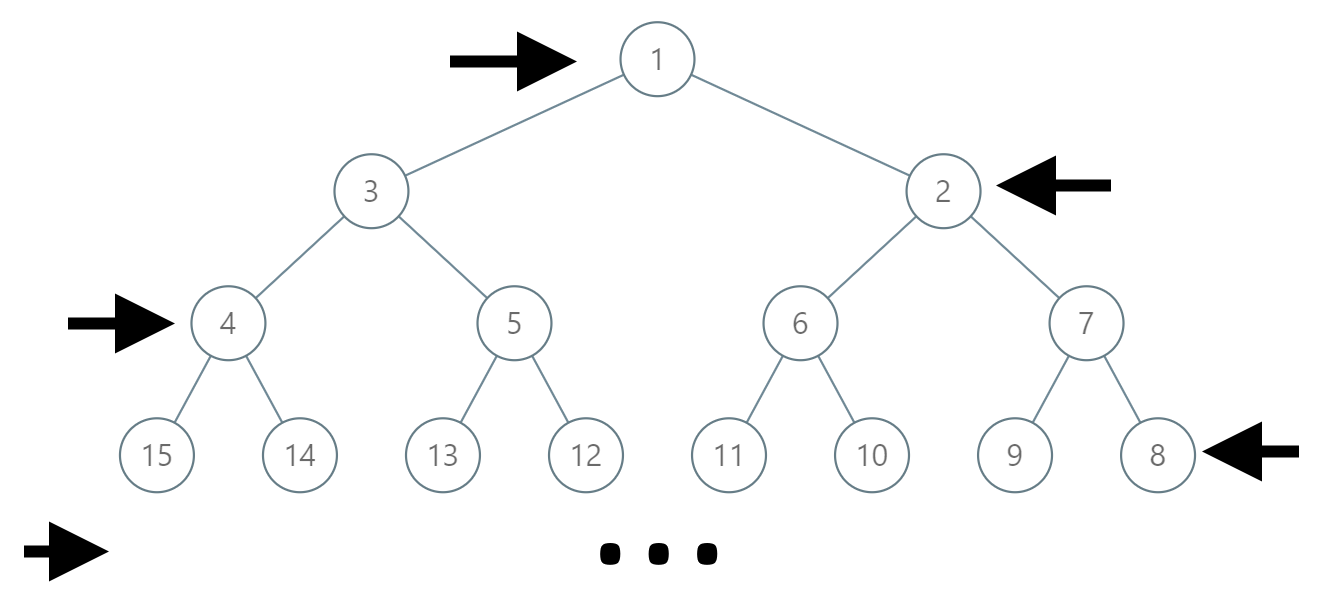
In an infinite binary tree where every node has two children, the nodes are labelled in row order.
In the odd numbered rows (ie., the first, third, fifth,…), the labelling is left to right, while in the even numbered rows (second, fourth, sixth,…), the labelling is right to left.
Given the label of a node in this tree, return the labels in the path from the root of the tree to the node with that label.
Example 1:
Input: label = 14
Output: [1,3,4,14]
Example 2:
Input: label = 26
Output: [1,2,6,10,26]
Constraints:
1 <= label <= 10^6
Solution: Math
Time complexity: O(logn) Space complexity: O(logn)
We have a sequence of books: the i-th book has thickness books[i][0] and height books[i][1].
We want to place these books in order onto bookcase shelves that have total width shelf_width.
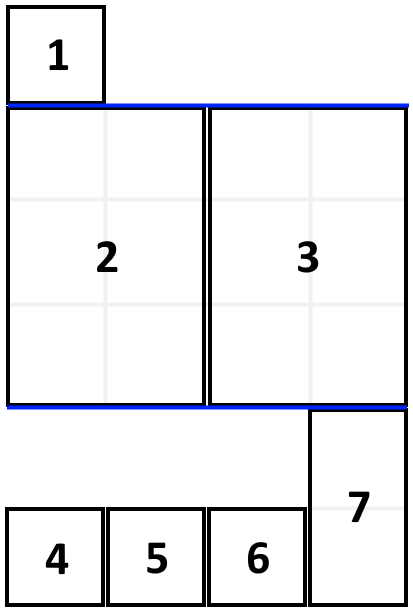
We choose some of the books to place on this shelf (such that the sum of their thickness is <= shelf_width), then build another level of shelf of the bookcase so that the total height of the bookcase has increased by the maximum height of the books we just put down. We repeat this process until there are no more books to place.
Note again that at each step of the above process, the order of the books we place is the same order as the given sequence of books. For example, if we have an ordered list of 5 books, we might place the first and second book onto the first shelf, the third book on the second shelf, and the fourth and fifth book on the last shelf.
Return the minimum possible height that the total bookshelf can be after placing shelves in this manner.
Example 1:
Input: books = [[1,1],[2,3],[2,3],[1,1],[1,1],[1,1],[1,2]], shelf_width = 4
Output: 6
Explanation:
The sum of the heights of the 3 shelves are 1 + 3 + 2 = 6.
Notice that book number 2 does not have to be on the first shelf.
Constraints:
1 <= books.length <= 1000
1 <= books[i][0] <= shelf_width <= 1000
1 <= books[i][1] <= 1000
Solution: DP
dp[i] := min height of placing books[0] ~ books[i] dp[-1] = 0 dp[j] = min{dp[i-1] + max(h[i] ~ h[j])}, 0 < i <= j, sum(w[i] ~ w[j]) <= shelf_width