Press "Enter" to skip to content

Huahua's Tech Road

花花酱 LeetCode 1094. Car Pooling

You are driving a vehicle that has capacity empty seats initially available for passengers.  The vehicle only drives east (ie. it cannot turn around and drive west.)

Given a list of tripstrip[i] = [num_passengers, start_location, end_location] contains information about the i-th trip: the number of passengers that must be picked up, and the locations to pick them up and drop them off.  The locations are given as the number of kilometers due east from your vehicle’s initial location.

Return true if and only if it is possible to pick up and drop off all passengers for all the given trips. 

Example 1:

Input: trips = [[2,1,5],[3,3,7]], capacity = 4
Output: false

Example 2:

Input: trips = [[2,1,5],[3,3,7]], capacity = 5
Output: true

Example 3:

Input: trips = [[2,1,5],[3,5,7]], capacity = 3
Output: true

Example 4:

Input: trips = [[3,2,7],[3,7,9],[8,3,9]], capacity = 11
Output: true

Solution1: Min heap

Sort events by location

Time complexity: O(nlogn)
Space complexity: O(n)

C++

Solution 2: Preprocessing

Time complexity: O(n)
Space complexity: O(1000)

C++

花花酱 LeetCode 23. Merge k Sorted Lists

Merge k sorted linked lists and return it as one sorted list. Analyze and describe its complexity.

Example:

Input:
[
  1->4->5,
  1->3->4,
  2->6
]
Output: 1->1->2->3->4->4->5->6

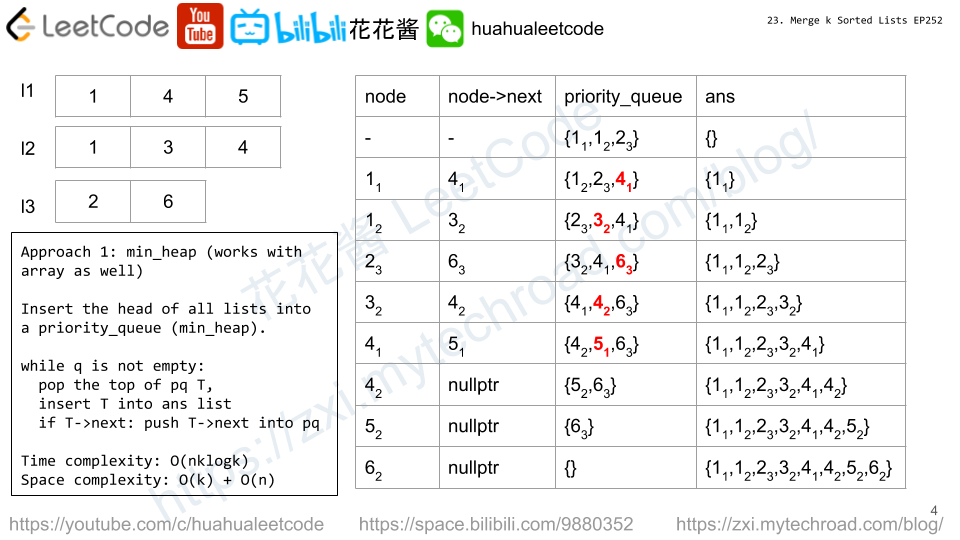
Solution 1: Min heap

Time complexity: O(nklogk)
Space complexity: O(k)

C++

Solution 2: Merge Sort

Time complexity: O(nklogk)
Space complexity: O(logk)

C++

花花酱 LeetCode 1092. Shortest Common Supersequence

Given two strings str1 and str2, return the shortest string that has both str1 and str2 as subsequences.  If multiple answers exist, you may return any of them.

(A string S is a subsequence of string T if deleting some number of characters from T (possibly 0, and the characters are chosen anywherefrom T) results in the string S.)

Example 1:

Input: str1 = "abac", str2 = "cab"
Output: "cabac"
Explanation: 
str1 = "abac" is a substring of "cabac" because we can delete the first "c".
str2 = "cab" is a substring of "cabac" because we can delete the last "ac".
The answer provided is the shortest such string that satisfies these properties.

Note:

  1. 1 <= str1.length, str2.length <= 1000
  2. str1 and str2 consist of lowercase English letters.

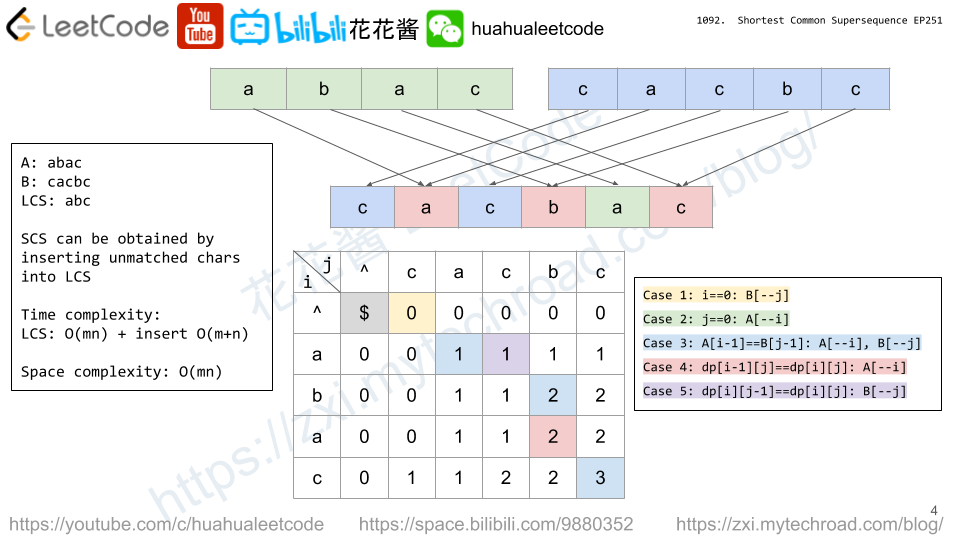
Solution: LCS

Find the LCS (longest common sub-sequence) of two strings, and insert unmatched characters into the LCS.

Time complexity: O(mn)
Space complexity: O(mn)

C++

花花酱 LeetCode 1073. Adding Two Negabinary Numbers

Given two numbers arr1 and arr2 in base -2, return the result of adding them together.

Each number is given in array format:  as an array of 0s and 1s, from most significant bit to least significant bit.  For example, arr = [1,1,0,1] represents the number (-2)^3 + (-2)^2 + (-2)^0 = -3.  A number arr in array format is also guaranteed to have no leading zeros: either arr == [0] or arr[0] == 1.

Return the result of adding arr1 and arr2 in the same format: as an array of 0s and 1s with no leading zeros.

Example 1:

Input: arr1 = [1,1,1,1,1], arr2 = [1,0,1]
Output: [1,0,0,0,0]
Explanation: arr1 represents 11, arr2 represents 5, the output represents 16.

Note:

  1. 1 <= arr1.length <= 1000
  2. 1 <= arr2.length <= 1000
  3. arr1 and arr2 have no leading zeros
  4. arr1[i] is 0 or 1
  5. arr2[i] is 0 or 1

Solution: Simulation

Time complexity: O(n)
Space complexity: O(n)

C++

花花酱 1054. Distant Barcodes

In a warehouse, there is a row of barcodes, where the i-th barcode is barcodes[i].

Rearrange the barcodes so that no two adjacent barcodes are equal.  You may return any answer, and it is guaranteed an answer exists.

Example 1:

Input: [1,1,1,2,2,2]
Output: [2,1,2,1,2,1]

Example 2:

Input: [1,1,1,1,2,2,3,3]
Output: [1,3,1,3,2,1,2,1]

Note:

  1. 1 <= barcodes.length <= 10000
  2. 1 <= barcodes[i] <= 10000

Soluton: Sorting

Sort the element by their frequency in descending order. Fill the most frequent element first in even positions, if reach the end of the array, start from position 1 then 3, 5, …

Time complexity: O(nlogn)
Space complexity: O(n)

C++

Solution 2: Find the most frequent

Actually, we only need to find the most frequent element and put in the even positions, then put the rest of the groups of elements in any order.

e.g. [1, 1, 2, 2, 2, 2, 2, 3, 4]
Can be
5*2 [2 – 2 – 2 – 2 – 2]
4*1 [2 4 2 – 2 – 2 – 2]
3*1 [2 4 2 3 2 – 2 – 2]
1*2 [ 2 3 2 3 2 1 2 1 2]

if we start with any other groups rather than 2, if will become:
[3 2 2 – 2 – 2 – 2 ] which is wrong…

Time complexity: O(n)
Space complexity: O(n)

C++