Given an array A of integers, we must modify the array in the following way: we choose an i and replace A[i] with -A[i], and we repeat this process K times in total. (We may choose the same index i multiple times.)
Return the largest possible sum of the array after modifying it in this way.
Example 1:
Input: A = [4,2,3], K = 1
Output: 5
Explanation: Choose indices (1,) and A becomes [4,-2,3].
Example 2:
Input: A = [3,-1,0,2], K = 3
Output: 6
Explanation: Choose indices (1, 2, 2) and A becomes [3,1,0,2].
Example 3:
Input: A = [2,-3,-1,5,-4], K = 2
Output: 13
Explanation: Choose indices (1, 4) and A becomes [2,3,-1,5,4].
Note:
1 <= A.length <= 10000
1 <= K <= 10000
-100 <= A[i] <= 100
Solution: Sorting
Flip as many as negative numbers as possible, if K > # of negative numbers and K is odd, flip the smallest element in the array.
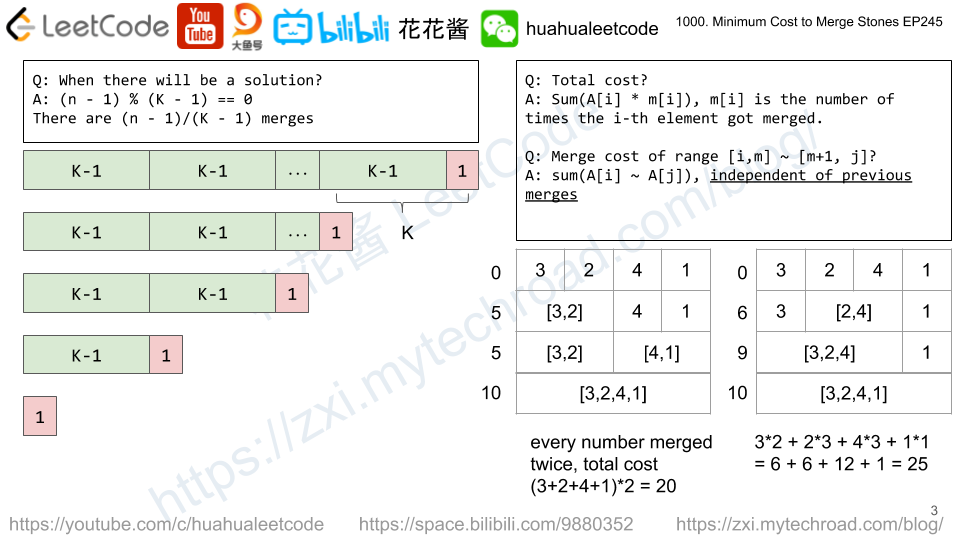
There are N piles of stones arranged in a row. The i-th pile has stones[i] stones.
A move consists of merging exactly K consecutive piles into one pile, and the cost of this move is equal to the total number of stones in these K piles.
Find the minimum cost to merge all piles of stones into one pile. If it is impossible, return -1.
Example 1:
Input: stones = [3,2,4,1], K = 2
Output: 20
Explanation:
We start with [3, 2, 4, 1].
We merge [3, 2] for a cost of 5, and we are left with [5, 4, 1].
We merge [4, 1] for a cost of 5, and we are left with [5, 5].
We merge [5, 5] for a cost of 10, and we are left with [10].
The total cost was 20, and this is the minimum possible.
Example 2:
Input: stones = [3,2,4,1], K = 3
Output: -1
Explanation: After any merge operation, there are 2 piles left, and we can't merge anymore.  So the task is impossible.
Example 3:
Input: stones = [3,5,1,2,6], K = 3
Output: 25
Explanation:
We start with [3, 5, 1, 2, 6].
We merge [5, 1, 2] for a cost of 8, and we are left with [3, 8, 6].
We merge [3, 8, 6] for a cost of 17, and we are left with [17].
The total cost was 25, and this is the minimum possible.
Note:
1 <= stones.length <= 30
2 <= K <= 30
1 <= stones[i] <= 100
Solution: DP
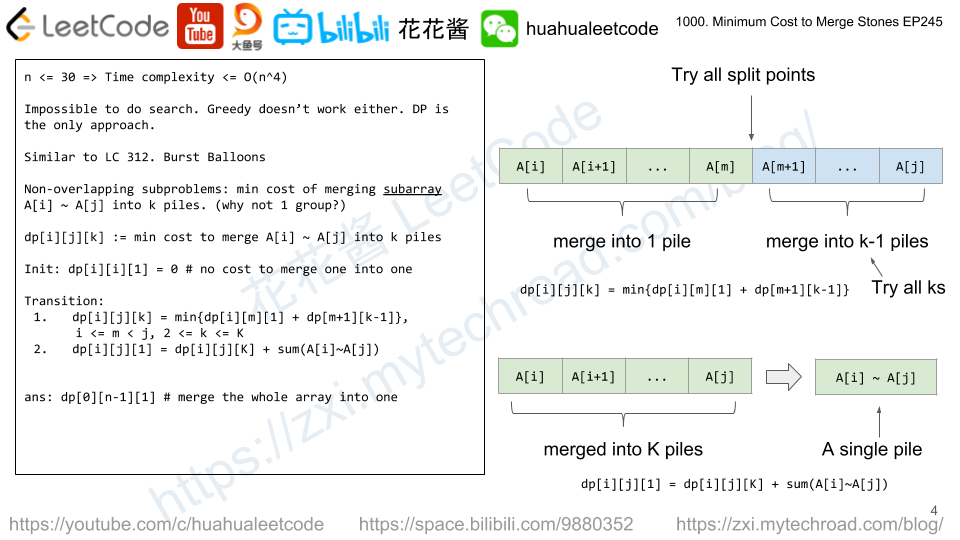
dp[i][j][k] := min cost to merge subarray i ~ j into k piles Init: dp[i][j][k] = 0 if i==j and k == 1 else inf ans: dp[0][n-1][1] transition: 1. dp[i][j][k] = min{dp[i][m][1] + dp[m+1][j][k-1]} for all i <= m < j 2. dp[i][j][1] = dp[i][j][K] + sum(A[i]~A[j])
Time complexity: O(n^3) Space complexity: O(n^2*K)
C++
1
2
3
4
5
6
7
8
9
10
11
12
13
14
15
16
17
18
19
20
21
22
23
24
25
26
// Running time: 12 ms, 12.1 MB
classSolution{
public:
intmergeStones(vector<int>&stones,intK){
constintn=stones.size();
if((n-1)%(K-1))return-1;
constintkInf=1e9;
vector<int>sums(n+1);
for(inti=0;i<stones.size();++i)
sums[i+1]=sums[i]+stones[i];
// dp[i][j][k] := min cost to merge subarray i~j into k piles.
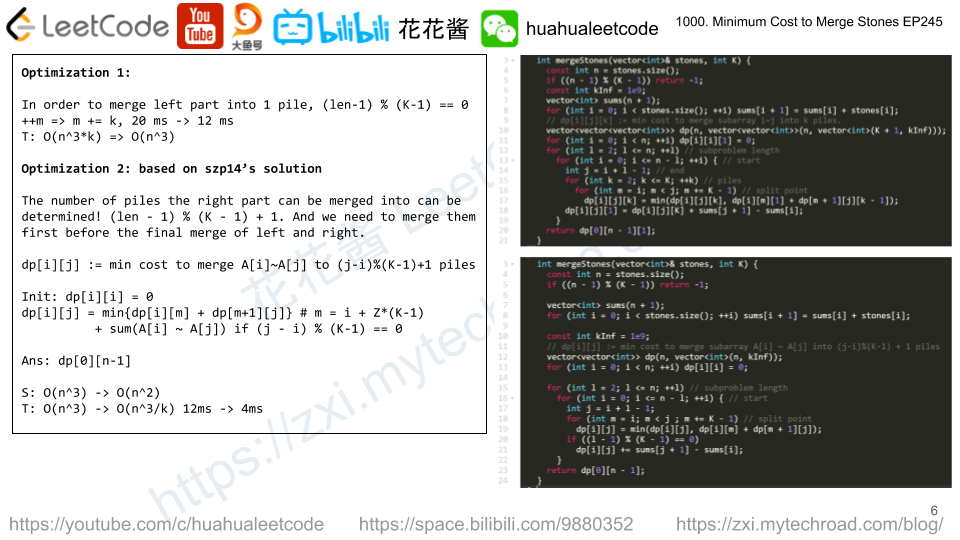
dp[l][i] := min cost to merge [i, i + l) into as less piles as possible. Number of merges will be (l-1) / (K – 1) and Transition: dp[l][i] = min(dp[m][i] + dp[l – m][i + m]) for 1 <= m < l if ((l – 1) % (K – 1) == 0) [i, i + l) can be merged into 1 pile, dp[l][i] += sum(A[i:i+l])
Time complexity: O(n^3 / k) Space complexity: O(n^2)
C++
1
2
3
4
5
6
7
8
9
10
11
12
13
14
15
16
17
18
19
20
21
22
23
24
25
26
27
28
29
// Author: Huahua 4ms, 9.6 MB
classSolution{
public:
intmergeStones(vector<int>&stones,intK){
constintn=stones.size();
if((n-1)%(K-1))return-1;
vector<int>sums(n+1);
for(inti=0;i<stones.size();++i)
sums[i+1]=sums[i]+stones[i];
constintkInf=1e9;
// dp[i][j] := min cost to merge subarray A[i] ~ A[j] into (j-i)%(K-1) + 1 piles
vector<vector<int>>dp(n,vector<int>(n,kInf));
for(inti=0;i<n;++i)dp[i][i]=0;
for(intl=2;l<=n;++l)// subproblem length
for(inti=0;i<=n-l;++i){// start
intj=i+l-1;
for(intm=i;m<j;m+=K-1)// split point
dp[i][j]=min(dp[i][j],dp[i][m]+dp[m+1][j]);
// If the current length can be merged into 1 pile
From any valid string V, we may split V into two pieces X and Y such that X + Y (X concatenated with Y) is equal to V. (X or Y may be empty.) Then, X + "abc" + Y is also valid.
If for example S = "abc", then examples of valid strings are: "abc", "aabcbc", "abcabc", "abcabcababcc". Examples of invalid strings are: "abccba", "ab", "cababc", "bac".
Return true if and only if the given string S is valid.
Example 1:
Input: "aabcbc"
Output: true
Explanation:
We start with the valid string "abc".
Then we can insert another "abc" between "a" and "bc", resulting in "a" + "abc" + "bc" which is "aabcbc".
Example 2:
Input: "abcabcababcc"
Output: true
Explanation:
"abcabcabc" is valid after consecutive insertings of "abc".
Then we can insert "abc" before the last letter, resulting in "abcabcab" + "abc" + "c" which is "abcabcababcc".
Example 3:
Input: "abccba"
Output: false
Example 4:
Input: "cababc"
Output: false
Note:
1 <= S.length <= 20000
S[i] is 'a', 'b', or 'c'
Solution: Stack
If current char can be appended to the stack do so, if the top of stack is “abc” pop, otherwise push the current char to the stack. Check whether the stack is empty after all chars were processed.
Given an array A of strings made only from lowercase letters, return a list of all characters that show up in all strings within the list (including duplicates). For example, if a character occurs 3 times in all strings but not 4 times, you need to include that character three times in the final answer.
Given an array A of 0s and 1s, we may change up to K values from 0 to 1.
Return the length of the longest (contiguous) subarray that contains only 1s.
Example 1:
Input: A = [1,1,1,0,0,0,1,1,1,1,0], K = 2
Output: 6
Explanation:
[1,1,1,0,0,1,1,1,1,1,1]
Bolded numbers were flipped from 0 to 1.  The longest subarray is underlined.
Example 2:
Input: A = [0,0,1,1,0,0,1,1,1,0,1,1,0,0,0,1,1,1,1], K = 3
Output: 10
Explanation:
[0,0,1,1,1,1,1,1,1,1,1,1,0,0,0,1,1,1,1]
Bolded numbers were flipped from 0 to 1.  The longest subarray is underlined.