Given a binary tree, determine if it is a complete binary tree.
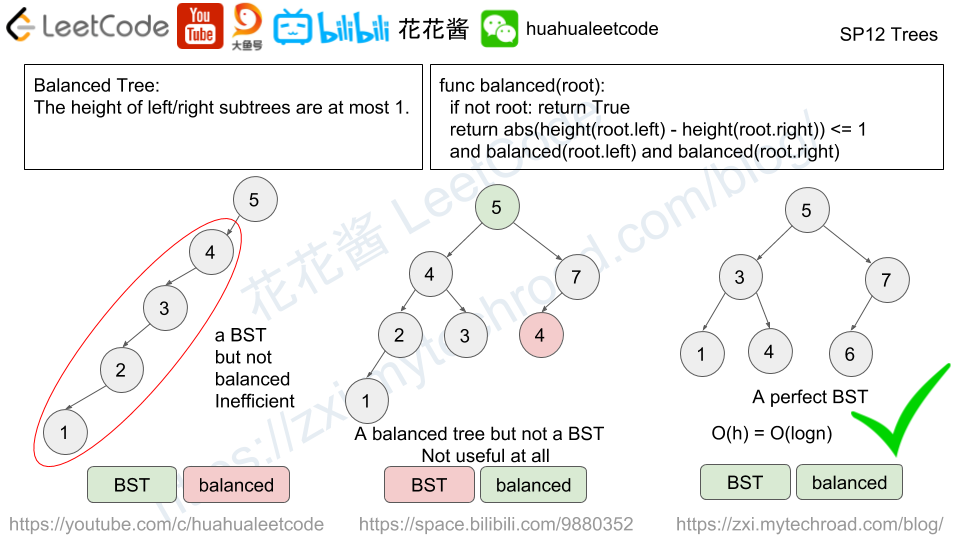
Definition of a complete binary tree from Wikipedia: In a complete binary tree every level, except possibly the last, is completely filled, and all nodes in the last level are as far left as possible. It can have between 1 and 2h nodes inclusive at the last level h.
Example 1:
Input: [1,2,3,4,5,6]
Output: true
Explanation: Every level before the last is full (ie. levels with node-values {1} and {2, 3}), and all nodes in the last level ({4, 5, 6}) are as far left as possible.
Example 2:
Input: [1,2,3,4,5,null,7]
Output: false
Explanation: The node with value 7 isn't as far left as possible.
Note:
The tree will have between 1 and 100 nodes.
Solution:
Level order traversal, if any nodes appears after a missing node then the tree is not a perfect binary tree.
You are installing a billboard and want it to have the largest height. The billboard will have two steel supports, one on each side. Each steel support must be an equal height.
You have a collection of rods which can be welded together. For example, if you have rods of lengths 1, 2, and 3, you can weld them together to make a support of length 6.
Return the largest possible height of your billboard installation. If you cannot support the billboard, return 0.
Example 1:
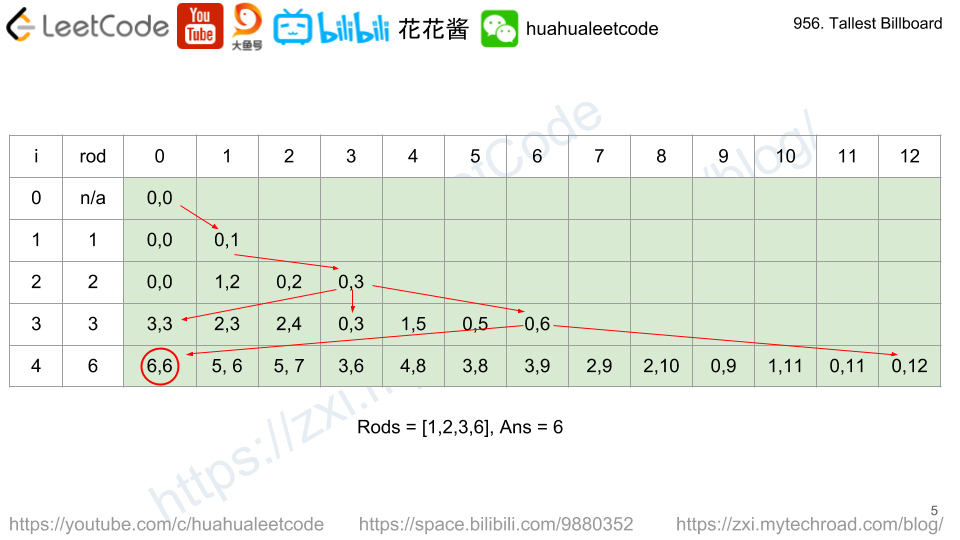
Input: [1,2,3,6]Output: 6Explanation: We have two disjoint subsets {1,2,3} and {6}, which have the same sum = 6.
Example 2:
Input: [1,2,3,4,5,6]Output: 10Explanation: We have two disjoint subsets {2,3,5} and {4,6}, which have the same sum = 10.
Example 3:
Input: [1,2]Output: 0Explanation: The billboard cannot be supported, so we return 0.