Press "Enter" to skip to content

Huahua's Tech Road

花花酱 LeetCode 954. Array of Doubled Pairs

Problem

Given an array of integers A with even length, return true if and only if it is possible to reorder it such that A[2 * i + 1] = 2 * A[2 * i] for every 0 <= i < len(A) / 2.

Example 1:

Input: [3,1,3,6]
Output: false

Example 2:

Input: [2,1,2,6]
Output: false

Example 3:

Input: [4,-2,2,-4]
Output: true
Explanation: We can take two groups, [-2,-4] and [2,4] to form [-2,-4,2,4] or [2,4,-2,-4].

Example 4:

Input: [1,2,4,16,8,4]
Output: false

Note:

  1. 0 <= A.length <= 30000
  2. A.length is even
  3. -100000 <= A[i] <= 100000

Solution 1:

Time complexity: O(N + 100000 * 2)

Space complexity: O(100000 * 2)

C++

Solution 2:

Time complexity: O(NlogN)

Space complexity: O(N)

C++


花花酱 LeetCode 953. Verifying an Alien Dictionary

Problem

In an alien language, surprisingly they also use english lowercase letters, but possibly in a different order. The order of the alphabet is some permutation of lowercase letters.

Given a sequence of words written in the alien language, and the order of the alphabet, return true if and only if the given words are sorted lexicographicaly in this alien language.


Example 1:

Input: words = ["hello","leetcode"], order = "hlabcdefgijkmnopqrstuvwxyz"
Output: true
Explanation: As 'h' comes before 'l' in this language, then the sequence is sorted.

Example 2:

Input: words = ["word","world","row"], order = "worldabcefghijkmnpqstuvxyz"
Output: false
Explanation: As 'd' comes after 'l' in this language, then words[0] > words[1], hence the sequence is unsorted.

Example 3:

Input: words = ["apple","app"], order = "abcdefghijklmnopqrstuvwxyz"
Output: false
Explanation: The first three characters "app" match, and the second string is shorter (in size.) According to lexicographical rules "apple" > "app", because 'l' > '∅', where '∅' is defined as the blank character which is less than any other character (More info).

Note:

  1. 1 <= words.length <= 100
  2. 1 <= words[i].length <= 20
  3. order.length == 26
  4. All characters in words[i] and order are english lowercase letters.

Solution: Hashtable

Time complexity: O(sum(len(words[i])))

Space complexity: O(26)

C++

花花酱 LeetCode 936. Stamping The Sequence

Problem

You want to form a target string of lowercase letters.

At the beginning, your sequence is target.length '?' marks.  You also have a stamp of lowercase letters.

On each turn, you may place the stamp over the sequence, and replace every letter in the sequence with the corresponding letter from the stamp.  You can make up to 10 * target.length turns.

For example, if the initial sequence is “?????”, and your stamp is "abc",  then you may make “abc??”, “?abc?”, “??abc” in the first turn.  (Note that the stamp must be fully contained in the boundaries of the sequence in order to stamp.)

If the sequence is possible to stamp, then return an array of the index of the left-most letter being stamped at each turn.  If the sequence is not possible to stamp, return an empty array.

For example, if the sequence is “ababc”, and the stamp is "abc", then we could return the answer [0, 2], corresponding to the moves “?????” -> “abc??” -> “ababc”.

Also, if the sequence is possible to stamp, it is guaranteed it is possible to stamp within 10 * target.length moves.  Any answers specifying more than this number of moves will not be accepted.

Example 1:

Input: stamp = "abc", target = "ababc"
Output: [0,2]
([1,0,2] would also be accepted as an answer, as well as some other answers.)

Example 2:

Input: stamp = "abca", target = "aabcaca"
Output: [3,0,1]

Note:

  1. 1 <= stamp.length <= target.length <= 1000
  2. stamp and target only contain lowercase letters.

Solution: Greedy + Reverse Simulation

Reverse the stamping process. Each time find a full or partial match. Replace the matched char to ‘?’.

Don’t forget the reverse the answer as well.

T = “ababc”, S = “abc”

T = “ab???”, index = 2

T = “?????”, index = 0

ans = [0, 2]

Time complexity: O((T – S)*S)

Space complexity: O(T)

C++

花花酱 LeetCode 952. Largest Component Size by Common Factor

Problem

Given a non-empty array of unique positive integers A, consider the following graph:

  • There are A.length nodes, labelled A[0] to A[A.length - 1];
  • There is an edge between A[i] and A[j] if and only if A[i] and A[j] share a common factor greater than 1.

Return the size of the largest connected component in the graph.

Example 1:

Input: [4,6,15,35]
Output: 4

Example 2:

Input: [20,50,9,63]
Output: 2

Example 3:

Input: [2,3,6,7,4,12,21,39]
Output: 8

Note:

  1. 1 <= A.length <= 20000
  2. 1 <= A[i] <= 100000

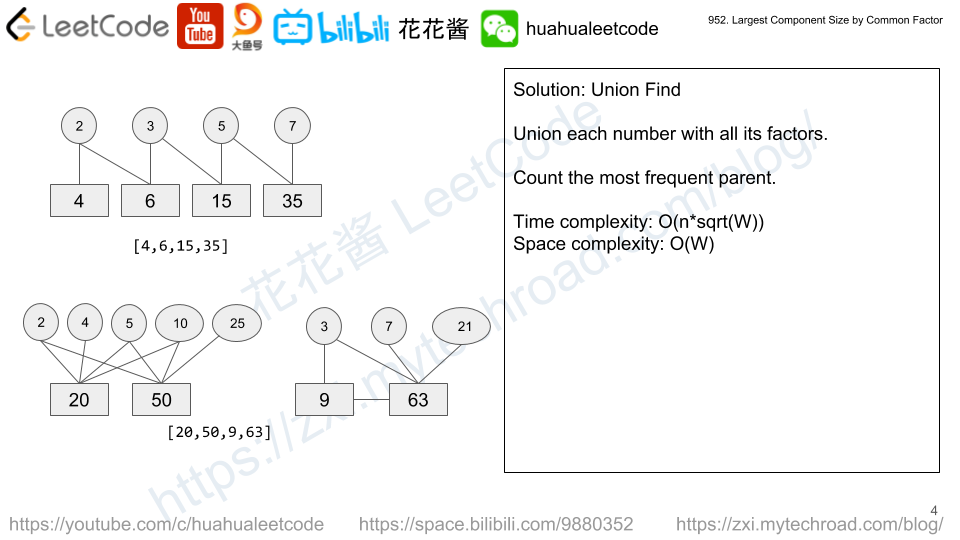
Solution: Union Find

For each number, union itself with all its factors.

E.g. 6, union(6,2), union(6,3)

Time complexity: \( O(\Sigma{sqrt(A[i])})  \)

Space complexity: \( O(max(A)) \)

C++

Python3