Problem
We have some permutation A of [0, 1, ..., N - 1], where N is the length of A.
The number of (global) inversions is the number of i < j with 0 <= i < j < N and A[i] > A[j].
The number of local inversions is the number of i with 0 <= i < N and A[i] > A[i+1].
Return true if and only if the number of global inversions is equal to the number of local inversions.
Example 1:
Input: A = [1,0,2]
Output: true
Explanation: There is 1 global inversion, and 1 local inversion.
Example 2:
Input: A = [1,2,0]
Output: false
Explanation: There are 2 global inversions, and 1 local inversion.
Note:
Awill be a permutation of[0, 1, ..., A.length - 1].Awill have length in range[1, 5000].- The time limit for this problem has been reduced.
Solution1: Brute Force (TLE)
Time complexity: O(n^2)
Space complexity: O(1)
C++
|
1 2 3 4 5 6 7 8 9 10 11 12 13 14 15 16 |
// Author: Huahua // Running time: TLE (208/208 test cases passed) class Solution { public: bool isIdealPermutation(vector<int>& A) { const int n = A.size(); int local = 0; for (int i = 0; i < n - 1; ++i) if (A[i] > A[i + 1]) ++local; int global = 0; for (int i = 0; i < n; ++i) for (int j = i + 1; j < n; ++j) if (A[i] > A[j] && ++global > local) return false; return global == local; } }; |
Solution2: MergeSort
Time complexity: O(nlogn)
Space complexity: O(n)
|
1 2 3 4 5 6 7 8 9 10 11 12 13 14 15 16 17 18 19 20 21 22 23 24 25 26 27 28 29 30 31 32 33 34 35 36 37 38 39 40 41 42 |
// Author: Huahua // Running time: 52 ms (<96.42%) class Solution { public: bool isIdealPermutation(vector<int>& A) { const int n = A.size(); int local = 0; for (int i = 0; i < n - 1; ++i) if (A[i] > A[i + 1]) ++local; tmp = vector<int>(n); int global = mergeSort(A, 0, n - 1); return global == local; } private: vector<int> tmp; int mergeSort(vector<int>& A, int l, int r) { if (l >= r) return 0; const int len = r - l + 1; int m = (r - l) / 2 + l; int inv = mergeSort(A, l, m) + mergeSort(A, m + 1, r); int i = l; int j = m + 1; int k = 0; while (i <= m && j <= r) { if (A[i] <= A[j]) { tmp[k++] = A[i++]; } else { tmp[k++] = A[j++]; inv += m - i + 1; } } while (i <= m) tmp[k++] = A[i++]; while (j <= r) tmp[k++] = A[j++]; std::copy(tmp.begin(), tmp.begin() + len, A.begin() + l); return inv; } }; |
C#
|
1 2 3 4 5 6 7 8 9 10 11 12 13 14 15 16 17 18 19 20 21 22 23 24 25 26 27 28 29 30 31 32 33 34 35 36 37 38 |
// Author: Huahua // Running time: 208 ms public class Solution { public bool IsIdealPermutation(int[] A) { var n = A.Length; var localInv = 0; for (var i = 1; i < n; ++i) if (A[i] < A[i - 1]) ++localInv; tmp = new int[n]; var globalInv = MergeSort(A, 0, n - 1); return localInv == globalInv; } private int[] tmp; private int MergeSort(int[] A, int l, int r) { if (l >= r) return 0; int m = (r - l) / 2 + l; int inv = MergeSort(A, l, m) + MergeSort(A, m + 1, r); int i = l; int j = m + 1; int k = 0; while (i <= m && j <= r) { if (A[i] <= A[j]) { tmp[k++] = A[i++]; } else { inv += m - i + 1; tmp[k++] = A[j++]; } } while (i <= m) tmp[k++] = A[i++]; while (j <= r) tmp[k++] = A[j++]; Array.Copy(tmp, 0, A, l, k); return inv; } } |
Solution3: Input Property
Input is a permutation of [0, 1, …, N – 1]
Time Complexity: O(n)
Space Complexity: O(1)
|
1 2 3 4 5 6 7 8 9 10 |
// Author: Huahua // Running time: 40 ms (<99.26%) class Solution { public: bool isIdealPermutation(vector<int>& A) { for (int i = 0; i < A.size(); ++i) if (abs(A[i] - i) > 1) return false; return true; } }; |
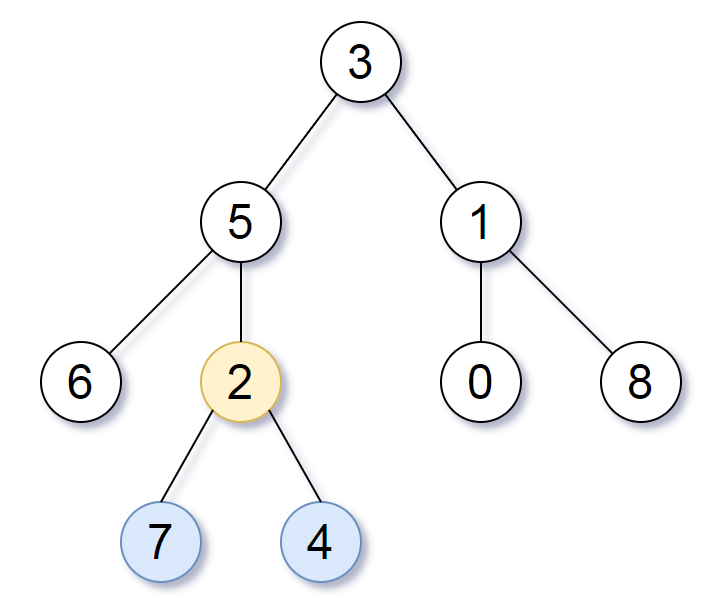 We return the node with value 2, colored in yellow in the diagram.
The nodes colored in blue are the deepest nodes of the tree.
The input "[3, 5, 1, 6, 2, 0, 8, null, null, 7, 4]" is a serialization of the given tree.
The output "[2, 7, 4]" is a serialization of the subtree rooted at the node with value 2.
Both the input and output have TreeNode type.
We return the node with value 2, colored in yellow in the diagram.
The nodes colored in blue are the deepest nodes of the tree.
The input "[3, 5, 1, 6, 2, 0, 8, null, null, 7, 4]" is a serialization of the given tree.
The output "[2, 7, 4]" is a serialization of the subtree rooted at the node with value 2.
Both the input and output have TreeNode type.