Press "Enter" to skip to content

Huahua's Tech Road

花花酱 LeetCode 164. Maximum Gap

https://leetcode.com/problems/maximum-gap/description/

Problem:

Given an unsorted array, find the maximum difference between the successive elements in its sorted form.

Try to solve it in linear time/space.

Return 0 if the array contains less than 2 elements.

You may assume all elements in the array are non-negative integers and fit in the 32-bit signed integer range.

题目大意:

给你一个没有排序的正整数数组。输出排序后,相邻元素的差的最大值(Max Gap)。需要在线性时间内解决。

Example:

Input:  [5, 0, 4, 2, 12, 10]

Output: 5

Explanation: 

Sorted: [0, 2, 4, 5, 10, 12]

max gap is 10 – 5 = 5

Idea:

Bucket sort. Use n buckets to store all the numbers. For each bucket, only track the min / max value.

桶排序。用n个桶来存放数字。对于每个桶,只跟踪存储最大值和最小值。

max gap must come from two “adjacent” buckets, b[i], b[j], j > i, b[i+1] … b[j – 1] must be empty.

max gap 只可能来自”相邻”的两个桶 b[i] 和 b[j], j > i, b[i] 和 b[j] 之间的桶(如果有)必须为空。

max gap = b[j].min – b[i].min

Time complexity: O(n)

时间复杂度: O(n)

Space complexity: O(n)

空间复杂度: O(n)

Solution:

C++


花花酱 LeetCode 530. Minimum Absolute Difference in BST

Link

Problem:

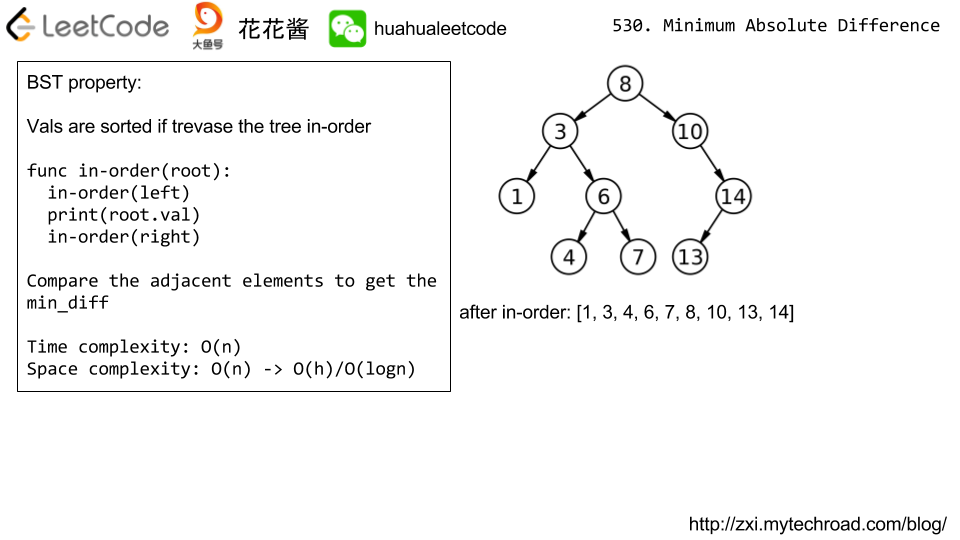
Given a binary search tree with non-negative values, find the minimum absolute difference between values of any two nodes.

Example:

Note: There are at least two nodes in this BST.


Idea:

Sorting via inorder traversal gives us sorted values, compare current one with previous one to reduce space complexity from O(n) to O(h).

Solution:

C++ O(n) space

C++ O(h) space

Java

Python

Related Problems:

  • [解题报告] LeetCode 98. Validate Binary Search Tree

花花酱 LeetCode 732. My Calendar III

Problem:

link: https://leetcode.com/problems/my-calendar-iii/description/

Implement a MyCalendarThree class to store your events. A new event can always be added.

Your class will have one method, book(int start, int end). Formally, this represents a booking on the half open interval [start, end), the range of real numbers x such that start <= x < end.

K-booking happens when K events have some non-empty intersection (ie., there is some time that is common to all K events.)

For each call to the method MyCalendar.book, return an integer K representing the largest integer such that there exists a K-booking in the calendar.

Your class will be called like this: MyCalendarThree cal = new MyCalendarThree();MyCalendarThree.book(start, end)

Example 1:

MyCalendarThree();
MyCalendarThree.book(10, 20); // returns 1
MyCalendarThree.book(50, 60); // returns 1
MyCalendarThree.book(10, 40); // returns 2
MyCalendarThree.book(5, 15); // returns 3
MyCalendarThree.book(5, 10); // returns 3
MyCalendarThree.book(25, 55); // returns 3
Explanation: 
The first two events can be booked and are disjoint, so the maximum K-booking is a 1-booking.
The third event [10, 40) intersects the first event, and the maximum K-booking is a 2-booking.
The remaining events cause the maximum K-booking to be only a 3-booking.
Note that the last event locally causes a 2-booking, but the answer is still 3 because
eg. [10, 20), [10, 40), and [5, 15) are still triple booked.

Note:

  • The number of calls to MyCalendarThree.book per test case will be at most 400.
  • In calls to MyCalendarThree.book(start, end)start and end are integers in the range [0, 10^9].

Idea:

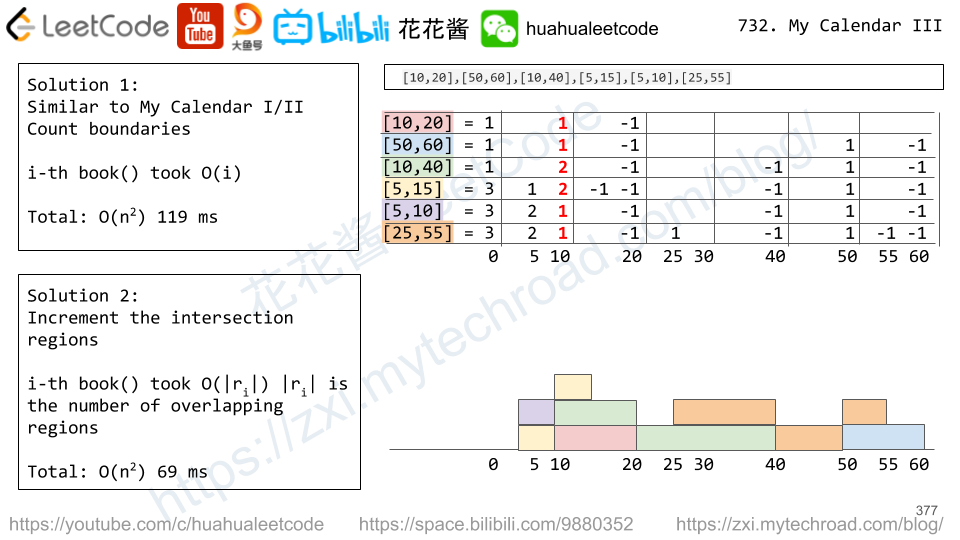
Similar to LeetCode 731 My Calendar II Use an ordered / tree map to track the number of event at current time.

For a new book event, increase the number of events at start, decrease the number of events at end.

Scan the timeline to find the maximum number of events.


Solution 1: Count Boundaries

Time complexity: O(n^2)

Space complexity: O(n)

C++

Solution 2

C++

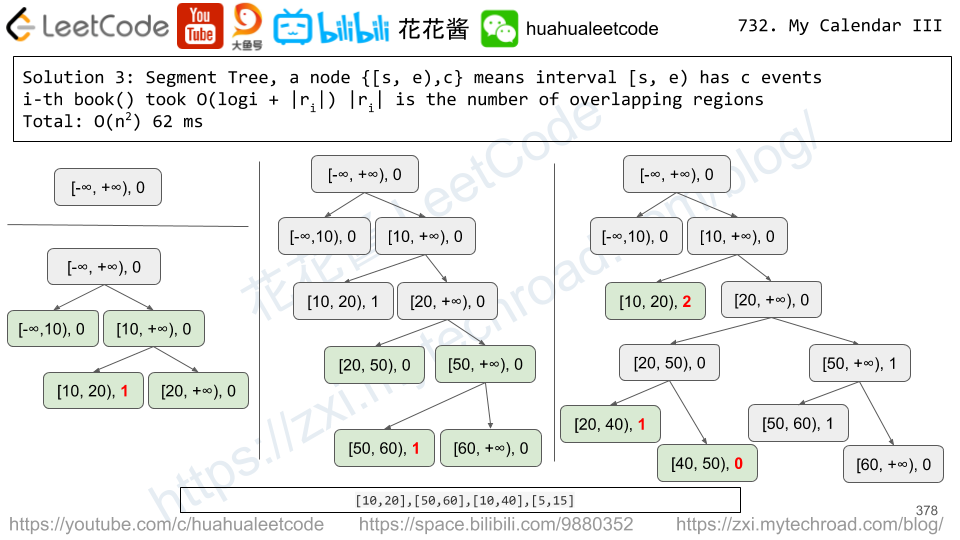
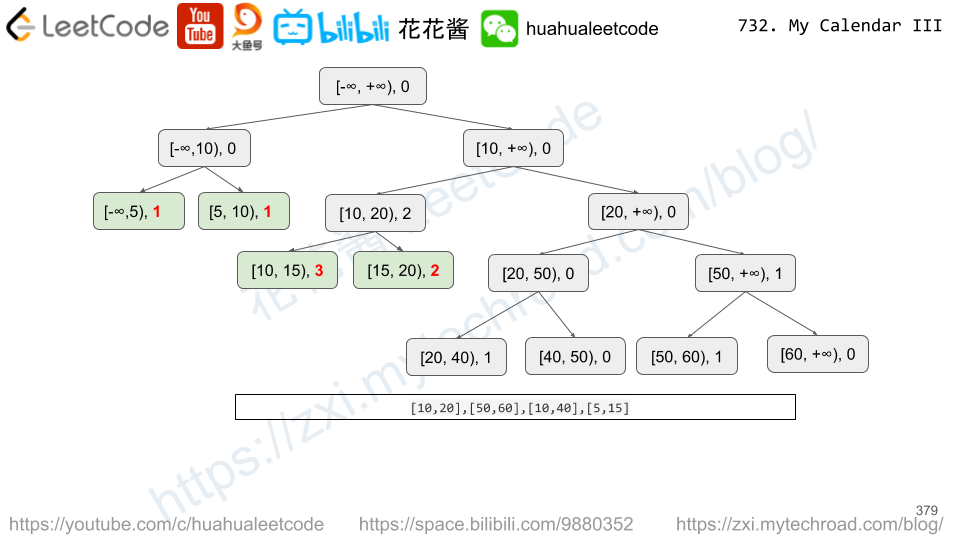
Solution 3: Segment Tree

C++

Python3

Related Problems:

花花酱 LeetCode 740. Delete and Earn

Problem:

Given an array nums of integers, you can perform operations on the array.

In each operation, you pick any nums[i] and delete it to earn nums[i] points. After, you must delete everyelement equal to nums[i] - 1 or nums[i] + 1.

You start with 0 points. Return the maximum number of points you can earn by applying such operations.

Example 1:

Example 2:

Note:

  • The length of nums is at most 20000.
  • Each element nums[i] is an integer in the range [1, 10000].


Idea:

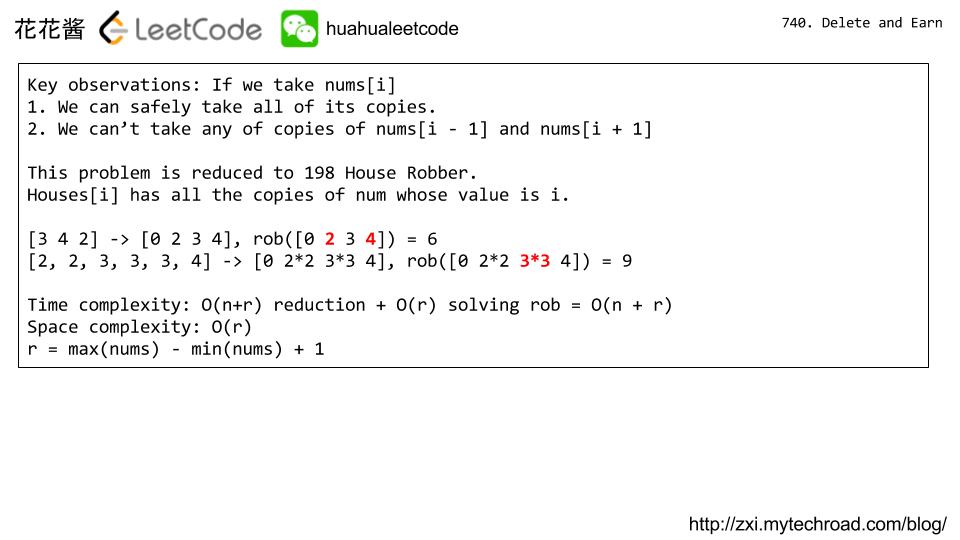
Reduce the problem to House Robber Problem

Key observations: If we take nums[i]

  1. We can safely take all of its copies.
  2. We can’t take any of copies of nums[i – 1] and nums[i + 1]

This problem is reduced to 198 House Robber.

Houses[i] has all the copies of num whose value is i.

[3 4 2] -> [0 2 3 4], rob([0 2 3 4]) = 6            

[2, 2, 3, 3, 3, 4] -> [0 2*2 3*3 4], rob([0 2*2 3*3 4]) = 9

Time complexity: O(n+r) reduction + O(r) solving rob = O(n + r)

Space complexity: O(r)

r = max(nums) – min(nums) + 1

Time complexity: O(n + r)

Space complexity: O(r)

Solution:

Related Problem:

花花酱 LeetCode 198. House Robber

Problem:

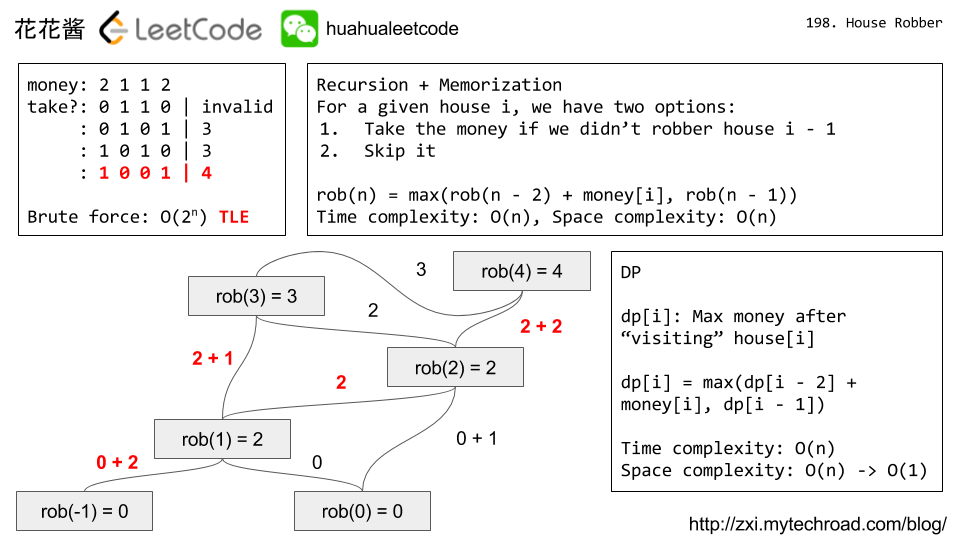
You are a professional robber planning to rob houses along a street. Each house has a certain amount of money stashed, the only constraint stopping you from robbing each of them is that adjacent houses have security system connected and it will automatically contact the police if two adjacent houses were broken into on the same night.

Given a list of non-negative integers representing the amount of money of each house, determine the maximum amount of money you can rob tonight without alerting the police.

Idea:

DP

Time complexity: O(n)

Space complexity: O(n) -> O(1)

Solution:

C++ / Recursion + Memorization

Time complexity: O(n)

Space complexity: O(n)


C++ / DP

Time complexity: O(n)

Space complexity: O(n)

C++ / O(1) Space