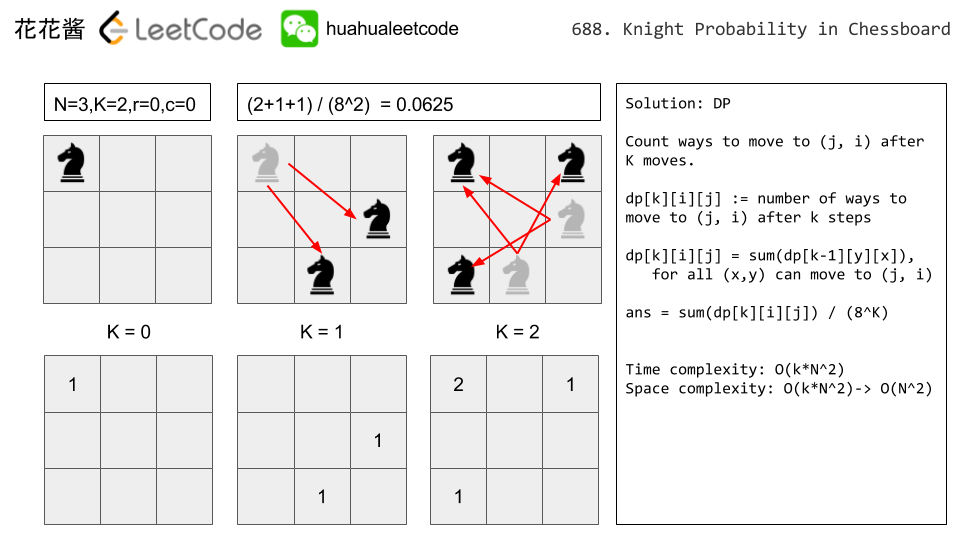
On an NxN chessboard, a knight starts at the r-th row and c-th column and attempts to make exactly Kmoves. The rows and columns are 0 indexed, so the top-left square is (0, 0), and the bottom-right square is (N-1, N-1).
A chess knight has 8 possible moves it can make, as illustrated below. Each move is two squares in a cardinal direction, then one square in an orthogonal direction.
Each time the knight is to move, it chooses one of eight possible moves uniformly at random (even if the piece would go off the chessboard) and moves there.
The knight continues moving until it has made exactly K moves or has moved off the chessboard. Return the probability that the knight remains on the board after it has stopped moving.
Example:
1
2
3
4
5
Input:3,2,0,0
Output:0.0625
Explanation:There are two moves(to(1,2),(2,1))that will keep the knight on the board.
From eachof those positions,there are also two moves that will keep the knight on
the board.The total probability the knight stays on the board is0.0625.
Note:
N will be between 1 and 25.
K will be between 0 and 100.
The knight always initially starts on the board.
Idea:
Dynamic programming
Count the ways to reach (x, y) after k moves from start.
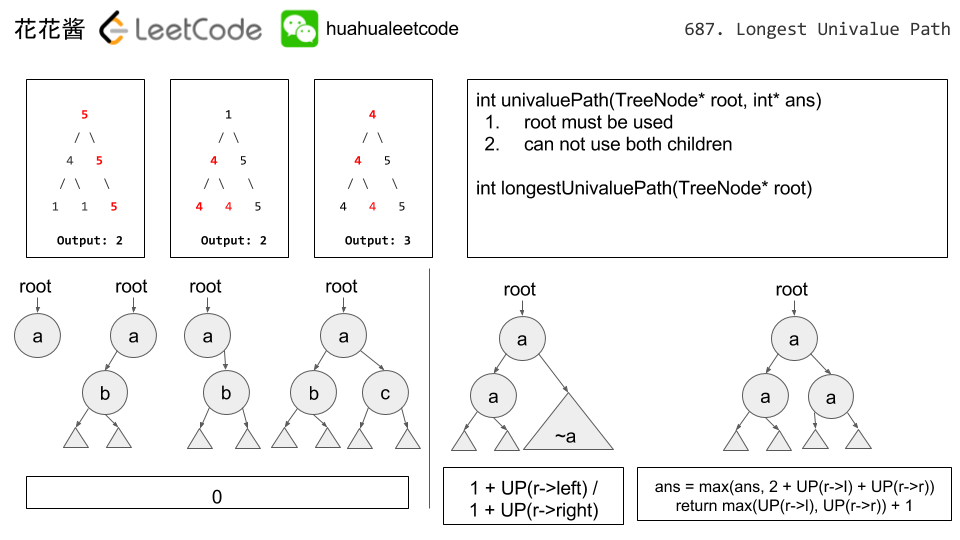
Given a binary tree, find the length of the longest path where each node in the path has the same value. This path may or may not pass through the root.
Note: The length of path between two nodes is represented by the number of edges between them.
Example 1:
Input:
              5
             / \
            4   5
           / \   \
          1   1   5
Output:
2
Example 2:
Input:
              1
             / \
            4   5
           / \   \
          4   4   5
Output:
2
Note: The given binary tree has not more than 10000 nodes. The height of the tree is not more than 1000.
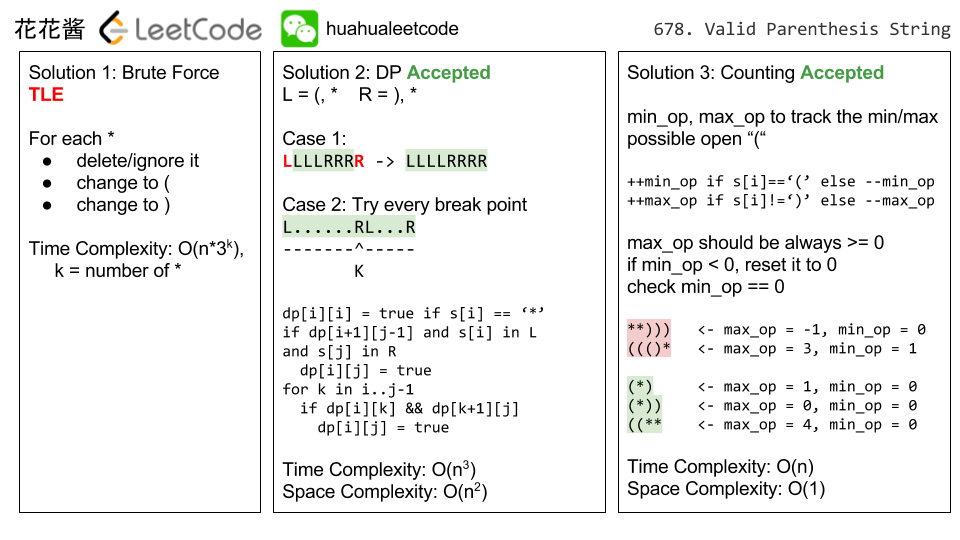
Given a string containing only three types of characters: ‘(‘, ‘)’ and ‘*’, write a function to check whether this string is valid. We define the validity of a string by these rules:
Any left parenthesis '(' must have a corresponding right parenthesis ')'.
Any right parenthesis ')' must have a corresponding left parenthesis '('.
Left parenthesis '(' must go before the corresponding right parenthesis ')'.
'*' could be treated as a single right parenthesis ')' or a single left parenthesis '(' or an empty string.
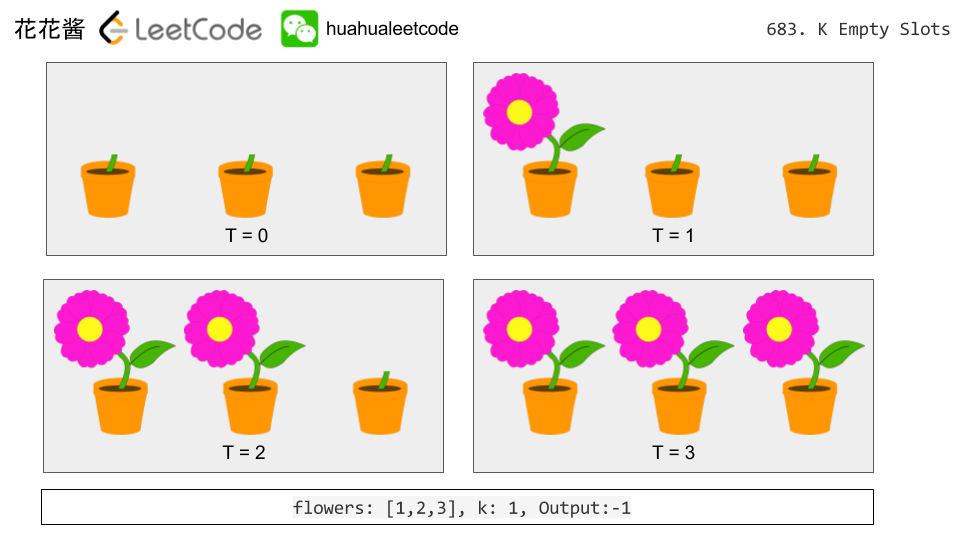
There is a garden with N slots. In each slot, there is a flower. The N flowers will bloom one by one in N days. In each day, there will be exactly one flower blooming and it will be in the status of blooming since then.
Given an array flowers consists of number from 1 to N. Each number in the array represents the place where the flower will open in that day.
For example, flowers[i] = x means that the unique flower that blooms at day i will be at position x, where i and x will be in the range from 1 to N.
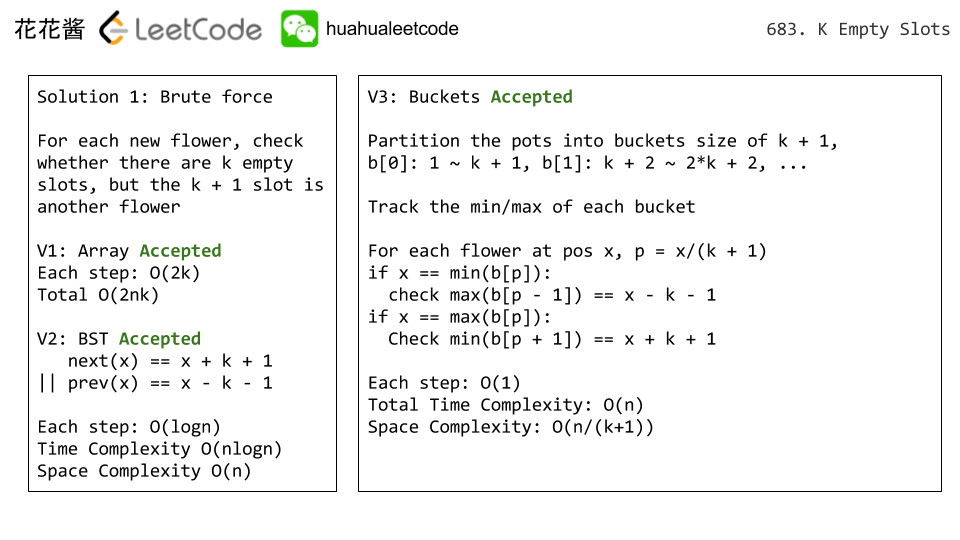
Also given an integer k, you need to output in which day there exists two flowers in the status of blooming, and also the number of flowers between them is k and these flowers are not blooming.
If there isn’t such day, output -1.
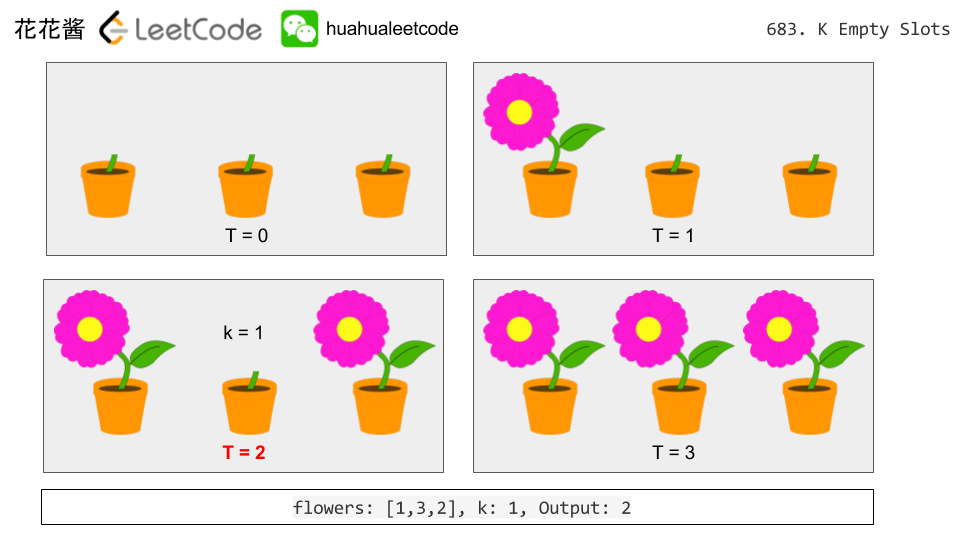
Example 1:
Input:
flowers: [1,3,2]
k: 1
Output: 2
Explanation: In the second day, the first and the third flower have become blooming.
 Each time the knight is to move, it chooses one of eight possible moves uniformly at random (even if the piece would go off the chessboard) and moves there.