Press "Enter" to skip to content

Huahua's Tech Road

花花酱 LeetCode 2073. Time Needed to Buy Tickets

There are n people in a line queuing to buy tickets, where the 0th person is at the front of the line and the (n - 1)th person is at the back of the line.

You are given a 0-indexed integer array tickets of length n where the number of tickets that the ith person would like to buy is tickets[i].

Each person takes exactly 1 second to buy a ticket. A person can only buy 1 ticket at a time and has to go back to the end of the line (which happens instantaneously) in order to buy more tickets. If a person does not have any tickets left to buy, the person will leave the line.

Return the time taken for the person at position k(0-indexed) to finish buying tickets.

Example 1:

Input: tickets = [2,3,2], k = 2
Output: 6
Explanation: 
- In the first pass, everyone in the line buys a ticket and the line becomes [1, 2, 1].
- In the second pass, everyone in the line buys a ticket and the line becomes [0, 1, 0].
The person at position 2 has successfully bought 2 tickets and it took 3 + 3 = 6 seconds.

Example 2:

Input: tickets = [5,1,1,1], k = 0
Output: 8
Explanation:
- In the first pass, everyone in the line buys a ticket and the line becomes [4, 0, 0, 0].
- In the next 4 passes, only the person in position 0 is buying tickets.
The person at position 0 has successfully bought 5 tickets and it took 4 + 1 + 1 + 1 + 1 = 8 seconds.

Constraints:

  • n == tickets.length
  • 1 <= n <= 100
  • 1 <= tickets[i] <= 100
  • 0 <= k < n

Solution 1: Simulation

Time complexity: O(n * tickets[k])
Space complexity: O(n) / O(1)

C++

Solution 2: Math

Each person before k will have tickets[k] rounds, each person after k will have tickets[k] – 1 rounds.

Time complexity: O(n)
Space complexity: O(1)

C++

花花酱 LeetCode 2071. Maximum Number of Tasks You Can Assign

You have n tasks and m workers. Each task has a strength requirement stored in a 0-indexed integer array tasks, with the ith task requiring tasks[i] strength to complete. The strength of each worker is stored in a 0-indexed integer array workers, with the jth worker having workers[j] strength. Each worker can only be assigned to a single task and must have a strength greater than or equal to the task’s strength requirement (i.e., workers[j] >= tasks[i]).

Additionally, you have pills magical pills that will increase a worker’s strength by strength. You can decide which workers receive the magical pills, however, you may only give each worker at most one magical pill.

Given the 0-indexed integer arrays tasks and workers and the integers pills and strength, return the maximum number of tasks that can be completed.

Example 1:

Input: tasks = [3,2,1], workers = [0,3,3], pills = 1, strength = 1
Output: 3
Explanation:
We can assign the magical pill and tasks as follows:
- Give the magical pill to worker 0.
- Assign worker 0 to task 2 (0 + 1 >= 1)
- Assign worker 1 to task 1 (3 >= 2)
- Assign worker 2 to task 0 (3 >= 3)

Example 2:

Input: tasks = [5,4], workers = [0,0,0], pills = 1, strength = 5
Output: 1
Explanation:
We can assign the magical pill and tasks as follows:
- Give the magical pill to worker 0.
- Assign worker 0 to task 0 (0 + 5 >= 5)

Example 3:

Input: tasks = [10,15,30], workers = [0,10,10,10,10], pills = 3, strength = 10
Output: 2
Explanation:
We can assign the magical pills and tasks as follows:
- Give the magical pill to worker 0 and worker 1.
- Assign worker 0 to task 0 (0 + 10 >= 10)
- Assign worker 1 to task 1 (10 + 10 >= 15)

Example 4:

Input: tasks = [5,9,8,5,9], workers = [1,6,4,2,6], pills = 1, strength = 5
Output: 3
Explanation:
We can assign the magical pill and tasks as follows:
- Give the magical pill to worker 2.
- Assign worker 1 to task 0 (6 >= 5)
- Assign worker 2 to task 2 (4 + 5 >= 8)
- Assign worker 4 to task 3 (6 >= 5)

Constraints:

  • n == tasks.length
  • m == workers.length
  • 1 <= n, m <= 5 * 104
  • 0 <= pills <= m
  • 0 <= tasks[i], workers[j], strength <= 109

Solution: Greedy + Binary Search in Binary Search.

Find the smallest k, s.t. we are NOT able to assign. Then answer is k- 1.

The key is to verify whether we can assign k tasks or not.

Greedy: We want k smallest tasks and k strongest workers.

Start with the hardest tasks among (smallest) k:
1. assign task[i] to the weakest worker without a pill (if he can handle the hardest work so far, then the stronger workers can handle any simpler tasks left)
2. If 1) is not possible, we find a weakest worker + pill that can handle task[i] (otherwise we are wasting workers)
3. If 2) is not possible, impossible to finish k tasks.

Let k = min(n, m)
Time complexity: O((logk)2 * k)
Space complexity: O(k)

C++

花花酱 LeetCode 2070. Most Beautiful Item for Each Query

You are given a 2D integer array items where items[i] = [pricei, beautyi] denotes the price and beauty of an item respectively.

You are also given a 0-indexed integer array queries. For each queries[j], you want to determine the maximum beauty of an item whose price is less than or equal to queries[j]. If no such item exists, then the answer to this query is 0.

Return an array answer of the same length as queries where answer[j] is the answer to the jth query.

Example 1:

Input: items = [[1,2],[3,2],[2,4],[5,6],[3,5]], queries = [1,2,3,4,5,6]
Output: [2,4,5,5,6,6]
Explanation:
- For queries[0]=1, [1,2] is the only item which has price <= 1. Hence, the answer for this query is 2.
- For queries[1]=2, the items which can be considered are [1,2] and [2,4]. 
  The maximum beauty among them is 4.
- For queries[2]=3 and queries[3]=4, the items which can be considered are [1,2], [3,2], [2,4], and [3,5].
  The maximum beauty among them is 5.
- For queries[4]=5 and queries[5]=6, all items can be considered.
  Hence, the answer for them is the maximum beauty of all items, i.e., 6.

Example 2:

Input: items = [[1,2],[1,2],[1,3],[1,4]], queries = [1]
Output: [4]
Explanation: 
The price of every item is equal to 1, so we choose the item with the maximum beauty 4. 
Note that multiple items can have the same price and/or beauty.  

Example 3:

Input: items = [[10,1000]], queries = [5]
Output: [0]
Explanation:
No item has a price less than or equal to 5, so no item can be chosen.
Hence, the answer to the query is 0.

Constraints:

  • 1 <= items.length, queries.length <= 105
  • items[i].length == 2
  • 1 <= pricei, beautyi, queries[j] <= 109

Solution: Prefix Max + Binary Search

Sort items by price. For each price, use a treemap to store the max beauty of an item whose prices is <= p. Then use binary search to find the max beauty whose price is <= p.

Time complexity: Pre-processing O(nlogn) + query: O(qlogn)
Space complexity: O(n)

C++

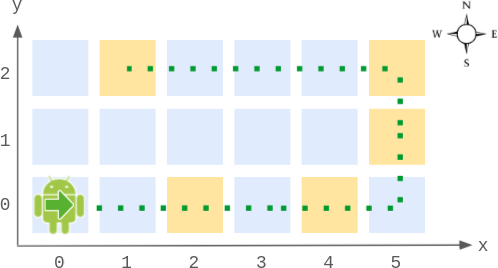
花花酱 LeetCode 2069. Walking Robot Simulation II

width x height grid is on an XY-plane with the bottom-left cell at (0, 0) and the top-right cell at (width - 1, height - 1). The grid is aligned with the four cardinal directions ("North""East""South", and "West"). A robot is initially at cell (0, 0) facing direction "East".

The robot can be instructed to move for a specific number of steps. For each step, it does the following.

  1. Attempts to move forward one cell in the direction it is facing.
  2. If the cell the robot is moving to is out of bounds, the robot instead turns 90 degrees counterclockwise and retries the step.

After the robot finishes moving the number of steps required, it stops and awaits the next instruction.

Implement the Robot class:

  • Robot(int width, int height) Initializes the width x height grid with the robot at (0, 0) facing "East".
  • void move(int num) Instructs the robot to move forward num steps.
  • int[] getPos() Returns the current cell the robot is at, as an array of length 2, [x, y].
  • String getDir() Returns the current direction of the robot, "North""East""South", or "West".

Example 1:

example-1
Input
["Robot", "move", "move", "getPos", "getDir", "move", "move", "move", "getPos", "getDir"]
[[6, 3], [2], [2], [], [], [2], [1], [4], [], []]
Output
[null, null, null, [4, 0], "East", null, null, null, [1, 2], "West"]

Explanation
Robot robot = new Robot(6, 3); // Initialize the grid and the robot at (0, 0) facing East.
robot.move(2);  // It moves two steps East to (2, 0), and faces East.
robot.move(2);  // It moves two steps East to (4, 0), and faces East.
robot.getPos(); // return [4, 0]
robot.getDir(); // return "East"
robot.move(2);  // It moves one step East to (5, 0), and faces East.
                // Moving the next step East would be out of bounds, so it turns and faces North.
                // Then, it moves one step North to (5, 1), and faces North.
robot.move(1);  // It moves one step North to (5, 2), and faces North (not West).
robot.move(4);  // Moving the next step North would be out of bounds, so it turns and faces West.
                // Then, it moves four steps West to (1, 2), and faces West.
robot.getPos(); // return [1, 2]
robot.getDir(); // return "West"

Constraints:

  • 2 <= width, height <= 100
  • 1 <= num <= 105
  • At most 104 calls in total will be made to movegetPos, and getDir.

Solution: Simulation

Note num >> w + h, when we hit a wall, we will always follow the boundary afterwards. We can do num %= p to reduce steps, where p = ((w – 1) + (h – 1)) * 2

Time complexity: move: O(min(num, w+h))
Space complexity: O(1)

C++

花花酱 LeetCode 2068. Check Whether Two Strings are Almost Equivalent

Two strings word1 and word2 are considered almost equivalent if the differences between the frequencies of each letter from 'a' to 'z' between word1 and word2 is at most 3.

Given two strings word1 and word2, each of length n, return true if word1 and word2 are almost equivalent, or false otherwise.

The frequency of a letter x is the number of times it occurs in the string.

Example 1:

Input: word1 = "aaaa", word2 = "bccb"
Output: false
Explanation: There are 4 'a's in "aaaa" but 0 'a's in "bccb".
The difference is 4, which is more than the allowed 3.

Example 2:

Input: word1 = "abcdeef", word2 = "abaaacc"
Output: true
Explanation: The differences between the frequencies of each letter in word1 and word2 are at most 3:
- 'a' appears 1 time in word1 and 4 times in word2. The difference is 3.
- 'b' appears 1 time in word1 and 1 time in word2. The difference is 0.
- 'c' appears 1 time in word1 and 2 times in word2. The difference is 1.
- 'd' appears 1 time in word1 and 0 times in word2. The difference is 1.
- 'e' appears 2 times in word1 and 0 times in word2. The difference is 2.
- 'f' appears 1 time in word1 and 0 times in word2. The difference is 1.

Example 3:

Input: word1 = "cccddabba", word2 = "babababab"
Output: true
Explanation: The differences between the frequencies of each letter in word1 and word2 are at most 3:
- 'a' appears 2 times in word1 and 4 times in word2. The difference is 2.
- 'b' appears 2 times in word1 and 5 times in word2. The difference is 3.
- 'c' appears 3 times in word1 and 0 times in word2. The difference is 3.
- 'd' appears 2 times in word1 and 0 times in word2. The difference is 2.

Constraints:

  • n == word1.length == word2.length
  • 1 <= n <= 100
  • word1 and word2 consist only of lowercase English letters.

Solution: Hashtable

Use a hashtable to track the relative frequency of a letter.

Time complexity: O(n)
Space complexity: O(1)

C++