There is a school that has classes of students and each class will be having a final exam. You are given a 2D integer array classes, where classes[i] = [passi, totali]. You know beforehand that in the ith class, there are totali total students, but only passi number of students will pass the exam.
You are also given an integer extraStudents. There are another extraStudents brilliant students that are guaranteed to pass the exam of any class they are assigned to. You want to assign each of the extraStudents students to a class in a way that maximizes the average pass ratio across all the classes.
The pass ratio of a class is equal to the number of students of the class that will pass the exam divided by the total number of students of the class. The average pass ratio is the sum of pass ratios of all the classes divided by the number of the classes.
Return the maximum possible average pass ratio after assigning the extraStudents students. Answers within 10-5 of the actual answer will be accepted.
Example 1:
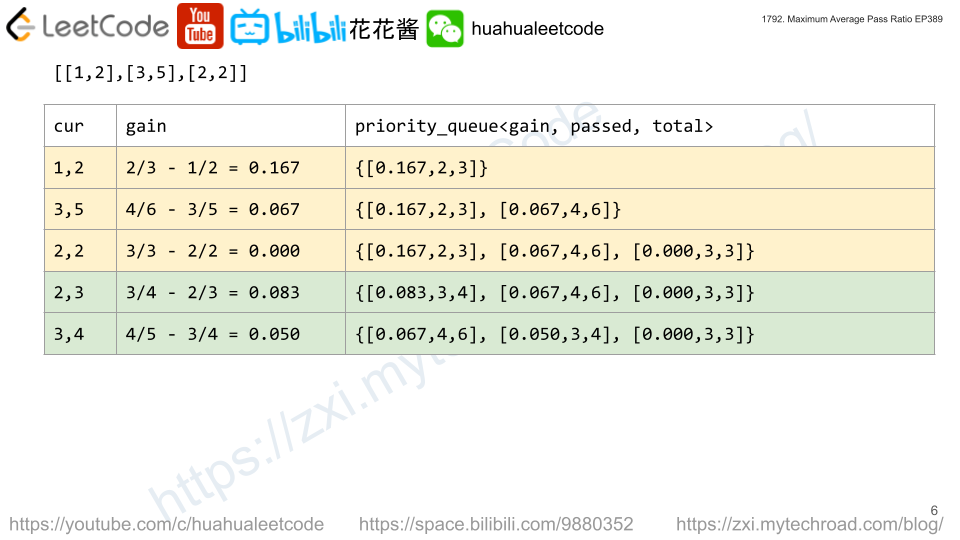
Input: classes = [[1,2],[3,5],[2,2]], extraStudents = 2
Output: 0.78333
Explanation: You can assign the two extra students to the first class. The average pass ratio will be equal to (3/4 + 3/5 + 2/2) / 3 = 0.78333.
There is an undirected star graph consisting of n nodes labeled from 1 to n. A star graph is a graph where there is one center node and exactlyn - 1 edges that connect the center node with every other node.
You are given a 2D integer array edges where each edges[i] = [ui, vi] indicates that there is an edge between the nodes ui and vi. Return the center of the given star graph.
Example 1:
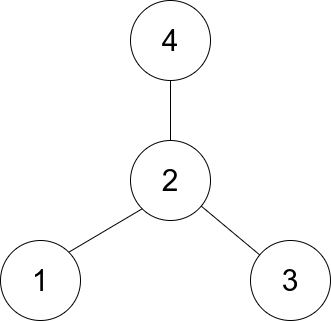
Input: edges = [[1,2],[2,3],[4,2]]
Output: 2
Explanation: As shown in the figure above, node 2 is connected to every other node, so 2 is the center.
You are given two strings s1 and s2 of equal length. A string swap is an operation where you choose two indices in a string (not necessarily different) and swap the characters at these indices.
Return trueif it is possible to make both strings equal by performing at most one string swap on exactly one of the strings. Otherwise, return false.
Example 1:
Input: s1 = "bank", s2 = "kanb"
Output: true
Explanation: For example, swap the first character with the last character of s2 to make "bank".
Example 2:
Input: s1 = "attack", s2 = "defend"
Output: false
Explanation: It is impossible to make them equal with one string swap.
Example 3:
Input: s1 = "kelb", s2 = "kelb"
Output: true
Explanation: The two strings are already equal, so no string swap operation is required.
Example 4:
Input: s1 = "abcd", s2 = "dcba"
Output: false
Constraints:
1 <= s1.length, s2.length <= 100
s1.length == s2.length
s1 and s2 consist of only lowercase English letters.
Solution: Remember two indices
There needs to be either 0 or 2 indices are different. Otherwise return false. s1[idx1] == s2[idx2] and s1[idx2] == s2[idx1]
There is an undirected weighted connected graph. You are given a positive integer n which denotes that the graph has n nodes labeled from 1 to n, and an array edges where each edges[i] = [ui, vi, weighti] denotes that there is an edge between nodes ui and vi with weight equal to weighti.
A path from node start to node end is a sequence of nodes [z0, z1,z2, ..., zk] such that z0 = start and zk = end and there is an edge between zi and zi+1 where 0 <= i <= k-1.
The distance of a path is the sum of the weights on the edges of the path. Let distanceToLastNode(x) denote the shortest distance of a path between node n and node x. A restricted path is a path that also satisfies that distanceToLastNode(zi) > distanceToLastNode(zi+1) where 0 <= i <= k-1.
Return the number of restricted paths from node1to noden. Since that number may be too large, return it modulo109 + 7.
Example 1:
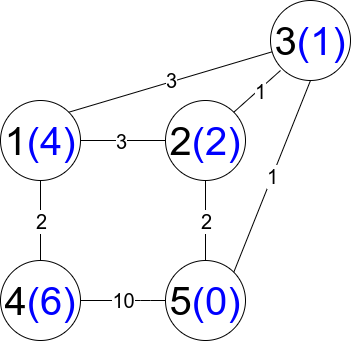
Input: n = 5, edges = [[1,2,3],[1,3,3],[2,3,1],[1,4,2],[5,2,2],[3,5,1],[5,4,10]]
Output: 3
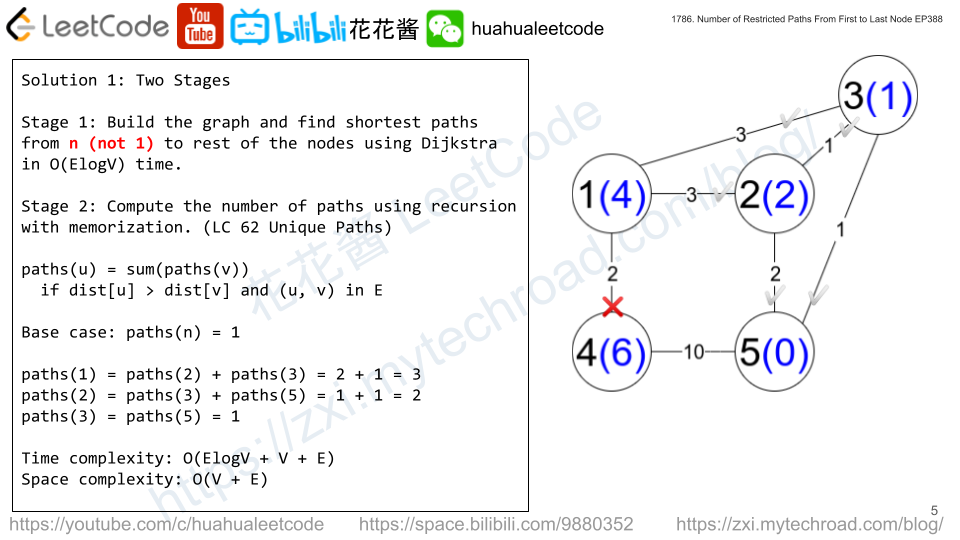
Explanation: Each circle contains the node number in black and its distanceToLastNode value in blue. The three restricted paths are:
1) 1 --> 2 --> 5
2) 1 --> 2 --> 3 --> 5
3) 1 --> 3 --> 5
Example 2:
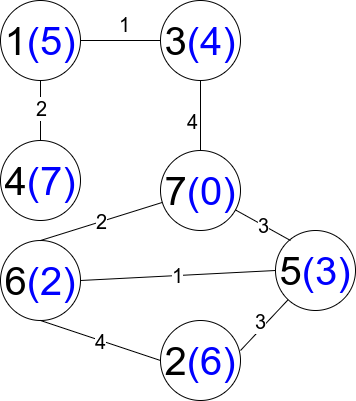
Input: n = 7, edges = [[1,3,1],[4,1,2],[7,3,4],[2,5,3],[5,6,1],[6,7,2],[7,5,3],[2,6,4]]
Output: 1
Explanation: Each circle contains the node number in black and its distanceToLastNode value in blue. The only restricted path is 1 --> 3 --> 7.
Constraints:
1 <= n <= 2 * 104
n - 1 <= edges.length <= 4 * 104
edges[i].length == 3
1 <= ui, vi <= n
ui != vi
1 <= weighti <= 105
There is at most one edge between any two nodes.
There is at least one path between any two nodes.
Solution: Dijkstra + DFS w/ memoization
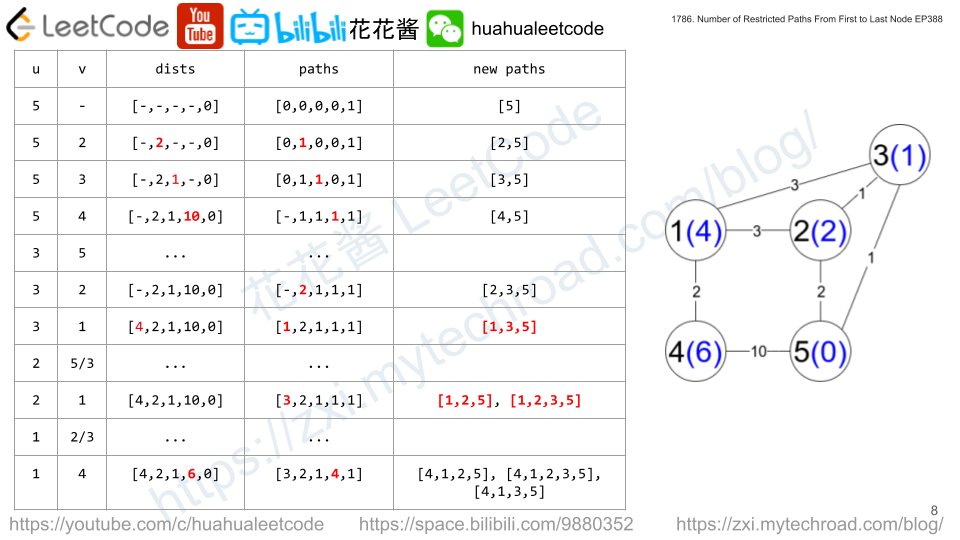
Find shortest path from n to all the nodes. paths(u) = sum(paths(v)) if dist[u] > dist[v] and (u, v) has an edge return paths(1)
Time complexity: O(ElogV + V + E) Space complexity: O(V + E)