Press "Enter" to skip to content

Huahua's Tech Road

花花酱 LeetCode 1753. Maximum Score From Removing Stones

You are playing a solitaire game with three piles of stones of sizes a​​​​​​, b,​​​​​​ and c​​​​​​ respectively. Each turn you choose two different non-empty piles, take one stone from each, and add 1 point to your score. The game stops when there are fewer than two non-empty piles (meaning there are no more available moves).

Given three integers a​​​​​, b,​​​​​ and c​​​​​, return the maximum score you can get.

Example 1:

Input: a = 2, b = 4, c = 6
Output: 6
Explanation: The starting state is (2, 4, 6). One optimal set of moves is:
- Take from 1st and 3rd piles, state is now (1, 4, 5)
- Take from 1st and 3rd piles, state is now (0, 4, 4)
- Take from 2nd and 3rd piles, state is now (0, 3, 3)
- Take from 2nd and 3rd piles, state is now (0, 2, 2)
- Take from 2nd and 3rd piles, state is now (0, 1, 1)
- Take from 2nd and 3rd piles, state is now (0, 0, 0)
There are fewer than two non-empty piles, so the game ends. Total: 6 points.

Example 2:

Input: a = 4, b = 4, c = 6
Output: 7
Explanation: The starting state is (4, 4, 6). One optimal set of moves is:
- Take from 1st and 2nd piles, state is now (3, 3, 6)
- Take from 1st and 3rd piles, state is now (2, 3, 5)
- Take from 1st and 3rd piles, state is now (1, 3, 4)
- Take from 1st and 3rd piles, state is now (0, 3, 3)
- Take from 2nd and 3rd piles, state is now (0, 2, 2)
- Take from 2nd and 3rd piles, state is now (0, 1, 1)
- Take from 2nd and 3rd piles, state is now (0, 0, 0)
There are fewer than two non-empty piles, so the game ends. Total: 7 points.

Example 3:

Input: a = 1, b = 8, c = 8
Output: 8
Explanation: One optimal set of moves is to take from the 2nd and 3rd piles for 8 turns until they are empty.
After that, there are fewer than two non-empty piles, so the game ends.

Constraints:

  • 1 <= a, b, c <= 105

Solution 1: Greedy

Take two stones (one each) from the largest two piles, until one is empty.

Time complexity: O(n)
Space complexity: O(1)

C++

Solution 2: Math

First, let’s assuming a <= b <= c.
There are two conditions:
1. a + b <= c, we can pair c with a first and then b. Total pairs is (a + b + (a + b)) / 2
2. a + b > c, we can pair c with a, b “evenly”, and then pair a with b, total pairs is (a + b + c) / 2

ans = (a + b + min(a + b, c)) / 2

Time complexity: O(1)
Space complexity: O(1)

C++

花花酱 LeetCode 1752. Check if Array Is Sorted and Rotated

Given an array nums, return true if the array was originally sorted in non-decreasing order, then rotated some number of positions (including zero). Otherwise, return false.

There may be duplicates in the original array.

Note: An array A rotated by x positions results in an array B of the same length such that A[i] == B[(i+x) % A.length], where % is the modulo operation.

Example 1:

Input: nums = [3,4,5,1,2]
Output: true
Explanation: [1,2,3,4,5] is the original sorted array.
You can rotate the array by x = 3 positions to begin on the the element of value 3: [3,4,5,1,2].

Example 2:

Input: nums = [2,1,3,4]
Output: false
Explanation: There is no sorted array once rotated that can make nums.

Example 3:

Input: nums = [1,2,3]
Output: true
Explanation: [1,2,3] is the original sorted array.
You can rotate the array by x = 0 positions (i.e. no rotation) to make nums.

Example 4:

Input: nums = [1,1,1]
Output: true
Explanation: [1,1,1] is the original sorted array.
You can rotate any number of positions to make nums.

Example 5:

Input: nums = [2,1]
Output: true
Explanation: [1,2] is the original sorted array.
You can rotate the array by x = 5 positions to begin on the element of value 2: [2,1].

Constraints:

  • 1 <= nums.length <= 100
  • 1 <= nums[i] <= 100

Solution: Counting and checking

Count how many turning points (nums[i] < nums[i – 1]) in the array. Return false if there are more than 1.
For the turning point r, (nums[r] < nums[r – 1), return true if both of the following conditions are satisfied:
1. nums[r – 1] is the largest number, e.g. nums[r – 1] >= nums[n – 1]
2. nums[r] is the smallest number, e.g. nums[r] <= nums[0]

Time complexity: O(n)
Space complexity: O(1)

C++

花花酱 LeetCode 1751. Maximum Number of Events That Can Be Attended II

You are given an array of events where events[i] = [startDayi, endDayi, valuei]. The ith event starts at startDayiand ends at endDayi, and if you attend this event, you will receive a value of valuei. You are also given an integer k which represents the maximum number of events you can attend.

You can only attend one event at a time. If you choose to attend an event, you must attend the entire event. Note that the end day is inclusive: that is, you cannot attend two events where one of them starts and the other ends on the same day.

Return the maximum sum of values that you can receive by attending events.

Example 1:

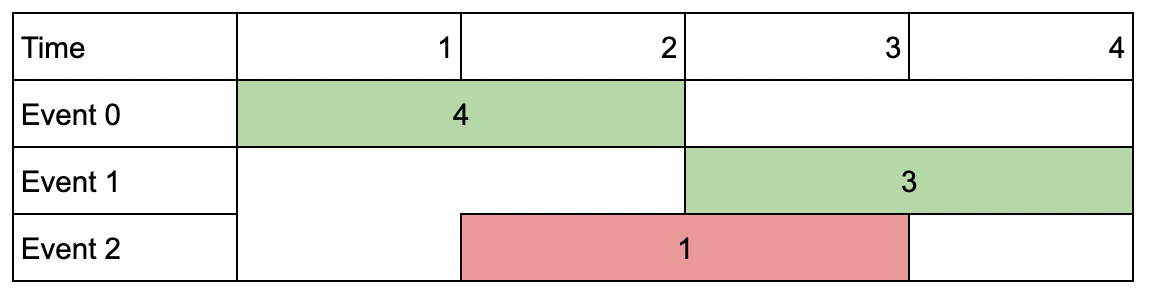
Input: events = [[1,2,4],[3,4,3],[2,3,1]], k = 2
Output: 7
Explanation: Choose the green events, 0 and 1 (0-indexed) for a total value of 4 + 3 = 7.

Example 2:

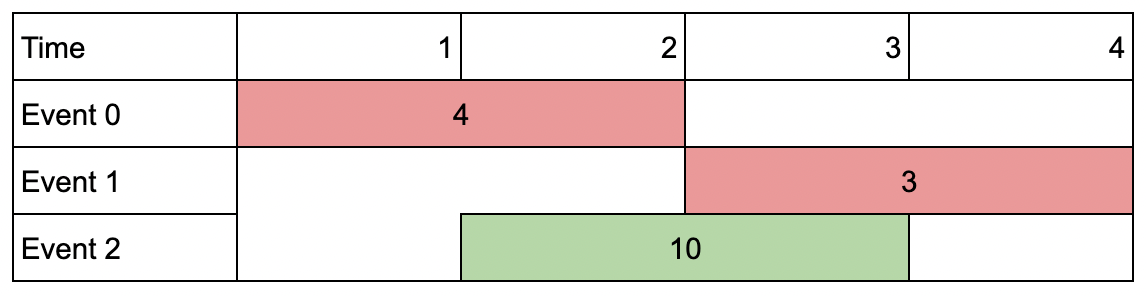
Input: events = [[1,2,4],[3,4,3],[2,3,10]], k = 2
Output: 10
Explanation: Choose event 2 for a total value of 10.
Notice that you cannot attend any other event as they overlap, and that you do not have to attend k events.

Example 3:

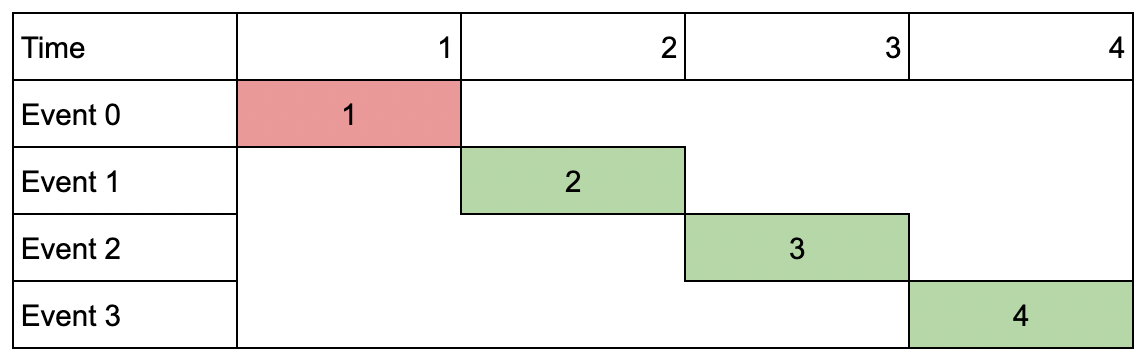
Input: events = [[1,1,1],[2,2,2],[3,3,3],[4,4,4]], k = 3
Output: 9
Explanation: Although the events do not overlap, you can only attend 3 events. Pick the highest valued three.

Constraints:

  • 1 <= k <= events.length
  • 1 <= k * events.length <= 106
  • 1 <= startDayi <= endDayi <= 109
  • 1 <= valuei <= 106

Solution: DP + Binary Search

Sort events by ending time.
dp[i][j] := max value we can get by attending at most j events among events[0~i].
dp[i][j] = max(dp[i – 1][j], dp[p][j – 1] + value[i])
p is the first event that does not overlap with the current one.

Time complexity: O(nlogn + nk)
Space complexity: O(nk)

C++

花花酱 LeetCode 1750. Minimum Length of String After Deleting Similar Ends

Given a string s consisting only of characters 'a''b', and 'c'. You are asked to apply the following algorithm on the string any number of times:

  1. Pick a non-empty prefix from the string s where all the characters in the prefix are equal.
  2. Pick a non-empty suffix from the string s where all the characters in this suffix are equal.
  3. The prefix and the suffix should not intersect at any index.
  4. The characters from the prefix and suffix must be the same.
  5. Delete both the prefix and the suffix.

Return the minimum length of s after performing the above operation any number of times (possibly zero times).

Example 1:

Input: s = "ca"
Output: 2
Explanation: You can't remove any characters, so the string stays as is.

Example 2:

Input: s = "cabaabac"
Output: 0
Explanation: An optimal sequence of operations is:
- Take prefix = "c" and suffix = "c" and remove them, s = "abaaba".
- Take prefix = "a" and suffix = "a" and remove them, s = "baab".
- Take prefix = "b" and suffix = "b" and remove them, s = "aa".
- Take prefix = "a" and suffix = "a" and remove them, s = "".

Example 3:

Input: s = "aabccabba"
Output: 3
Explanation: An optimal sequence of operations is:
- Take prefix = "aa" and suffix = "a" and remove them, s = "bccabb".
- Take prefix = "b" and suffix = "bb" and remove them, s = "cca".

Constraints:

  • 1 <= s.length <= 105
  • s only consists of characters 'a''b', and 'c'.

Solution: Two Pointers + Greedy

Delete all the chars for each prefix and suffix pair.

Time complexity: O(n)
Space complexity: O(1)

C++

花花酱 LeetCode 1749. Maximum Absolute Sum of Any Subarray

You are given an integer array nums. The absolute sum of a subarray [numsl, numsl+1, ..., numsr-1, numsr] is abs(numsl + numsl+1 + ... + numsr-1 + numsr).

Return the maximum absolute sum of any (possibly empty) subarray of nums.

Note that abs(x) is defined as follows:

  • If x is a negative integer, then abs(x) = -x.
  • If x is a non-negative integer, then abs(x) = x.

Example 1:

Input: nums = [1,-3,2,3,-4]
Output: 5
Explanation: The subarray [2,3] has absolute sum = abs(2+3) = abs(5) = 5.

Example 2:

Input: nums = [2,-5,1,-4,3,-2]
Output: 8
Explanation: The subarray [-5,1,-4] has absolute sum = abs(-5+1-4) = abs(-8) = 8.

Constraints:

  • 1 <= nums.length <= 105
  • -104 <= nums[i] <= 104

Solution: Prefix Sum

ans = max{abs(prefix_sum[i] – max(prefix_sum[0:i])), abs(prefix_sum – min(prefix_sum[0:i])}

Time complexity: O(n)
Space complexity: O(1)

C++