Press "Enter" to skip to content

Huahua's Tech Road

花花酱 LeetCode 1476. Subrectangle Queries

Implement the class SubrectangleQueries which receives a rows x cols rectangle as a matrix of integers in the constructor and supports two methods:

1. updateSubrectangle(int row1, int col1, int row2, int col2, int newValue)

  • Updates all values with newValue in the subrectangle whose upper left coordinate is (row1,col1) and bottom right coordinate is (row2,col2).

2. getValue(int row, int col)

  • Returns the current value of the coordinate (row,col) from the rectangle.

Example 1:

Input
["SubrectangleQueries","getValue","updateSubrectangle","getValue","getValue","updateSubrectangle","getValue","getValue"]
[[[[1,2,1],[4,3,4],[3,2,1],[1,1,1]]],[0,2],[0,0,3,2,5],[0,2],[3,1],[3,0,3,2,10],[3,1],[0,2]]
Output

[null,1,null,5,5,null,10,5]

Explanation SubrectangleQueries subrectangleQueries = new SubrectangleQueries([[1,2,1],[4,3,4],[3,2,1],[1,1,1]]); // The initial rectangle (4×3) looks like: // 1 2 1 // 4 3 4 // 3 2 1 // 1 1 1 subrectangleQueries.getValue(0, 2); // return 1 subrectangleQueries.updateSubrectangle(0, 0, 3, 2, 5); // After this update the rectangle looks like: // 5 5 5 // 5 5 5 // 5 5 5 // 5 5 5 subrectangleQueries.getValue(0, 2); // return 5 subrectangleQueries.getValue(3, 1); // return 5 subrectangleQueries.updateSubrectangle(3, 0, 3, 2, 10); // After this update the rectangle looks like: // 5 5 5 // 5 5 5 // 5 5 5 // 10 10 10 subrectangleQueries.getValue(3, 1); // return 10 subrectangleQueries.getValue(0, 2); // return 5

Example 2:

Input
["SubrectangleQueries","getValue","updateSubrectangle","getValue","getValue","updateSubrectangle","getValue"]
[[[[1,1,1],[2,2,2],[3,3,3]]],[0,0],[0,0,2,2,100],[0,0],[2,2],[1,1,2,2,20],[2,2]]
Output

[null,1,null,100,100,null,20]

Explanation SubrectangleQueries subrectangleQueries = new SubrectangleQueries([[1,1,1],[2,2,2],[3,3,3]]); subrectangleQueries.getValue(0, 0); // return 1 subrectangleQueries.updateSubrectangle(0, 0, 2, 2, 100); subrectangleQueries.getValue(0, 0); // return 100 subrectangleQueries.getValue(2, 2); // return 100 subrectangleQueries.updateSubrectangle(1, 1, 2, 2, 20); subrectangleQueries.getValue(2, 2); // return 20

Constraints:

  • There will be at most 500 operations considering both methods: updateSubrectangle and getValue.
  • 1 <= rows, cols <= 100
  • rows == rectangle.length
  • cols == rectangle[i].length
  • 0 <= row1 <= row2 < rows
  • 0 <= col1 <= col2 < cols
  • 1 <= newValue, rectangle[i][j] <= 10^9
  • 0 <= row < rows
  • 0 <= col < cols

Solution 1: Simulation

Update the matrix values.

Time complexity:
Update: O(m*n), where m*n is the area of the sub-rectangle.
Query: O(1)

Space complexity: O(rows*cols)

C++

Solution 2: Geometry

For each update remember the region and value.

For each query, find the newest updates that covers the query point. If not found, return the original value in the matrix.

Time complexity:
Update: O(1)
Query: O(|U|), where |U| is the number of updates so far.

Space complexity: O(|U|)

C++

花花酱 LeetCode 1475. Final Prices With a Special Discount in a Shop

Given the array prices where prices[i] is the price of the ith item in a shop. There is a special discount for items in the shop, if you buy the ith item, then you will receive a discount equivalent to prices[j] where j is the minimum index such that j > i and prices[j] <= prices[i], otherwise, you will not receive any discount at all.

Return an array where the ith element is the final price you will pay for the ith item of the shop considering the special discount.

Example 1:

Input: prices = [8,4,6,2,3]
Output: [4,2,4,2,3]
Explanation: 
For item 0 with price[0]=8 you will receive a discount equivalent to prices[1]=4, therefore, the final price you will pay is 8 - 4 = 4. 
For item 1 with price[1]=4 you will receive a discount equivalent to prices[3]=2, therefore, the final price you will pay is 4 - 2 = 2. 
For item 2 with price[2]=6 you will receive a discount equivalent to prices[3]=2, therefore, the final price you will pay is 6 - 2 = 4. 
For items 3 and 4 you will not receive any discount at all.

Example 2:

Input: prices = [1,2,3,4,5]
Output: [1,2,3,4,5]
Explanation: In this case, for all items, you will not receive any discount at all.

Example 3:

Input: prices = [10,1,1,6]
Output: [9,0,1,6]

Constraints:

  • 1 <= prices.length <= 500
  • 1 <= prices[i] <= 10^3

Solution 1: Simulation

Time complexity: O(n^2)
Space complexity: O(1)

C++

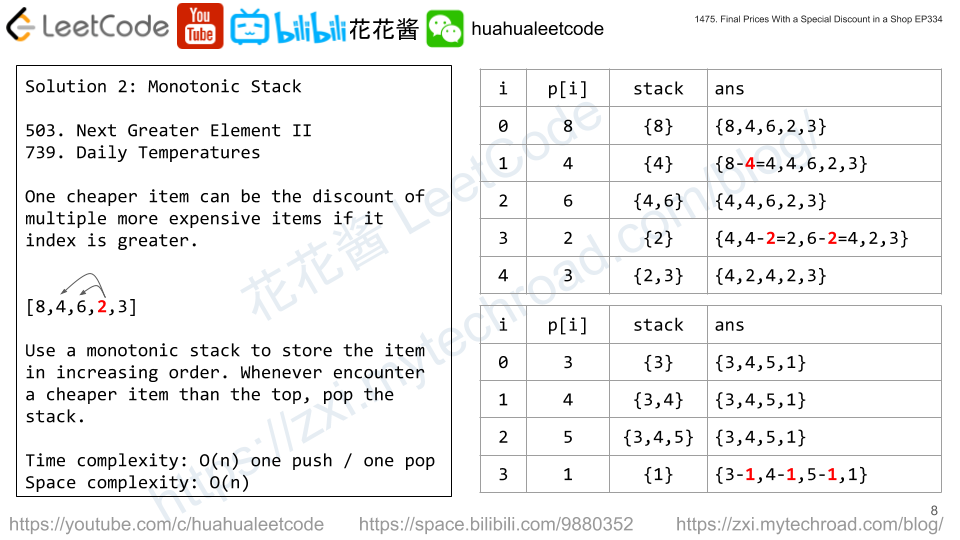
Solution 2: Monotonic Stack

Use a stack to store monotonically increasing items, when the current item is cheaper than the top of the stack, we get the discount and pop that item. Repeat until the current item is no longer cheaper or the stack becomes empty.

Time complexity: O(n)
Space complexity: O(n)

C++

index version

C++

C++ 11 Smart Pointers 智能指针

Example code

C++

Output

花花酱 LeetCode 1473. Paint House III

There is a row of m houses in a small city, each house must be painted with one of the n colors (labeled from 1 to n), some houses that has been painted last summer should not be painted again.

A neighborhood is a maximal group of continuous houses that are painted with the same color. (For example: houses = [1,2,2,3,3,2,1,1] contains 5 neighborhoods  [{1}, {2,2}, {3,3}, {2}, {1,1}]).

Given an array houses, an m * n matrix cost and an integer target where:

  • houses[i]: is the color of the house i0 if the house is not painted yet.
  • cost[i][j]: is the cost of paint the house i with the color j+1.

Return the minimum cost of painting all the remaining houses in such a way that there are exactly target neighborhoods, if not possible return -1.

Example 1:

Input: houses = [0,0,0,0,0], cost = [[1,10],[10,1],[10,1],[1,10],[5,1]], m = 5, n = 2, target = 3
Output: 9
Explanation: Paint houses of this way [1,2,2,1,1]
This array contains target = 3 neighborhoods, [{1}, {2,2}, {1,1}].
Cost of paint all houses (1 + 1 + 1 + 1 + 5) = 9.

Example 2:

Input: houses = [0,2,1,2,0], cost = [[1,10],[10,1],[10,1],[1,10],[5,1]], m = 5, n = 2, target = 3
Output: 11
Explanation: Some houses are already painted, Paint the houses of this way [2,2,1,2,2]
This array contains target = 3 neighborhoods, [{2,2}, {1}, {2,2}]. 
Cost of paint the first and last house (10 + 1) = 11.

Example 3:

Input: houses = [0,0,0,0,0], cost = [[1,10],[10,1],[1,10],[10,1],[1,10]], m = 5, n = 2, target = 5
Output: 5

Example 4:

Input: houses = [3,1,2,3], cost = [[1,1,1],[1,1,1],[1,1,1],[1,1,1]], m = 4, n = 3, target = 3
Output: -1
Explanation: Houses are already painted with a total of 4 neighborhoods [{3},{1},{2},{3}] different of target = 3.

Constraints:

  • m == houses.length == cost.length
  • n == cost[i].length
  • 1 <= m <= 100
  • 1 <= n <= 20
  • 1 <= target <= m
  • 0 <= houses[i] <= n
  • 1 <= cost[i][j] <= 10^4

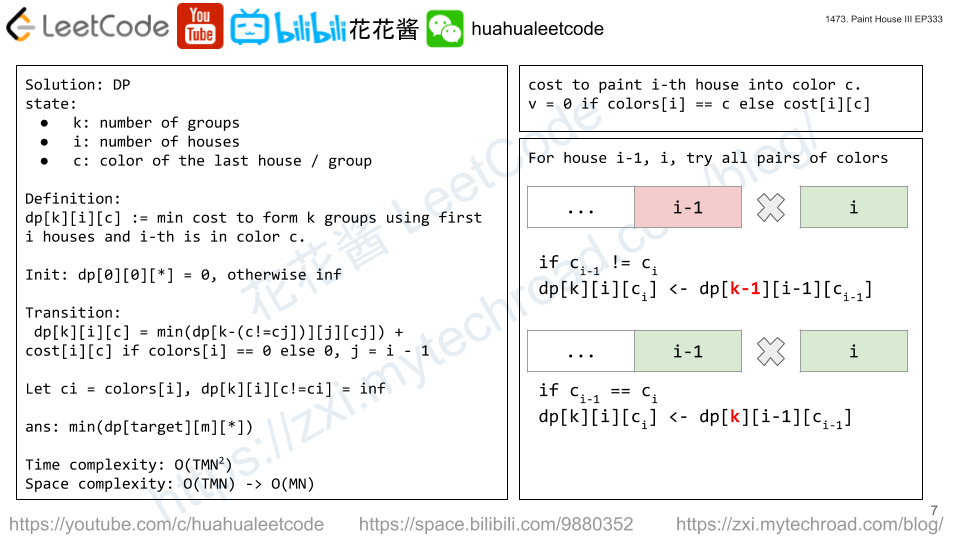
Solution: DP

dp[k][i][c] := min cost to form k neighbors with first i houses and i-th house is in color c.

dp[k][i][c] := min{dp[k-(c != cj)][j][cj] for cj in 1..n} + 0 if houses[i] == c else cost[i][c]

init: dp[0][0][*] = 0 otherwise inf
ans = min(dp[target][m])

Time complexity: O(T*M*N^2)
Space complexity: O(T*M*N) -> O(M*N)

C++

花花酱 LeetCode 1472. Design Browser History

You have a browser of one tab where you start on the homepage and you can visit another url, get back in the history number of steps or move forward in the history number of steps.

Implement the BrowserHistory class:

  • BrowserHistory(string homepage) Initializes the object with the homepage of the browser.
  • void visit(string url) visits url from the current page. It clears up all the forward history.
  • string back(int steps) Move steps back in history. If you can only return x steps in the history and steps > x, you will return only x steps. Return the current url after moving back in history at most steps.
  • string forward(int steps) Move steps forward in history. If you can only forward x steps in the history and steps > x, you will forward only x steps. Return the current url after forwarding in history at most steps.

Example:

Input:
["BrowserHistory","visit","visit","visit","back","back","forward","visit","forward","back","back"]
[["leetcode.com"],["google.com"],["facebook.com"],["youtube.com"],[1],[1],[1],["linkedin.com"],[2],[2],[7]]
Output:
[null,null,null,null,"facebook.com","google.com","facebook.com",null,"linkedin.com","google.com","leetcode.com"]

Explanation: BrowserHistory browserHistory = new BrowserHistory("leetcode.com"); browserHistory.visit("google.com"); // You are in "leetcode.com". Visit "google.com" browserHistory.visit("facebook.com"); // You are in "google.com". Visit "facebook.com" browserHistory.visit("youtube.com"); // You are in "facebook.com". Visit "youtube.com" browserHistory.back(1); // You are in "youtube.com", move back to "facebook.com" return "facebook.com" browserHistory.back(1); // You are in "facebook.com", move back to "google.com" return "google.com" browserHistory.forward(1); // You are in "google.com", move forward to "facebook.com" return "facebook.com" browserHistory.visit("linkedin.com"); // You are in "facebook.com". Visit "linkedin.com" browserHistory.forward(2); // You are in "linkedin.com", you cannot move forward any steps. browserHistory.back(2); // You are in "linkedin.com", move back two steps to "facebook.com" then to "google.com". return "google.com" browserHistory.back(7); // You are in "google.com", you can move back only one step to "leetcode.com". return "leetcode.com"

Constraints:

  • 1 <= homepage.length <= 20
  • 1 <= url.length <= 20
  • 1 <= steps <= 100
  • homepage and url consist of  ‘.’ or lower case English letters.
  • At most 5000 calls will be made to visitback, and forward.

Solution: Vector

Time complexity:
visit: Amortized O(1)
back: O(1)
forward: O(1)

C++